

By Frederic J. Frommer
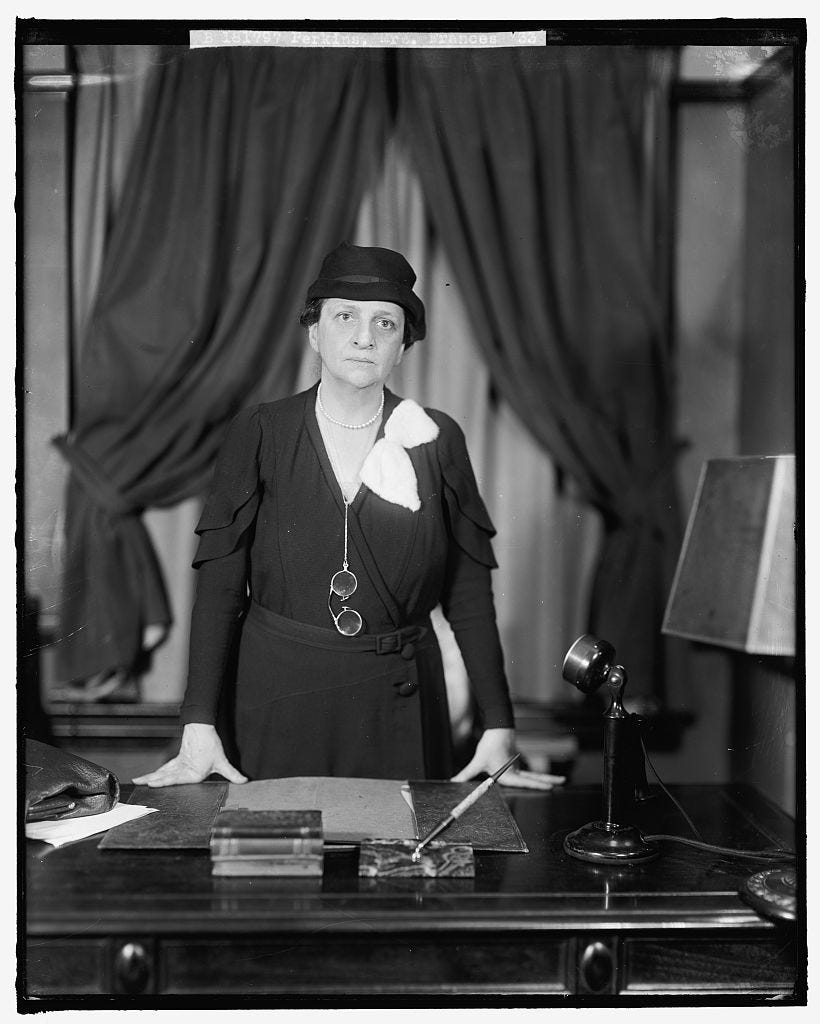
Frances Perkins, who became President Franklin D. Roosevelt’s secretary of Labor in 1933, didn’t come from the usual Labor secretary stock. The position was relatively new, but all three of her predecessors had worked in a union, starting with William B. Wilson, a former United Mine Workers executive, who became the first Labor secretary in 1913 under President Woodrow Wilson.
Perkins’s legacy is so monumental that the Department of Labor building is named for her. But when she surfaced as a potential Cabinet member for Roosevelt, Perkins faced opposition both as a woman and as someone who didn’t come from the ranks of organized labor. In fact, she urged FDR not to nominate her for the post.
As the New York Times reported on Feb. 9, 1933, “Miss Frances Perkins of New York, who has been heralded as likely to be Secretary of Labor in the new administration, has notified President-elect Roosevelt that she does not wish to be considered for a Cabinet post. Her action, a Roosevelt adviser stated tonight, was due to the fact that she has been opposed by organized labor, and this might handicap the coming administration if she took the place.”
Although Perkins didn’t hail from a union, she had established a record as a champion for America’s working men and women. After starting out as a social worker, Perkins in 1910 became executive secretary of the Consumers League of New York, which studied workshop conditions. The following year, Perkins was an eyewitness to the infamous Triangle Shirtwaist Factory fire in New York City, where she saw 47 workers jump to their death in a fire that killed 146 people – mostly young women. In response, Perkins successfully championed workplace safety laws, which other states and the federal government used as a model.
When FDR became governor of New York, he named Perkins industrial commissioner, where she worked on behalf of unemployment insurance, among other causes.
With skyrocketing unemployment and millions of people living in poverty during the Great Depression, labor was a huge issue in the 1932 presidential election, which Roosevelt won in a landslide. Labor leaders had a lot at stake, and they favored Teamsters President Daniel J. Tobin for Labor secretary.
But Roosevelt calculated that picking someone from a labor organization would anger the unions that didn’t get the pick, according to Cornell University’s Kheel Center for Labor-Management Documentation & Archive, which noted that Perkins’s gender was also a factor in leaders’ opposition. No woman had been named Cabinet secretary before.
FDR went forward with her appointment, and Perkins brought high energy to the job right off the bat, helping with legislation in 1933 that created the Civilian Conservation Corps, which provided jobs in conservation and natural resources to unemployed men. That same year, she delivered more than 100 speeches, and by August 1933, she was on the cover of Time magazine.
Perhaps her biggest contribution to the New Deal was the creation of Social Security. After Democrats won big in the 1934 midterms, FDR named Perkins to chair a special Cabinet committee to draft the bill, advising her, “Keep it simple. So simple that everybody will understand it.” In August 1935—90 years ago this month—the president signed the Social Security Act, creating a lifeline for millions and laying the groundwork for programs such as Medicare and Medicaid that became law in the 1960s.
Perkins was also a driving force behind the Fair Labor Standards Act of 1938, which included a ban on child labor, a minimum wage and the 40-hour workweek.
Despite her accomplishments, Perkins continued to have detractors throughout her 12 years as Labor secretary (the entire length of FDR’s presidency).
“Through all the strikes, peaks of unemployment, technological relocation and mobilization for the war, Miss Perkins presided efficiently and with restraint, withstanding repeated private and public attacks,” the Times observed in its 1965 obituary for Perkins. The paper noted that she helped push through New Deal reforms such as Social Security and the National Labor Relations Act “over a vocal and militant opposition.” There was even a short-lived attempt in the House to force her dismissal.
When FDR ran for a third term in office in 1940, his Republican opponent, Wendell Willkie, continued to harp on her lack of organized labor bona fides – and, clumsily, her gender. As Jean Edward Smith wrote in his bio, “FDR”:
Speaking to a labor audience in Pittsburgh he announced he would appoint a secretary of labor directly from the ranks of organized labor – a slam at Frances Perkins that drew raucous cheers. Hoping to get another big hand he added gratuitously, "And it will not be a woman either."
"Why didn't he have sense enough to leave well enough alone?" FDR asked Frances Perkins. "He was going good. Why did he have to insult every woman in the United States? It will make them mad, it will lose him votes." Which apparently it did.
Last year, President Joe Biden established a national monument honoring Perkins in her ancestral home state of Maine, calling her “one of America’s greatest labor leaders, and that’s not hyperbole.” He added that Perkins “cemented the idea that if you’re working a full-time job, you shouldn’t have to live in poverty.”
Frederic J. Frommer, a writer and sports and politics historian, has written for the Washington Post, the New York Times, the Atlantic, History.com and other national publications. A former Associated Press reporter, Frommer is the author of several books, including “You Gotta Have Heart: Washington Baseball from Walter Johnson to the 2019 World Series Champion Nationals." Follow him on X.
This 14 August 1935 photo speaks volumes: https://www.usnews.com/photos/2024/08/12/the-birth-of-social-security-and-world-war-ii-nears-its-end-picturing-this-week-in-history-august-12-18 Appreciative that you were “allowed” to be in the photo. Take a bow Frances for all the work you spearheaded and accomplished for our country.
“U.S. President Franklin Roosevelt signs the landmark Social Security Act in Washington, D.C., establishing the system that would provide economic benefits to retired workers, dependent children, and the unemployed. In his remarks at the signing, Roosevelt said “We can never insure one hundred percent of the population against one hundred percent of the hazards and vicissitudes of life, but we have tried to frame a law which will give some measure of protection to the average citizen and to his family against the loss of a job and against poverty-ridden old age.”
She's one of my heroines. She travelled around the country asking working people what they needed. The mayor of one town wouldn't let her hold a meeting on city property, so she held it at the post office. I used this story as an argument when we were fighting the closure of our downtown post office in Berkeley. We won!