


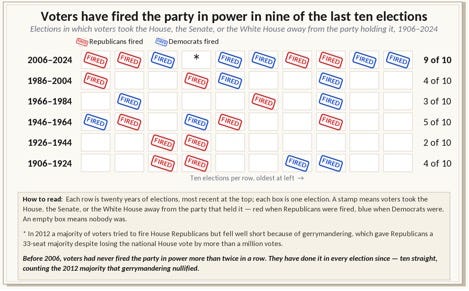
Republicans are likely to take a drubbing in the midterms, when they will feel the rage of working class voters for the first time in recent memory.1 Unfortunately, many Democrats already see the polling as an endorsement, rather than a rejection of Trump and MAGA. Consultants are already taking credit for their genius “affordability” messaging. Democrats, and many of their allied media, are about to make a very old mistake: confusing working class anger at Republicans for working class attraction to Democrats, and taking credit for that fiction instead of working to make it a reality.
Labor Day, as we head into the final stretch of the campaign, is a good time to start thinking about what comes after a likely blue-collar, blue-wave midterm. How can Democrats start banking the next win into a durable governing coalition that actually deserves the support of working people, instead of just resetting the clock on the same two-to-four-year flail back to the other party that’s defined the last two decades?
Democrats won’t become the party of the working class by finding the right message. Instead, they need to understand why they once were the “party of the working class,” and why they no longer are. Spoiler: It’s not because Democrats are too woke for non-college voters, and it’s not because the virulently anti-worker Republicans are now the real party of the working class. The most important reason Democrats stopped being the party of the working class is because Democrats stopped treating working class voters as partners, and started treating them as consumers.
When I first came to Washington, D.C. in 1975, organized labor was still a mass-membership pillar of the Democratic Party. But in the decades that followed, two developments changed that: union membership collapsed under escalating attacks from organized corporate interests, and federal campaigning was reorganized around a paid industry of pollsters, media consultants, and data vendors. Over time, the Democratic Party replaced its direct knowledge of and engagement with working class voters with a set of professional services that structurally cannot deliver that same knowledge or engagement.
Today, too many Democratic and media professionals talk about working people the same way that Coca-Cola executives would talk about regaining a prized market segment they’ve lost to Pepsi — which is not the way anyone in a democracy should be talking about its citizens, regardless of their demographic group. That most commentators ask how Democrats can “win back” the working class — not “represent” or “answer to” them — reveals this dynamic in action.
For the last six years, Gallup has found historically high levels of approval for unions — 71% overall (89% among Democrats, 70% among independents, and even 52% among Republicans). What’s more, unions are the only major institution that has gained and not lost support since the Great Recession.
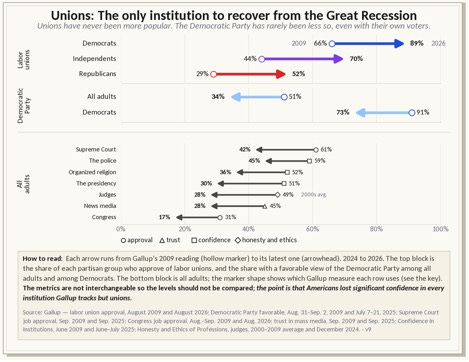
Moreover, new Gallup polling also shows record-high levels of support for unions having more influence than they do today, a sentiment that 73% of Democratic voters agree with. It’s not hard to see why: especially over the last few years, as union workers keep winning high-profile strikes, it’s become increasingly obvious to more and more working people that unions are the only institution in America that will actually fight for them, isn’t beholden to special interests, and is capable of delivering real results.
Eye-popping numbers like this might get some dutiful media coverage on Labor Day — and then the people who write about “the working class” for a living will manage not to say the word “union” out loud again for 364 days. (See what happens when you search for the words “union” or “labor” in the collected writings or transcripts of your favorite liberal podcaster, Substacker, or op-ed writer, and compare that to the results for “working class.”)
Some might argue that the dearth of attention to organized labor is because union membership is so small. But that’s not for lack of desire: 56 million workers who don’t currently belong to a union say they would join one tomorrow if they could. Since the mid-1940s, corporate interests have waged a relentless, brutal, lawless and largely successful campaign to make sure they never get the chance. Those interests know that worker organizing is the most effective check on their power; it’s the same reason unions have always been the first targets of authoritarians worldwide, as I explained last year for The Contrarian.
That campaign did not succeed over the objections of Democrats, the liberal media, or the liberal establishment. It succeeded with their acquiescence, and often their help. Even under Democratic trifectas, labor law reform bills have either died or never been introduced. Most Democratic electees, candidates, and consultants treat unions like an afterthought in the party’s coalition, even though Senators Rosen (NV), Slotkin (MI), Baldwin (WI), Cortez-Masto (NV), and Peters (MI) all serve despite having lost voters who were not in union households (imagine a 42-58 U.S. Senate), and union members made up about the same share of the 2024 electorate as either Latino or Black voters. Many of the same liberal institutions that are wringing their hands about the “working class” spent decades treating the “decline” of unions as naturally occurring. So when the people who watched that happen, or profited from it, ask why working people don’t see Democrats as their party anymore, they sound like the defendant convicted of murdering his parents who asks the court for mercy because he’s an orphan.
“Kitchen Table” Scraps
Every Democratic politician will tell you — correctly — that “kitchen table issues” are paramount. But their vision for what those issues include, and what to do about them, is much too limited.
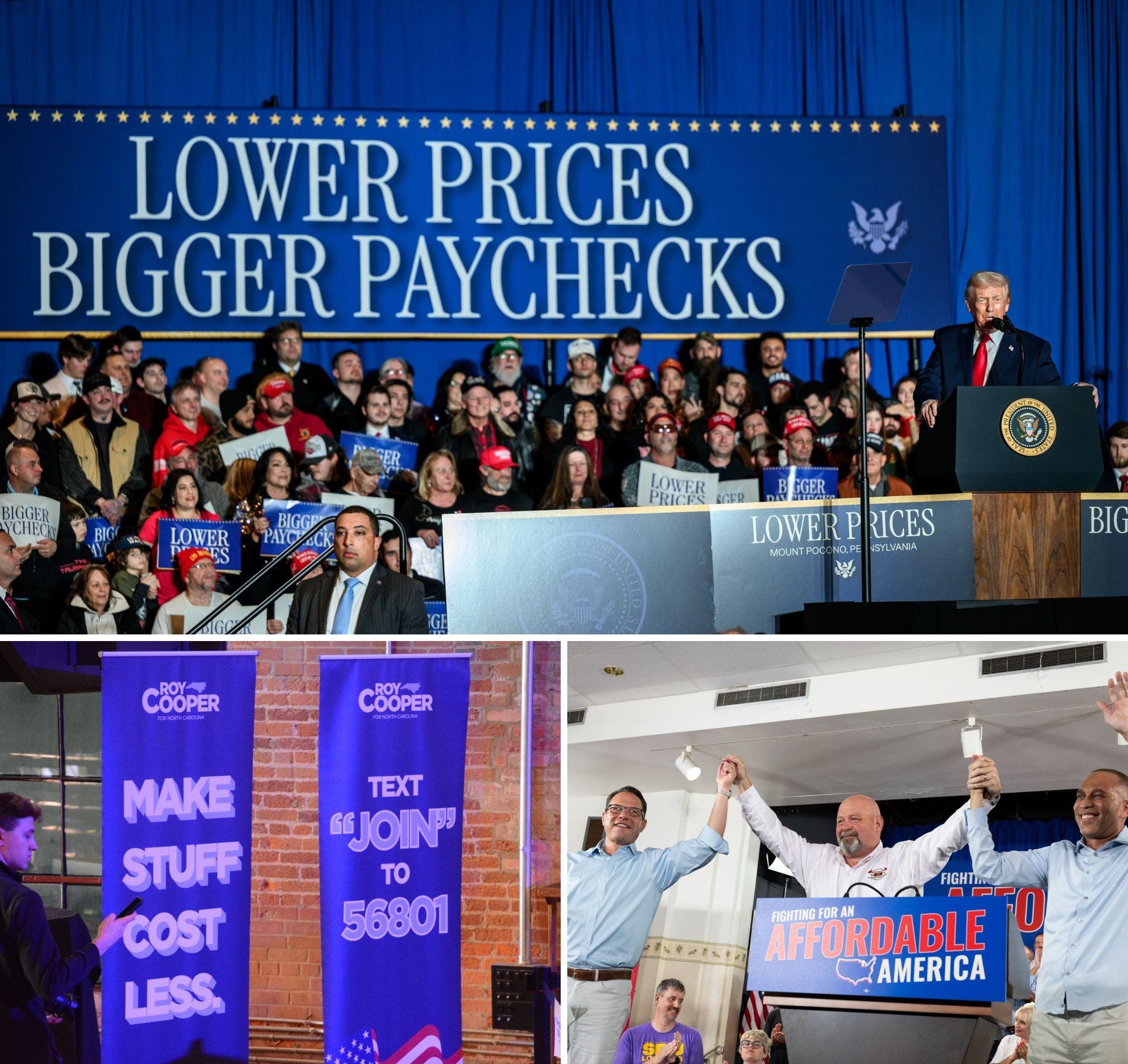
Take the conversation about “affordability.” The Democratic story is all about prices. But the real definition of affordability is a comparison — between what things cost and what you make. Democratic professionals focus on the former because they, too, are surprised by gas prices — but for the people who work at the gas stations, the cost of everyday necessities has never not been a concern. Trump’s campaign staff seem to have at least overheard the concern about paychecks from real workers, even though Trump’s actual policies have been economically ruinous on countless fronts.
Wages are just the tip of the iceberg when it comes to the urgent concerns people have about their jobs. Working people not only know that they aren’t getting paid what they deserve; they also might have to work two jobs to cover one rent, suffer the whims of unpredictable scheduling regimes that wreak havoc on their marriages and child raising, lack job security or benefits in a gig economy, and have little or no protection from unsafe conditions, wage theft, being fired for personal social media posts, or any number of other abuses.
According to Gallup, 60 percent of Americans hold jobs that fail basic quality standards — past 70 percent among those without a degree and among the young. Yet those concerns about job quality, despite being surfaced by a gold-standard non-partisan polling operation like Gallup, never appear in takes about “the working class,” or in the polling and other opinion research that Democratic organizations pay for (most of which is sponsored by the party’s billionaire donors and Super PACs).Laser-focusing on prices doesn’t just fail to address the full range of issues with people’s work lives — it also helps set unrealistic expectations for what Democrats could actually do in office, and fails to set expectations for what they can do.
They can do more than you might think.
Show (Up), Don’t Tell
Democrats keep leaving opportunities on the table to raise the salience of the “one neat trick” we have to meaningfully improve the full spectrum of kitchen table issues — fairer pay, more retirement security, better health care, more paid time off, a schedule that’s reliable enough to make daycare arrangements, and more. Unions routinely secure these things for their roughly 16 million members. And they frequently get much better results than their members could ever hope to gain from improvements to the safety net, without needing to fight about how much it might cost taxpayers.
Obviously, even if Democrats retake both chambers of Congress in the midterms, they won’t be able to overcome Trump’s veto on much of anything that will meaningfully increase working class economic freedom and security. Yes, labor law is a shell of its former self, and labor law enforcement is even worse off. Yes, Trump has been pulling every lever his team can think of, legal or not, to shred as many of our remaining worker protections as possible.
So what can Democrats do for the working class today? It starts with taking a “show, don’t tell” approach — being willing to show up, deeply engage with, and fight for working people in a substantive way on a regular basis. That can include standing on picket lines; coming out, by name, against specific companies that are union-busting; or intervening in the moments when there are visibly two sides and refusing to stay neutral between them. These are actions Democrats can always take, no matter which party is in power. And once Democrats have enough power to make significant legislative and regulatory changes, they need to “do, not promise” — make those changes an urgent priority, instead of just settling for messaging bills.
Zohran Mamdani rose to prominence not only because of his social media savvy, but because he consistently walks the walk on working to improve people’s lives, which inspires people to boost him. He makes a politics of dignity and shared fate tangible in a way no ad could ever do. Every Democrat should listen to and take notes on the speech Mamdani made in January when he walked the picket line with 15,000 nurses as part of one of the largest nurses’ strikes in American history. That strike wasn’t primarily about wages; it was about staffing ratios — in other words, whether there are enough nurses on shift to take good care of your kid who spiked a fever at 2 a.m. or your grandmother who broke her hip. It’s one thing to focus-group test effective messages for ads about health care; it’s a different thing entirely to publicly name and call out the hospital administrators squeezing the dedicated nurses who care for our families, and to show those nurses you have their backs.
Joe Biden’s joining a picket line in 2023 for UAW, the first sitting president ever to do so, was just the most visible example of his pro-worker bona fides. Pundits have naively argued that Harris’s loss proved this to be a failed strategy for the Biden administration — but they don’t mention, or don’t know, that Harris improved on Biden’s 2020 performance with union members by 2 points, even as the electorate as a whole swung away from Biden by 6 points.
Whose Side Are You On?
“The working class” isn’t a fixed category that simply exists, waiting to be won back. It’s an identity that needs to be activated. We all have a suite of different identities that define us, some of which will always matter to us more than others and some of which will matter less at different times, depending on circumstances and influences. We don’t act as if we’re any single one of those identity categories just because a consultant decides to target their messaging at it.
Right now, opposition to Trump and MAGA is a real, powerful political identity that is motivating people to vote against them in record-high numbers. For most Americans, especially young people, “working class” is not the identity they care about most, or at all. But it gets easier to activate the more people align themselves in a winnable fight against a nameable enemy.
The peanut-gallery media debate over Democratic strategy goes exactly two places: the affordability crisis and the culture wars. But there is an electric fence around a third piece of territory: power at work. Power is something somebody has over you, and you cannot talk about power at work without naming the employers who are hoarding too much power over their employees.
There’s an unspoken second half of the classic “win back the working class” question: How can Democrats win back the working class without pissing off their donors? That’s a bit glib and reductive, and there’s much more to say about it. But it describes a real phenomenon that’s less about Democrats “selling out” to business or being “bought” by their donors, and more about two self-reinforcing cycles: one where business interests tend to back the campaigns and party infrastructure that are already the most business-friendly; and another where the more that politicians rely on polling and message-testing, the more money they have to raise to fund it — which means the more time they need to spend socializing with and listening to donors whose concerns are far removed from those of most working people.
Uber and Lyft drivers are organizing right now in Illinois and California and getting further than any previous attempt to form a union of gig workers. If you think the problem is the nature of the work, remember that actors and directors were the original gig workers, and they remain union strong to this day, for the simple reason that their unions were built in the 1930s, when Democrats actually were the party of the working class.
It’s just one of many opportunities any Democrat could take to be visibly on the side of working people in a way that’s much more than lip service. The gig companies are consumer-facing; they dread bad publicity and any scrutiny of how they treat the people who do the work. According to OpenSecrets, these companies have spent tens of millions of dollars lobbying Congress and contributing to campaigns, with most of the contributions going to Democrats; a few well-placed Democrats standing with those drivers might cost the companies something real. Right now, though, too many leading Democrats are more at home in gig-company boardrooms and on gig-company payrolls than they are in union halls or on picket lines.
New Deal Democrats could credibly say they were “on the side of working people” because they conceded there were sides, and acted accordingly. They named corporate villains and showed up to fight them. (And, of course, they didn’t go to work for union busting companies to undo the New Deal they had just built.)

The prevailing attitude among Democratic professionals and aligned media is that America is a restaurant whose customers just need to do a better job advertising their menu than the one Republicans are offering, but under no circumstances should the customers be allowed in the kitchen. Working people don’t need to own the restaurant. But they do need a say in what’s on the menu, and the power to send it back when it’s inedible.
Throughout history, the only reliable way for working people to get an actual seat at the table has been through unions. Unions are the single best lever available for shifting the underlying balance of power, not just winning this cycle’s vote.
Democrats can spend the next two years taking credit for a wave they didn’t make. Or they can share the kitchen.
There are many definitions of “working class” — nearly all of them dictated by those who are trying to make statements and draw conclusions about the working class in a “data driven” way, which means using criteria that can be derived from a survey or census form. Since that’s not what this piece is about, by “working class” I mean those who work for wages, either literally or as “independent contractors” only so their employers can avoid paying for their health care or giving them time off. If anything unifies this “class,” it’s how little control they have over the terms and conditions of their work, or how little say they have in the performance of their duties (unless they are in a union).

This is a big part of the reckoning that Democrats, and those who have always supported them (like me), need to have to move forward. I had to read it twice to take it in. Also, live in one of the bluest blue states like Illinois? This helps me understand what to hold elected officials accountable to.
Excellent solid thinking, Michael! Back to essential basics. I have visions of Schumer, Jeffries or the DNC trying to figure out if they are actually suited to this reality of being a Democrat. Also wondering if the "working class" should presently be called the "worked out" class?