


Two key court decisions
The Trump regime suffered two major legal defeats on Friday.
First, District Judge Indira Talwani in Massachusetts issued a 49-page preliminary injunction (replacing her temporary restraining order) to block the Trump regime’s hastily thrown together scheme to enlist the U.S. Postal Service to massively disrupt mail-in voting. Brand new requirements imposed on the eve of voting to match voters’ names to a newly concocted voter-roll list rife with errors, redesign ballots, reprint envelopes, and revamp bar codes would have made compliance impossible and therefore disenfranchise millions of voters, all in violation of the Constitution, which gives states the responsibility for elections (subject to congressional, not presidential, action).
Talwani held that the rule was unconstitutional and would have inevitably deprived millions of their right to vote with “no evidence relating to fraudulent mail voting to support the rushed implementation of the Final Rule.” The Trump crew is racing to appeal directly to its MAGA lackeys on the Supreme Court, determined to deprive voters of the ability to hold the MAGA regime accountable at the polls. Make no mistake: Republicans are bent on denying millions the right to vote or creating widespread chaos because they know they are heading for a drubbing at the ballot box.
Separately on Friday, the U.S. Court of Appeals for the D.C. Circuit in a 2-1 decision in League of Women Voters v. U.S. upheld a lower court ruling barring expansion of the Systematic Alien Verification Entitlements (SAVE) database (an error-ridden system), preventing a massive purge of voting rolls. Had the change gone into effect, millions of Americans’ private information would have been disclosed in violation of the Social Security Act. In a press release, the League explained that the court stopped “the Trump administration’s attempt to revive an unlawful voter purge system built on unreliable data and Americans’ personal information,” noting that Trump “has repeatedly tried to sidestep the law in pursuit of policies that threaten voters and another court has now ruled to protect privacy and our democracy.”
In short, the Trump regime’s nonstop plot to block millions of voters’ access to the ballot and undermine confidence in voting and its blatant disregard of Americans’ privacy will continue, stopped only by dogged litigation brought by pro-democracy groups and Democratic state attorneys general and by stalwart lower courts. Unless and until Republicans get booted from office, the onslaught will continue.
Organized Labor is front and center in our democracy struggle
Labor Day holds special significance for Americans this year. In a time of unparalleled economic distress inflicted on working Americans due to the incompetence and reverse-Robin-Hood schemes of the most anti-worker president since Herbert Hoover, organized labor has helped spearhead the fight for economic opportunity and for democracy. Labor has played a critical role in legal battles — from challenging a disastrous Paramount merger that would wipe out jobs and crush viewpoint diversity to protecting federal workers from disastrous unilateral cuts to fending off efforts to dismantle the Department of Education and impose new burdens on student borrowers — all while organizing a broad-based, pro-worker, pro-democracy political opposition to the Trump regime.
In her fourth annual “State of the Unions” address, AFL-CIO President Liz Shuler last week declared: “This Labor Day, shit’s too expensive. That’s what 94% of workers told us, in our new poll. Four out of five say: paychecks aren’t keeping up with the cost of living—groceries, rent, childcare, gas.” She added, “This is happening, by the way, in a country where CEOs now make an average of 312 times what the median worker makes. CEOs got a 21% raise in one year—who else gets that? Democrat, Republican, Independent—whatever your politics, this economy isn’t working for working people.”
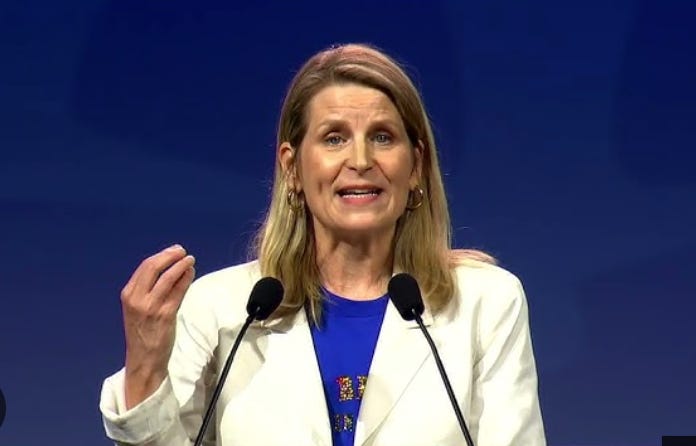
In response to the unprecedented assault on workers, organized labor (as Shuler recounted) did more than talk. Union membership climbed to a 16-year high. “Nearly half a million workers joined a union last year—almost all of them under the age of 40,” she said, with more to follow:
So this June, our unions voted to double down and organize 2 million more workers into unions over the next five years. We’re going to deliver a Workers’ First AI Agenda, making sure technology works for working people, not just billionaires and corporations. We’re going to keep fighting for good housing, better pay, health care and retirement—and bringing good union jobs to everyone.
Labor Day signals the traditional kickoff of the final sprint to November elections, and the labor movement is poised to engage up and down the ballot. Organized labor movements intend to turn out more voters than ever before (aiming for 16 million union members and families; 2 million more than in 2022) and will be out in force to defend voting with 50,000 election monitors in every battleground. We’re going to be there with our yellow vests at polling places, helping people navigate the process,” Shuler said. “Even after the election, we’re going to keep our election protectors right there on the ground, including legal support, making sure every single vote is counted.”
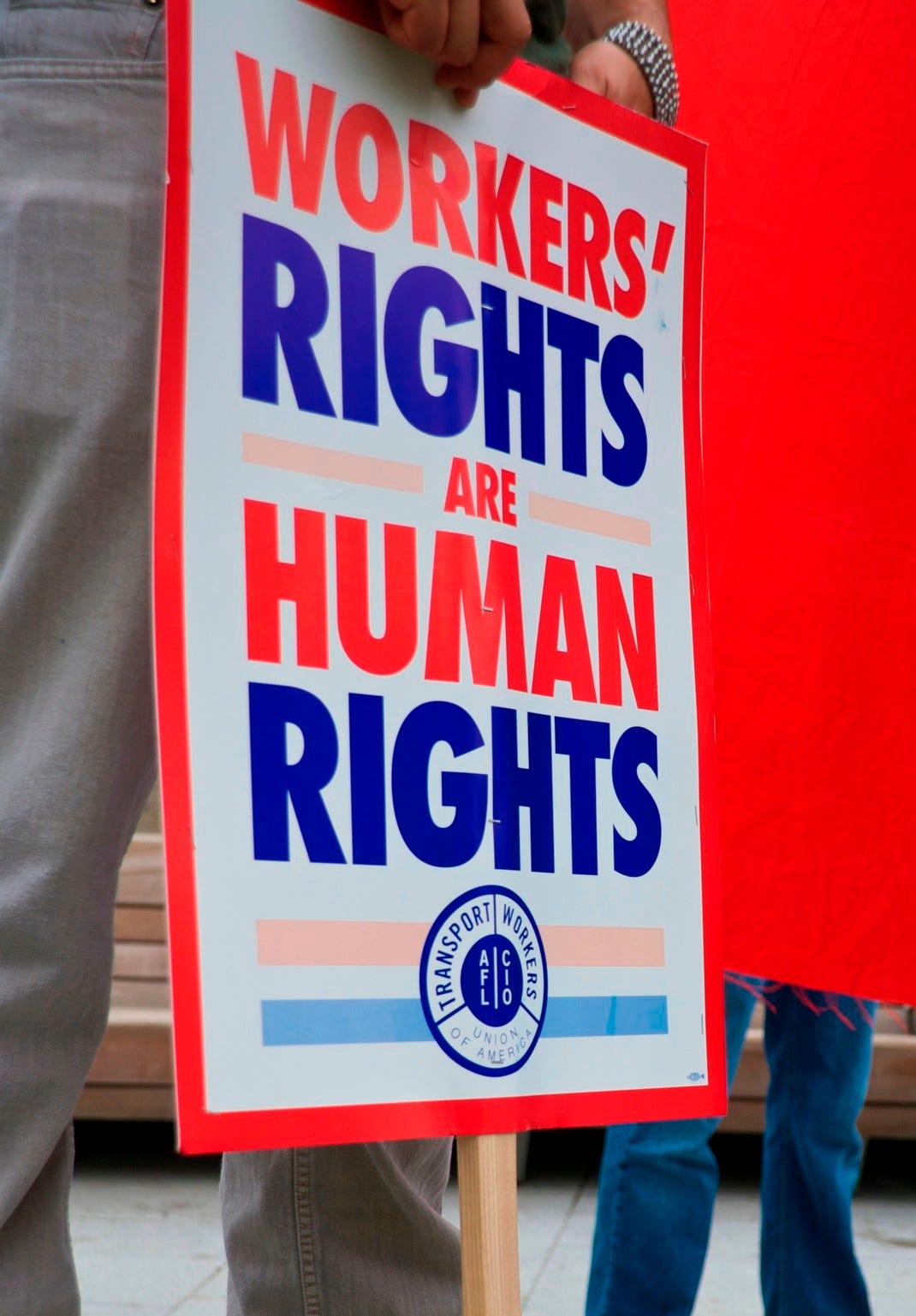
The example set by organized labor, as it has for over 100 years, should resonate with all pro-democracy voters. Since Trump returned to office, the pro-democracy, pro-worker coalition has had to play largely on defense (e.g., litigating against unconstitutional moves, lobbying Democrats to block Trump’s agenda). But elections are about going on offense, making the critical pivot from pleading in court to persuading voters, from countering re-redistricting and the disastrous MAGA Supreme Court Callais decision to turning voters out en masse — no matter where district lines are drawn. That crucial transition gets underway with vigor this week.
Words for the wise for the midterms
Pro-democracy forces in their midterm push can draw on three lessons from the experiences of pro-democracy movements, most importantly from the toppling of Hungarian Prime Minister Viktor Orbán in April’s election.
First, the Orbán ouster underscored the importance of linking regime corruption to voters’ widespread economic angst. Hungary expert Kim Lane Scheppele tells me that opposition forces started with evidence of corruption (i.e., they stole) and linked it to evidence that “the state was not functioning” (as evidenced by failing, decrepit hospitals and transportation, among other things). “The through-line connecting the two was that democracy had been damaged and people needed to get out to vote.” That unifying message (not right- or left-wing ideology) carried the day.
For our upcoming midterms, there is no issue more powerful and timely than corruption. As Gallup reported, “Americans’ perceptions of government corruption in the U.S. are at their highest level in 20 years, with 89% of U.S. adults [including 90% of independents] saying it is widespread.” That’s 10 points higher than last year. Plainly, Trump’s nauseating self-enrichment has hit home, giving Democrats the perfect opening to vow to end the orgy of corruption and to advance credible reform (e.g., claw back Trump’s ill-gotten gains, end crypto scams, ban building monuments to himself, and demand full financial disclosure and stock trading bans for all three branches).
Second, Democrats must be realistic about the current media environment. Media giants are so afraid of Trump that they have preemptively relabeled “Lake Ontario” as “Lake America.” Such institutions are not living up to their obligations to defend truth and uphold democratic norms.
When corporate and billionaire-owned legacy media curries favor with Trump, perpetuating ludicrous moral equivalence, Democratic insiders would be foolish to cater to those same legacy media outlets for coverage. Instead, Democrats should maintain a constant presence on podcasts, independent media outlets, and social media platforms to reach and motivate voters who don’t ordinarily turn out for midterms. Again, Hungary provides a positive model, Scheppele tells me, in which young people “were able to boost the campaign by calling out disinformation bots and meme-ifying the themes” (including zebra memes that exploited a hysterical example of Orbán’s corruption!)
Finally, and most importantly, democracy forces must be additive, determined to embrace candidates and voters who do not share positions on all issues, even ones ordinarily at the top of the political agenda. Perfect alignment on all issues must not become the enemy of “good” — that is, solidarity with pro-democracy candidates who share broad goals such as restoring healthcare benefits, eliminating anti-immigrant abuse, and holding Trump and his cronies accountable. Flyspecking pro-democracy candidates on minute issues that are unlikely to arise anytime soon or rejecting a candidate in a fit of pique over a stray appearance with a fringe character years ago will enable continued MAGA rule. Defeating MAGA fascism requires formation of the broadest pro-democracy movement in U.S. history.
Laying out the challenge ahead, Ian Bassin, executive director of the nonpartisan Protect Democracy, told me, “One of the biggest errors the democracy movement made over the past decade was to respond to Trumpism by moving into a defensive posture. …The problem was: the system wasn’t working for people.” In setting out a pro-democracy vision for the future, the Resistance’s task will be to “focus not on what we need to preserve but on what we need to change and what we need to create: a democratic system that is more representative and more responsive to the American people — not just those at the top, but more importantly, those in the middle and those at the bottom.”
That fight gets fully underway today.
For your Labor Day, we hope you enjoy what became an unofficial labor anthem, authored and sung by Nashville Association of Musicians (AFM Local 257) and SAG-AFTRA member, philanthropic giant, and musical genius, Dolly Parton:
Happy Labor Day, Contrarians!