

By Frederic J. Frommer
Around this time of year, millions of basketball fans hear about the Larry O’Brien Trophy, awarded to the NBA champions. Jalen Brunson, the MVP of the NBA Finals, proudly carried the trophy at the New York Knicks’ recent ticker-tape parade.
But who was Larry O’Brien?
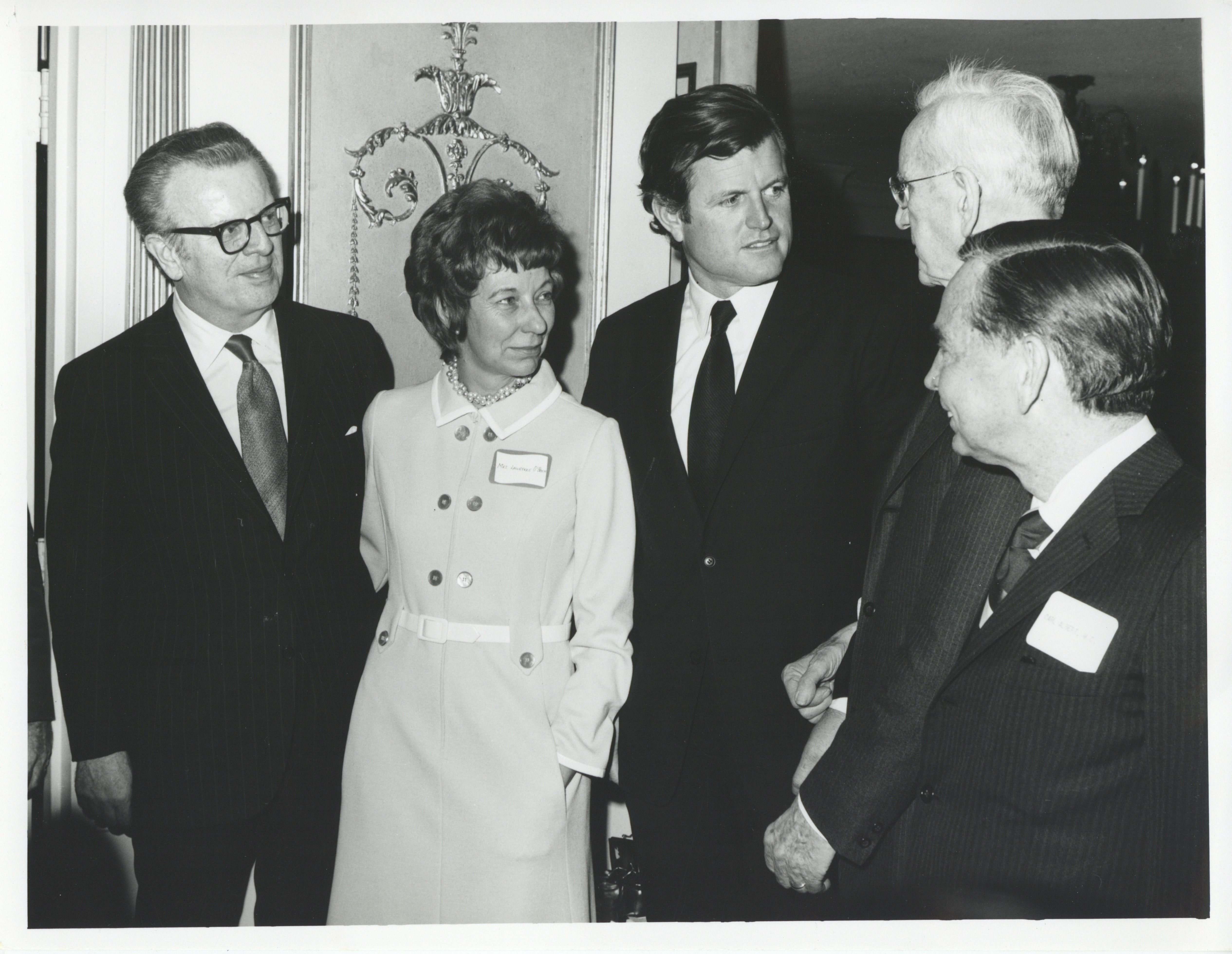
As commissioner of the NBA in the 1970s and ‘80s, O’Brien helped usher the league into the modern era, through everything from labor peace to the adoption of the three-point shot. But in a previous life, he was a key strategist on John F. Kennedy’s successful 1960 presidential campaign in 1960, one of several national campaigns he worked on.
And a dozen years later, as chairman of the Democratic National Committee, he was at the center of another turning point in American political history when burglars connected to President Richard Nixon’s re-election committee broke into the DNC’s Watergate offices. That would lead to the unraveling of the Nixon presidency, culminating in his 1974 resignation.
In short, O’Brien had a unique perch at the pinnacle of sports and politics, two of America’s most favorite pastimes.
O’Brien was born in 1917 in Springfield, Mass., the city where basketball was invented. He ran his first campaign in 1946 for an old pal from Springfield, Mass., Foster Furcolo, who lost the race but won the seat in 1948, and brought O’Brien to Washington as his administrative assistant.
After a falling out between the two men, O’Brien got a call from Kennedy. The young Democratic congressman from Boston hired O’Brien as director of organization for his 1952 Senate campaign. Overcoming political headwinds that saw Dwight D. Eisenhower win the presidency, Kennedy unseated Republican Sen. Henry Cabot Lodge.
Then in 1960, when JFK ran for president, O’Brien was indispensable in helping him win primaries on his way to the nomination and, ultimately, a victory over Nixon. Theodore H. White, author of the classic book The Making of the President, 1960, called O’Brien’s work on the pivotal West Virginia primary “a masterpiece.”
Once in the White House, the president named O’Brien special assistant for congressional relations, where he helped push through much of Kennedy’s New Frontier agenda, including the creation of the Peace Corps.
After Kenndy’s assassination, O’Brien helped with President Lyndon Johnson’s 1964 landslide win and, as a White House aide, was instrumental in several of LBJ’s legislative accomplishments, including the Civil Rights Act of 1964. He also served as postmaster general under LBJ.
In 1968, O’Brien worked for Bobby Kennedy’s presidential campaign. Five years after being with JFK when he was assassinated – and recalling later how he couldn’t accept that it happened – O’Brien was there for RFK’s assassination, too.
“My reaction was: ‘That’s it,’” he told the Los Angeles Times. “At that moment, I became a fatalist.”
He then served as campaign director for presidential candidate Hubert Humphrey, who named O’Brien head of the DNC; he served a second stint as chairman from 1970-72. On June 17, 1972, burglars were arrested after breaking into his office and installing listening devices. In photographs and news clips of the Watergate break-in, his name is seen prominently displayed on the front door to the DNC in distinctive ‘70s font.
“I’ve been a politician for most of my life and I’ve never dreamed of bugging an opponent’s telephone or breaking into his office,” O’Brien wrote in his 1974 memoir, No Final Victories: A Life in Politics from John F. Kennedy to Watergate. “If a generation of Americans becomes convinced that burglary and wiretapping are ‘politics as usual,’ then there’s not much hope for our political system.”
In 1975, the NBA named him commissioner – just the third in the sport’s history – but it created something of a backlash when owners bypassed the league’s Black deputy commissioner Simon Gourdine, whom many considered the favorite for the gig. That led to calls for a boycott of the NBA.
At the time, the NBA was facing antitrust lawsuits from the rival American Basketball Association and the NBA players union, and O’Brien’s political savvy was considered a plus in handling those thorny challenges.
O’Brien made significant changes to modernize the league: negotiating free agency for players in 1976 in response to a suit filed by star Oscar Robertson, adopting the three-point shot, and expanding the league with four teams from the ABA.
In 1983, he headed off a potential players’ strike by negotiating a salary cap in exchange for providing players with 53 percent of the NBA’s gross revenue, which helped to stabilize the league’s finances. Other accomplishments included a big TV contract with CBS. His tenure lasted from 1975 to 1984, helping to transform a once-struggling league to a sports powerhouse. O’Brien later became president of the Basketball Hall of Fame in Springfield.
“He deserves complete credit for taking this league from the mishmash it was … and setting its course so it could grow to where it is today,” said David Stern, who succeeded O’Brien as commissioner in 1984, on O’Brien’s 1990 death. “The settlement of the Oscar Robertson case, the expansion of the NBA by adding the four ABA teams, and the collective bargaining agreement with the salary cap were all achieved during Larry’s tenure.”
When O’Brien announced his retirement, he made a comment that made it clear he still had interest in issues beyond sports.
“Basketball just isn’t the most important thing in the world to me anymore,” he said.
Frederic J. Frommer, a sports and politics historian who has written for the Washington Post, the New York Times, the Atlantic and other national publications, is working on a book on ‘70s baseball.
The basketball commish was a Democrat? Those were the days, my friends. They ended too soon. Can anyone imagine any commissioner of any sports league being a Democrat nowadays???