

By Roman Palomares and Juan Proaño
Since 1929, the League of United Latin American Citizens (LULAC) has defended the economic, political, and cultural rights of Latinos across the United States. On behalf of our members throughout California, and the Latino community at large, we thank California Attorney General Rob Bonta for bringing the lawsuit to block Paramount Skydance’s $110 billion acquisition of Warner Bros. Discovery.
As Bonta recently stated, “if these two entertainment titans merge, they will be a behemoth.” To protect the futures of Latino crew members, small businesses, storytellers, and journalists, we need structural remedies that will keep these corporate entities separate, rather than settle for empty promises that history shows companies do not keep and cannot be enforced. We need firm commitments that will ensure authentic representation of Latino and diverse communities on screen, behind the scenes, and at every corporate level and facet of the business.
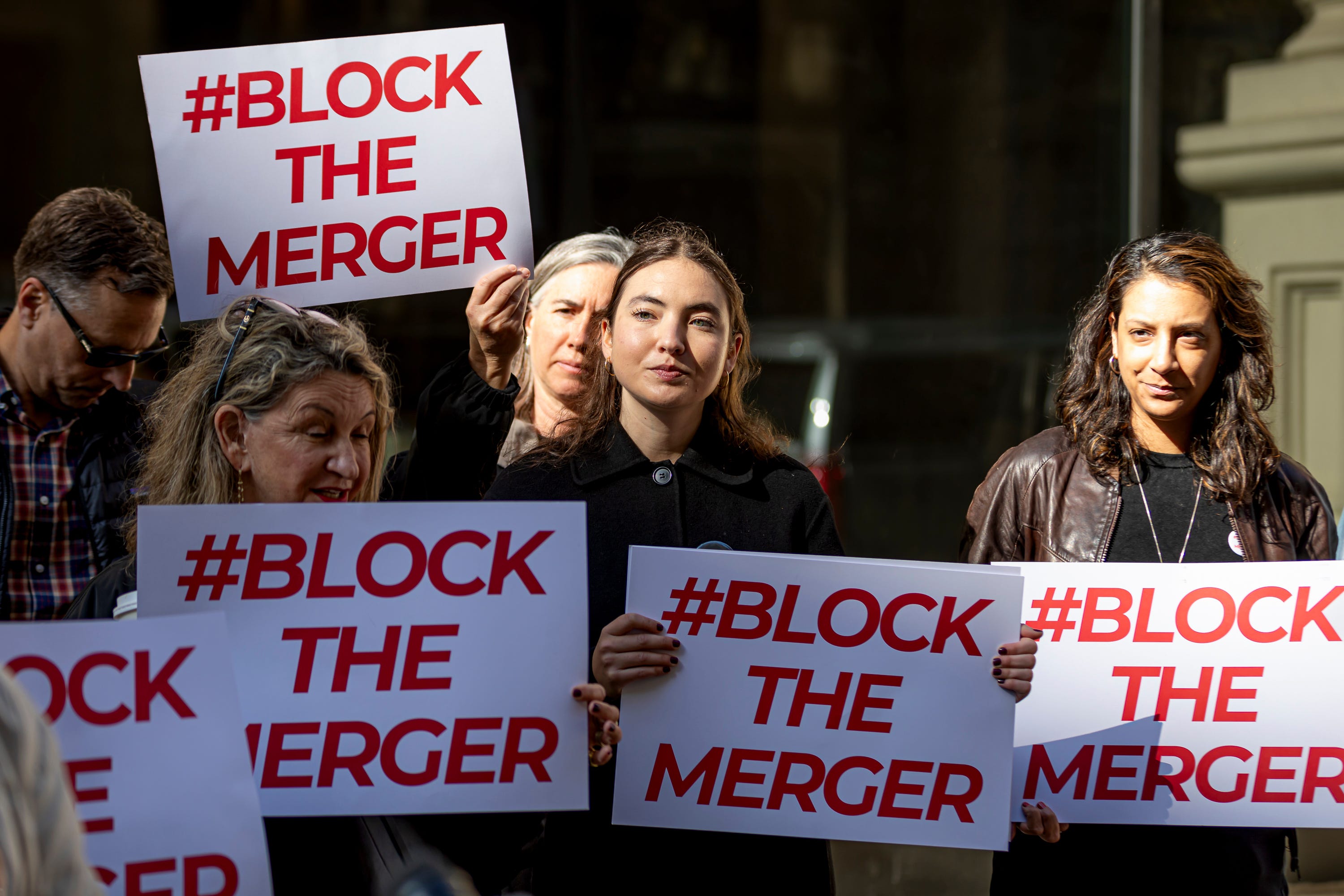
The current form of the consolidation would have a devastating and unacceptable impact on Latinos, including those who reside in the Los Angeles community. According to a recently issued Los Angeles County report, the merger would put at risk “4,500 direct film and television jobs,” “2,661 indirect jobs at small businesses that support production, like prop houses, printers, transportation companies, and other vendors,” and “3,204 jobs induced from local production spending in the broader economy.” In all, “more than 10,000 total job-years … and $4.06 billion in business output are at risk.” Because 49.3 percent of the population of Los Angeles County is Hispanic or Latino, the impact would be ruinous for a community that has already suffered from significant business disruptions over the past year.
No state has more to lose from this disastrous merger (absent true structural remedies) than California. Latinos make up roughly 40 percent of California’s population and nearly half of Los Angeles, according to recent Census figures, and our tax dollars subsidize this industry. It is already buckling. Los Angeles County lost more than 40,000 motion picture jobs between 2022 and late 2024, while local shoot days fell from 36,792 in 2022 to 19,694 in 2025. Latino grips, electricians, drivers, set builders, and caterers absorb those losses first and recover last. A merger engineered around $6 billion in cuts would convert this ongoing crisis into a catastrophe for the working families we represent.
Latino families also comprise a significant portion of the film and television industry audience. Latinos, who account for 19 percent of the U.S. population, purchased 29 percent of all movie tickets sold in 2020, and MPA data consistently show Latinos attending theaters more often per capita than any other group. The Pew Research Center reported this year that 59 percent of Hispanic adults visited a movie theater in the past year, a higher share than white or Black adults. Hollywood returns almost nothing for that loyalty. Latino characters filled only 5 percent of speaking roles across 1,300 top-grossing films, and nearly 44 percent of those films featured no Latino speaking character at all.
Latino actors held just ten lead or co-lead roles among the 100 highest-grossing films of 2022, and only 76 such roles across sixteen years of top releases. And the door is closing further: people of color lost ground in 2025 in every employment category in the industry, and Latinos are among the most underrepresented groups in every job, on screen and behind the camera.
These and other harms are not collateral to the antitrust case. They are consequences of the diminished competition that will result. Every studio absorbed by a rival is one fewer buyer for a script, one fewer employer for a crew, and one fewer distributor willing to bet on a story its franchise slate does not need. The combined company would become the nation’s largest buyer of original film and television programming, with the power to reduce output, employ fewer workers, and depress pay. For instance, Disney’s purchases of rival studios cut its film output by 65 percent between 2009 and 2017, and the Disney-Fox wide-release slate has since fallen from 26 films to 14 per year. Independent producers lose the leverage of competing bidders and find vertically integrated studios closed to outside projects; audiences lose the choices those producers would have supplied; and Latino audiences, who already fill one speaking role in twenty, lose first.
We need not only forecast what this merger would do to the Latino community because Warner Bros. Discovery already ran the experiment. After the 2022 WarnerMedia-Discovery merger, the company shelved the completed $90 million film Batgirl, starring Afro-Latina actress Leslie Grace in one of the only mainstream superhero films ever led by a Latina. It then canceled a series about a Dominican immigrant family, Gordita Chronicles, five weeks after its debut, despite being seventh most-watched comedy of 2022. It later erased it from the platform entirely. Following the cancellation and deletion, the show’s creator warned that consolidation contributes to “the erasure of U.S. Latinos.”
Paramount followed the same script: Within months of closing its Skydance merger in August 2025, it laid off roughly 2,000 employees, about ten percent of its workforce, just after dismantling its diversity programs earlier that year. Members of Congress, led by Rep. Joaquin Castro (D-TX), had to ask the Justice Department to reexamine the Warner deal because the harms arrived only after regulators waved it through. Approval first, erasure second. That is the pattern, which is why we insist on full structural reforms that protect authentic and full participation of Latino and diverse communities.
Paramount now demands through the press that the suit must settle by October 1 or it will move the studio out of California. These are desperate measures — “blackmail,” as Bonta put it, is not negotiation. A corporation shouldn’t be permitted to accomplish through threats to workers what it cannot accomplish under antitrust laws. This is why Hollywood’s Teamsters have rightly condemned the use of workers’ livelihoods as a bargaining chip.
We thank Bonta for rejecting unenforceable paper commitments: Paramount pledges 30 theatrical releases a year, yet exhibitors remain unconvinced, as they have still not recovered from the smaller slates that followed the 2019 Disney-Fox merger. Every assurance offered to win approval of the WarnerMedia-Discovery deal came before Batgirl, before Gordita Chronicles, before thousands of pink slips. Behavioral conditions expire or go unenforced with B-level substitutes; the market power a merger creates is permanent. The Justice Department approved this transaction in June, reportedly over the objections of career staff, so the coalition of state attorneys general now stands as the last line of defense. The restraining order the AGs won and the March 2027 trial date give the law room to work.
That is why we were so pleased to read Bonta’s statement in advance of Monday’s reported meeting between the AG’s and Paramount:
As I’ve said before, generally for all of my cases, I prefer to resolve disputes in the boardroom, not the courtroom. As I’ve also said, if the opposing party in litigation wants to meet in good faith to make a sincere effort to resolve the case, we’ll meet. And as I have further said, any potential discussions about the Paramount-Warner Brothers merger will be unproductive absent robust structural remedies on the table that address our concerns. As it stands today, the proposed Warner Bros./Paramount merger will mean higher costs, less competition, lower wages, job cuts, and fewer movies and TV shows. This merger violates long-standing federal antitrust law, and we are committed to enforcing the law.
The National Hispanic Media Coalition and dozens of public interest organizations have called for precisely the action Bonta took. We thank him for holding firm against limp behavioral promises that could devastate our Latino community with major job losses. LULAC stands behind the California attorney general.
Roman Palomares is the National President and chairman of LULAC. Juan Proaño is the chief executive officer of LULAC.
Editor’s note: This essay is adapted from a letter LULAC sent to California Attorney General Rob Bonta.