


The next time you try to tune in to your local 6 p.m. newscast, it might not be there. Those familiar faces at the anchor desk, news reporters and meteorologists, all the news broadcasters you count on for fact-based local news and timely weather alerts might have just been fired and the newsroom operation shut down.
That’s what happened in Indianapolis a few weeks ago. On a busy news night, with no advance notice, an entire newsroom was abruptly shut down, a staff of more than 50 people fired, and the station’s multiple newscasts abruptly replaced with content from a competing station. “I am officially unemployed. I just received this news minutes ago,” wrote multi-media journalist Nico Pennisi on social media. The next morning, anchor Kaitlyn Kendall posted this: “This is not an April Fool’s joke … even though part of me wishes it was. Yesterday, when I said ‘Good Morning, Indiana,’ I didn’t know it would be the last time I’d get to say those words.”
It also happened in California. In a regularly scheduled morning editorial meeting last fall, reporters at a Central California TV station found out they’d been fired and the newsroom dissolved. One reporter was told “We’re never doing local news again.” Within hours, the locally produced news content on KION-TV was replaced with newscasts from a TV station over 100 miles away in San Francisco. Telemendo 23, which shared a newsroom with KION, was also dissolved, leaving the region’s large Latino population without its only Spanish-speaking newscast.
Nexstar is bad news
Local television news is disappearing before our eyes. These recent newsroom closings were jarring, but each involved small-scale broadcast consolidations. That’s nothing like what could happen with the rapacious Nexstar-Tegna mega merger. Nexstar is a behemoth with massive holdings, including the News Nation cable channel and over 200 local television stations. The pending merger deal does require Nexstar to divest of six local stations, but the Texas-based company would ultimately own 256 stations nationwide, reaching 80% of the country.
That merger is temporarily on hold pending an anti-trust case that doubles as a test of whether Donald Trump can just waive a law that explicitly limits the number of TV stations a company can own in one community. But if it isn’t stopped, journalists could be fired and local newsrooms dramatically shrunk or even shuttered. That’s especially true in the 35 markets where Nexstar and Tegna have overlapping television stations, including in smaller communities such as the Quad Cities in Illinois and in big cities such as Dallas, Denver, and Phoenix.
Last month, Nexstar CEO Perry Sook told Inside Edition’s Deborah Norville that “I don’t close newsrooms. I just move the address and move them into one building, so I pay to heat and cool one facility.” But the local TV merger track record of closing newsrooms and cutting personnel doesn’t support Sook’s claim. In fact, in anticipation of the merger going through, Nexstar has already implemented sweeping layoffs at its three largest stations. The layoffs at Chicago’s WGN-TV were the biggest in at least 25 years. Along with numerous journalists, at least one meteorologist was also fired — raising concerns about merger impacts on the quality and availability of local weather forecasts.
Tegna has already added what they call multi-market weather forecasters who “appear across multiple stations, filling in during major weather events, vacations or staffing gaps.” The next step could be complete centralization of local weather with regional meteorologists replacing local staff. Or local weather forecasts could vanish altogether with one-size-fits-all weather segments from a commercial weather company.
Because local weather information is so popular with viewers, I’d argue that it’s the third rail for local TV news companies. Mess with it at your peril. Just look what happened when The Allen Media Group — owner of 22 local stations — tried to ditch its local weather and replace it with segments produced by the Weather Channel. Viewers were so outraged by AMG’s plan to fire “100 local forecasters across 36 outlets,” the company quickly backtracked and dropped its plans — for now.
“The staff at WRTV was shown the door today”
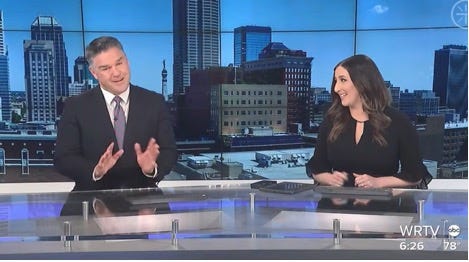
Potentially dangerous spring storms were the top story on the 6 p.m. newscast on WRTV in Indianapolis on March 31. Longtime chief meteorologist Todd Klaassen warned viewers about the potential for high winds, hail, and isolated thunderstorms. Klaassen made at least two more appearances between stories about preparations for the Final Four games held in Indianapolis later that week.
That 6 p.m. newscast would be Klaassen’s last time doing the weather on Indy’s Channel 6. By the time the broadcast ended, Klaassen and over 50 other news staffers at WRTV had been abruptly fired. Multiple news reports indicate the newsroom of experienced broadcast news professionals — reporters, editors, news photographers and weather forecasters — were all terminated without warning as part of a merger with Circle City Broadcasting, the owner of two other local Indy stations, including WISH-TV. On the 11 p.m. newscast that same night and with no explanation to the audience, a weathercaster from WISH gave viewers the storm update in Klaassen’s place.
One of Klaassen’s colleagues took to social media that night to tell viewers what had happened. Meteorologist Kyle Mounce wrote: “The staff at WRTV was shown the door today, as new management took over. It’s getting late, so I’ll keep this post brief. You, the loyal viewers, at least deserve to know that’s why you won’t be seeing us on your tv.”
The next day, Klaassen also posted to his social media: “If you haven’t heard yet, WRTV was sold yesterday to another owner in town, and essentially the entire staff was let go.” The post included a photo of him departing WRTV for the last time.
Less local coverage, more copycat content
With the March merger between Circle City Broadcasting and the E.W. Scripps-owned WRTV, CC CEO DuJuan McCoy promised more local news, but so far that’s not happening. Nearly every local news story on the WRTV website and live newscasts are produced by its sister station WISH. Three new ”locally focused shows” were announced for WRTV, but all three already air on WISH. There is one new hour of local news on WRTV, but it’s at 4 a.m., so that doesn’t seem like a meaningful addition. Indy resident and broadcast news talent agent Rick Gevers told me, “now you’ve got four local stations, +8,000 cable channels and unlimited streaming opportunities battling for 7 ratings points at that hour.”
I also talked with longtime Indy TV news anchor and reporter Phil Bremen, who spent seven years at WRTV. Bremen told me he’s both disappointed and offended by this recent merger. He added:
I am disappointed that good people are out of work and that many of the stories they would have covered will be neglected. This is not theoretical. I have been present in recent months at important events that only WRTV covered. Too bad for all the folks who were not there or did not watch WRTV.
And, yes, I am offended. That’s because WRTV’s new owner appears to think the viewing audience is stupid. He is promising us more hours of news — but failing to acknowledge that the content filling those hours will largely repeat what his CW affiliate here, WISH-TV, is already airing…. We’re not getting more stories — only an additional place to find exactly the same stories.
The WRTV-WISH merger is just one of two mergers happening in Indianapolis. The other — you guessed it — involves Nexstar and Tegna, which would result in Nexstar owning three stations in Indianapolis. It’s impossible to imagine that all the newsrooms would remain intact despite Sook’s “I don’t close newsrooms” claim. Sook has also claimed that the Nexstar mega-merger would help local stations survive and make them better “positioned to deliver exceptional journalism.”
That’s wrong on two counts. First, Nexstar’s local stations are now going to be filled with partisan-tinged stories from Sook’s MAGA-coded “News Nation” cable network that puts ideology ahead of its journalism. We’ve already seen right-wing Sinclair do something similar with its 185 local stations. The pro-Trump media company closed local news operations at as many as 10 stations and replaced the local news with its “National Desk” program filled with disinformation and MAGA drek.
Second, without the sharp elbows of local journalists competing to dig up stories, far too many important local stories will never get told. That means less coverage of city hall, fewer notices about public meetings, less reporting on cultural events happening over the weekend — all of which adds up to less accountability for politicians, decreased public engagement in community affairs, and missed opportunities to do something fun because you didn’t know it was happening.
Jennifer Schulze is a former local TV news executive, reporter, and producer in Chicago. She’s on Bluesky @newsjennifer.bsky.social and subscribe to her Substack, Indistinct Chatter.

It just goes on and on and on and there is no end in sight. To be all-around well informed these days means to go to numerous independent sites and making it a full time job. I am retired, so I can afford to do that, but I feel sorry for people with full-time jobs.
All of this must be another ploy by the billionaire class, to keep more people uninformed and making them ignorant. It's the only way to keep their fascist order takers in power.
No one i know watches any legacy news on TV. No one has cable. I'm 80 yo, and that first sentence made me laugh. Local news is online, too.