

By Alan Light
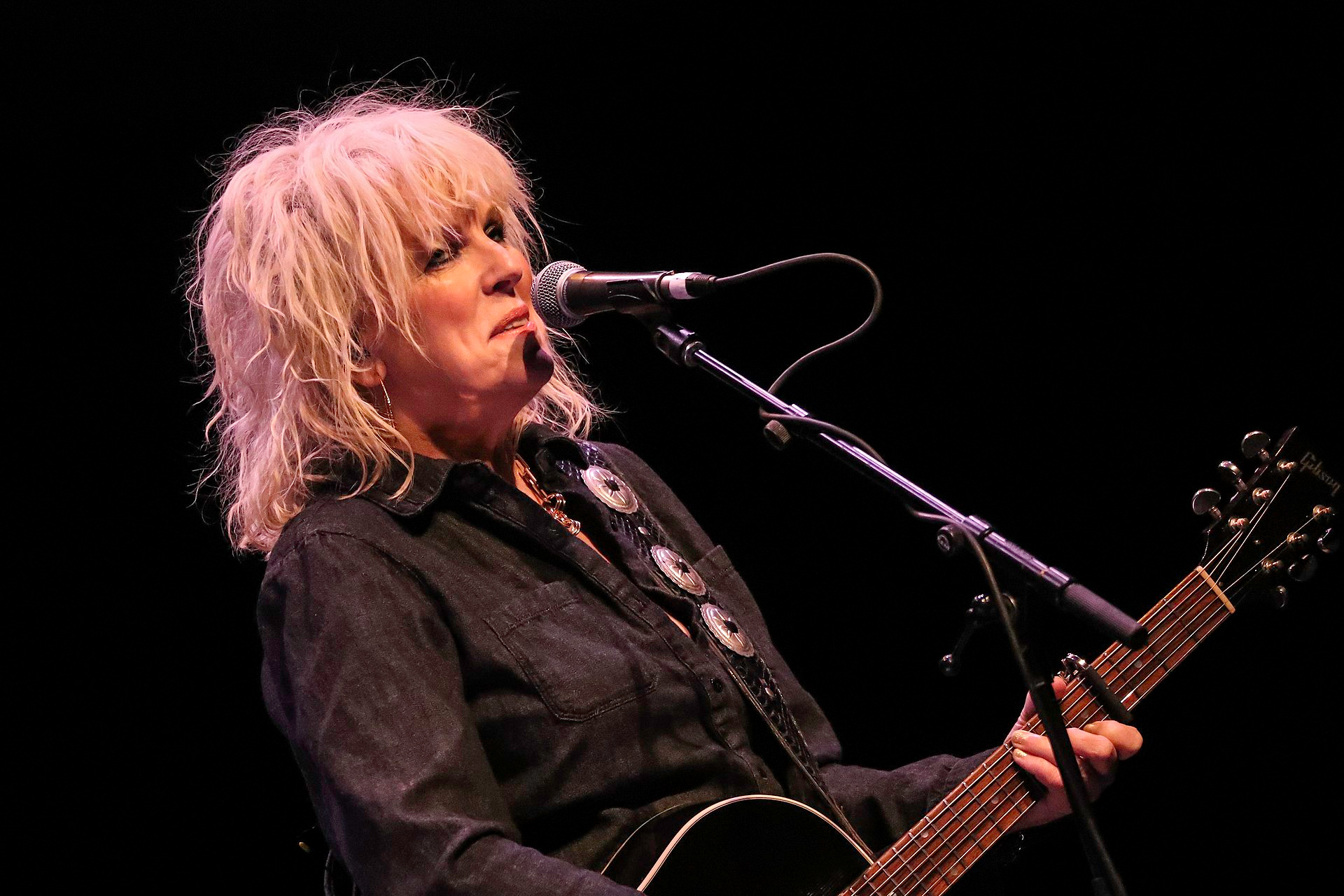
“I’m not trying to cause a riot, but I do want to wake people up,” says Lucinda Williams. “I like to push people’s buttons. I want them to get a little pissed off.”
On her eighteenth album, World’s Gone Wrong, Williams—who Time magazine once called “America’s best songwriter”—expresses her outrage at our nation’s current condition. Titles like “How Much Did You Get for Your Soul” and “Something’s Gotta Give,” and a rendition of Bob Marley’s “So Much Trouble in the World,” featuring the incomparable Mavis Staples, let you know where she’s coming from.
Williams, 72, suffered a stroke in late 2020, but has been on something of a creative tear since recovering. In 2023 she released a new album and an acclaimed memoir, Don’t Tell Anybody the Secrets I Told You. Livestreams during lockdown led to the “Lu’s Jukebox” series—so far, seven albums of covers dedicated to themes from the Beatles to ‘60s Country Classics. She’s even part of the team behind Lucinda’s, a new honky tonk–style bar in New York City’s East Village.
But with the blues- and gospel-charged World’s Gone Wrong, the three-time Grammy winner felt a particular urgency that took her back to her early days as a teenage folk singer.
Rather than simply blaming sinister political leaders, Williams focuses on the impact of today’s inequality and polarization—“how it affects people day-to-day,” as she put it in a recent video interview from her Nashville studio. The title track tells the story of a nurse and a car salesman struggling to get by. The songs are filled with a sense of fury and betrayal, of the political exploitation of our fears and confusion; “There’s division in these days/Bonds being broken,” she sings, and “Apathy will blind you/Until it’s way too late.”
“People seem to want to hear these kinds of songs right now,” says Williams. “When I’ve done these songs on stage, they’re grateful and they thank me, which always surprises me. I didn’t feel like, Wow, I’m so brave for doing this.”
Below are more excerpts from our conversation.
*
As you were writing these songs, what did you feel coming out?
Frustration and anger and like the majority—well, I like to think the majority of people in the country are feeling. It’s just in your face every day, some ridiculous, crazy story: “He said what? He did what?” After a while, you feel this urge to write about it, just to help process it, get it out of your system. That’s the best way I know how to deal with things, is to write about them.
It’s striking that rather than instead of focusing on the maniacs at the top, you’re looking at why people are buying into this sense of misplaced anger. In one song, you sing about “False gods and deceivers playing on our deepest fears.”
Well, that’s been something that I’ve thought about, struggled with for a while, and a lot of us have. Why would somebody vote for that? I didn’t even want to say vote for him, because I don’t want to put a human element to it. And it’s bigger than that. But it’s always been a mystery to a lot of us, who are the people who put this guy in office?
I’ve always written about things from an everyday man or woman perspective. That’s kind of my thing. This guy from Ireland who was interviewing me yesterday asked me if I’d grown up in a working-class family because I was so good at writing about it, and I had to admit that, no, I hadn’t. I grew up in academic world. But my father’s father was a Methodist preacher, so he grew up more like that, and my mother did, and some of that stuff got handed down to me.
You’re known for more personal songs and character sketches. Have you tried to write about a particular moment like this before?
I’ve written a bit like that, but I’ve been wanting to for a while. The topical songs I was influenced by were so brilliantly written, mostly by Bob Dylan, of course—songs like “Masters of War” and “With God on our Side” and even going back to “The Times They are a-Changing or “Blowin’ in the Wind,” those are all amazing songs. In the past, I would try to tackle something like that, but it would end up sounding too flowery, or “Let’s all hold hands and dance in a circle” or something. Topical songs are hard to write, I find them very difficult. A love song is a lot easier.
In your book, you wrote beautifully about some of your very first performances, playing folk and protest songs on a tour of schools in Mexico. Do you feel some connection to that time in this new work?
Yeah, because I was a little activist. When I was a teenager, I was at every demonstration, every march, with my guitar, hoping to be able to sing a protest song. And I grew to love the feeling. There’s no feeling like it, really, of being in that situation with other people of like minds, all singing together, and the rush that I would get from that. I’ve been feeling remnants of that, especially when we were in Portland and the demonstrators were out, and it reminded me of when we were all doing that.
Another question I get asked a lot is “Do you think music can change the world?,” which is a pretty loaded question. I can’t really say yes or no. The way I feel about it is, it helps the movement. It helps the human psyche as we all try to process this insanity. Music can always help that way.
Whenever I do an interview with someone from overseas, they always want to talk about the political climate over here, and how are we dealing with it every day. When we were in Australia, not too long ago, some of the guys in the band and I went to have a glass of wine after the show and this guy came over—I guess he could hear us talking and knew we were Americans—and he said, “I just want to tell you that I’m so sorry about all that stuff that’s going on in your country.”
This was a perfect stranger who feels bad for us. He feels sorry for us. The world is watching.
Music journalist and author Alan Light is the former editor in chief of Vibe and Spin magazines and a former senior writer for Rolling Stone. A frequent contributor to the New York Times and Esquire, he co-hosts the music news podcast Sound Up! Alan’s latest book is Don’t Stop: Why We (Still) Love Fleetwood Mac’s Rumours.
This is where I put in a plug for the station that often plays Louisiana native Williams's music often, WWOZ-FM New Orleans. This public station is proud of its local music history, and anyone can listen online at https://www.wwoz.org/listen/player/.
Special shout-out to Friday night DJ Black Mold's show, Music of Mass Distraction at 7-10 Central. Bet he plays some Lucinda tonight!
Thank you for sharing this.