


We should be cautious in comparing what’s happening in the United States with history’s greatest calamities. America is not a dictatorship; Donald Trump isn’t Hitler; ICE is despicable but not the Gestapo; and Americans are about to use our freedom to vote to put our country on a better path. But sometimes, when Trump’s acolytes open their mouths, it’s hard to suppress analogies to the darkest ideas of the past. Exhibit A last week was a speech Secretary of State Marco Rubio gave by the Parthenon in Athens, Greece, that, well, you should read it in full here and judge for yourself. My reaction was that it belongs on the syllabus of every class on the intellectual foundations of fascism.
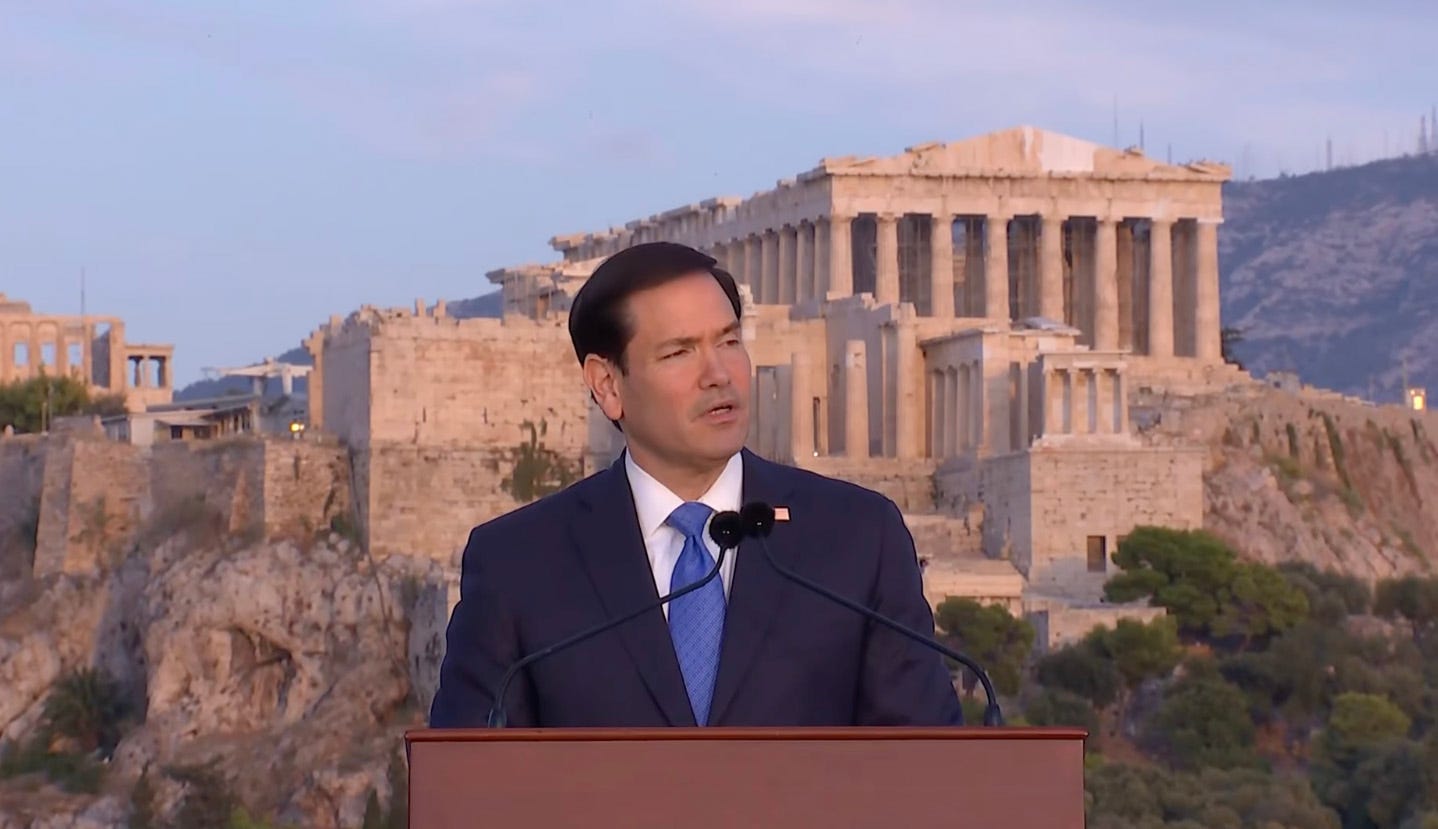
Rubio’s ostensible purpose was to define and defend the idea of the “West” — by itself a perfectly appropriate thing for an emissary of the leading Western power to do. The first sign that something weird was afoot was that this major address by a secretary of state on European soil did not mention Russia, Ukraine, China, or pretty much any foreign policy issue that a person with his job would normally be concerned with.
A second tell was that Rubio was not talking about the geopolitical concept of the “West” that past American leaders from Truman to Kennedy to Reagan have invoked. That version of the “West” arose only after World War II; it was centered on the allied democracies to the geographical west of the Iron Curtain (while including Asian allies such as Japan) and distinguished them from the captive dictatorships of the Eastern Bloc (most of which are now, happily, on the democratic side of that old divide). Rubio’s focus was on something older and different — on a Western civilization descended from ancient Greeks, on a culture, not on a political community, one rooted in Christian and European customs, soil, and blood.
In his speech, Rubio described the “essential traits” that define his idea of the “West.” They include: “Fierce individuality and relentless ambition; daring exploration and invention; a yearning for discovery, for adventure, risk and glory.” “A distinctive understanding of virtue; of destiny and fate; of truth, goodness, and beauty.” “The ideal of the great man: the exceptional individual who obtains immortality through his own deeds,” and who is “willing to pay any cost for a cause worthy of his loyalty.”
He related these qualities to the ancient Greek concept of “thumos,” the “fire of passion, strength, courage, pride. The ideal society, he said, like the Greek city-states, provides an “arena for great men to test and prove themselves, to hone their potential through perpetual struggle.”
And he bemoaned what he sees as the modern Western world’s rejection of these virtues, as we allegedly made “nationalism” a “dirty word, “tore down our monuments,” “condemned our own history,” “opened our borders and outsourced our industry, and allowed our militaries to wither and to decay.”
It’s tempting to point out how disconnected this is from reality — the only monuments Americans have torn down are Confederate statues; our advanced industries have rebounded this decade; we have the world’s mightiest military. But what matters is Rubio’s belief in this myth and in what he said next — that the Western world has lost the “will to fight, the will to strive, the will to survive.”
He didn’t quite say we’ve lost the “will to power.” But wait! For here is the kicker, the part that relates all this to actual foreign policy:
“Under President Trump, the United States has made its choice. We choose the unapologetic pursuit of national power: to take back control of our critical supply chains, to reindustrialize our economy, to rebuild our defense, to fight for dominance of the technologies and industries of the future.”
Now, there’s nothing wrong with saying we need more courage, striving, love of adventure, or pursuit of glory from good people today. And we should all want the United States to be the strongest country in the world.
But notice what was missing in Rubio’s litany of virtues. The ancient Greeks would have seen it. Plato himself wrote that the spirit and passion of “thumos” must be subordinate to reason; otherwise, the state devolves into a “timocracy,” in which an ambitious, glory-seeking ruling class begins to secretly hoard wealth, and ultimately into oligarchy.
The founding principles of America allow for pursuit of power but say it must be tethered to moral ends and tempered by the rule of law and respect for human rights. The guiding principle of American foreign policy has long been that we don’t use power merely to enrich and exalt ourselves, and that advancing the freedom and wellbeing of others serves our interests. All of this was absent from Rubio’s vision of American “dominance.” He praised Athens but mentioned its democracy only in passing. He brought up America’s Declaration of Independence — but only to compare its signers’ willingness to sacrifice their lives, fortunes, and sacred honor with the self-sacrifice of ancient Spartans. He said nothing of the American founders’ cause — of the truth they held self-evident that all men are created equal.
In fact, Rubio literally says all men and women are not equal. We are wrong to assume, he said, that “the West’s conception of heroism, honor, duty ... somehow are universal to all people in all times and in all places. They are not. They are the product of a distinct character, which arose [in Athens] and shaped the whole story of the civilization that came after it.” It seems that if you’re Japanese, Indian, or Brazilian, Rubio thinks you have an inferior conception of heroism, honor, and duty; there is no place for your democracy in his version of the “West.” If you’re a European country that lets in too many immigrants from such inferior cultures, you’re out of the club, too.
I wonder if there would be room in his vision even for his own parents, who migrated to America from Cuba. In the speech, he described himself not as their son but as the “great-grandson of settlers who arrived in the new world from Spain.”
So — where have we heard such a worldview before, one that glorifies national power with no allowance for past mistakes, one that worships military strength, industrial and technological dominance, and the cleansing from society of immigrants from other cultures, one that views the desire to serve humanity as weakness?
Italian fascists often used the slogan “Vivere pericolosamente” (living dangerously). In Mussolini’s own words, “fascism wants man to be active and to engage in action with all his energies; it wants him to be manfully aware of the difficulties besetting him and ready to face them. It conceives of life as a struggle in which it behooves a man to win.”
Both the German and Italian fascists were obsessed with the alleged “atrophy, servitude, and decline” (Rubio’s words) of their nations, and built a cult of unity and energy, of action, daring, and pursuit of glory. Fascism sought to engineer a “New Man,” stripped of humanitarian sympathies, entirely dedicated to state ambition, and driven to conquer, build, and dominate, with no legal or ethical limits.
Unsurprisingly, Rubio doesn’t explicitly reject such limits (he just doesn’t mention them); he doesn’t say a dictatorship should be formed around the great men he glorifies. But once you become convinced Western democracies are decadent and that heroic men engaged in perpetual struggle must rise to save their nations, whose power must be wielded without apology, you’re not far from the logical conclusion.
The Russian and Chinese dictators Vladimir Putin and Xi Jinping would love Rubio’s speech, because it portrays American values as mirror images of their own. So would the European neo-Nazis Rubio’s State Department pals around with. Our allies will see nothing worth following in its vision of American domination — or in the rank corruption, threats to invade allies, and now to stage public executions that define the current American government’s image in the world. They will cling to the hope that Americans will elect wiser leaders while planning for a world without us, which, if it comes, will ironically leave our nation pitifully alone, vulnerable, and weak.
Fortunately, there’s another speech about the meaning of the “West” that can show us a better way. It was given in Munich, Germany, in 2017, by the late great Sen. John McCain (R-AZ).
“From the ashes of the most awful calamity in human history,” McCain said, “was born what we call the West — a new and different and better kind of world order, one based not on blood-and-soil nationalism, or spheres of influence, or conquest of the weak by the strong, but rather on universal values, rule of law, open commerce, and respect for national sovereignty and independence. Indeed, the entire idea of the West is that it is open to any person or any nation that honors and upholds these values.”
That is the American creed — that our strength derives from our ideals, that America’s promise of equal human rights remains, as Abraham Lincoln put it, an “electric cord” that connects our founding fathers to our newest immigrants and to all “patriotic hearts” who love freedom “throughout the world.”
This American creed has undying energy and unlimited ambition. It has appeal to all people, in all places. It is being championed today, with both passionate and virtuous “thumos,” by Ukrainians defending their free country from a Russian invasion, by Iranians risking their lives to oppose their brutal regime, by Americans risking safety and comfort to protect their immigrant neighbors, and by the good, strong people of Greenland telling losers like Rubio to go to hell.
These are the heroes that the true Western world marshals its power to defend. I’m proud to be fighting to preserve it.
Tom Malinowski is a former member of Congress from New Jersey who was an assistant secretary of state in the Obama administration.

Forget Rubio's faciast speech. It is totally un-American!! Not to mention destructive to any sane and human world order! Read Tom's piece instead. Hear it from the experienced and the expert instead. Let's reject this gas lighting, propaganda from Rubio!
What does that say about Rubio that he would suck up to someone who denigrated him as "little Marco"?