


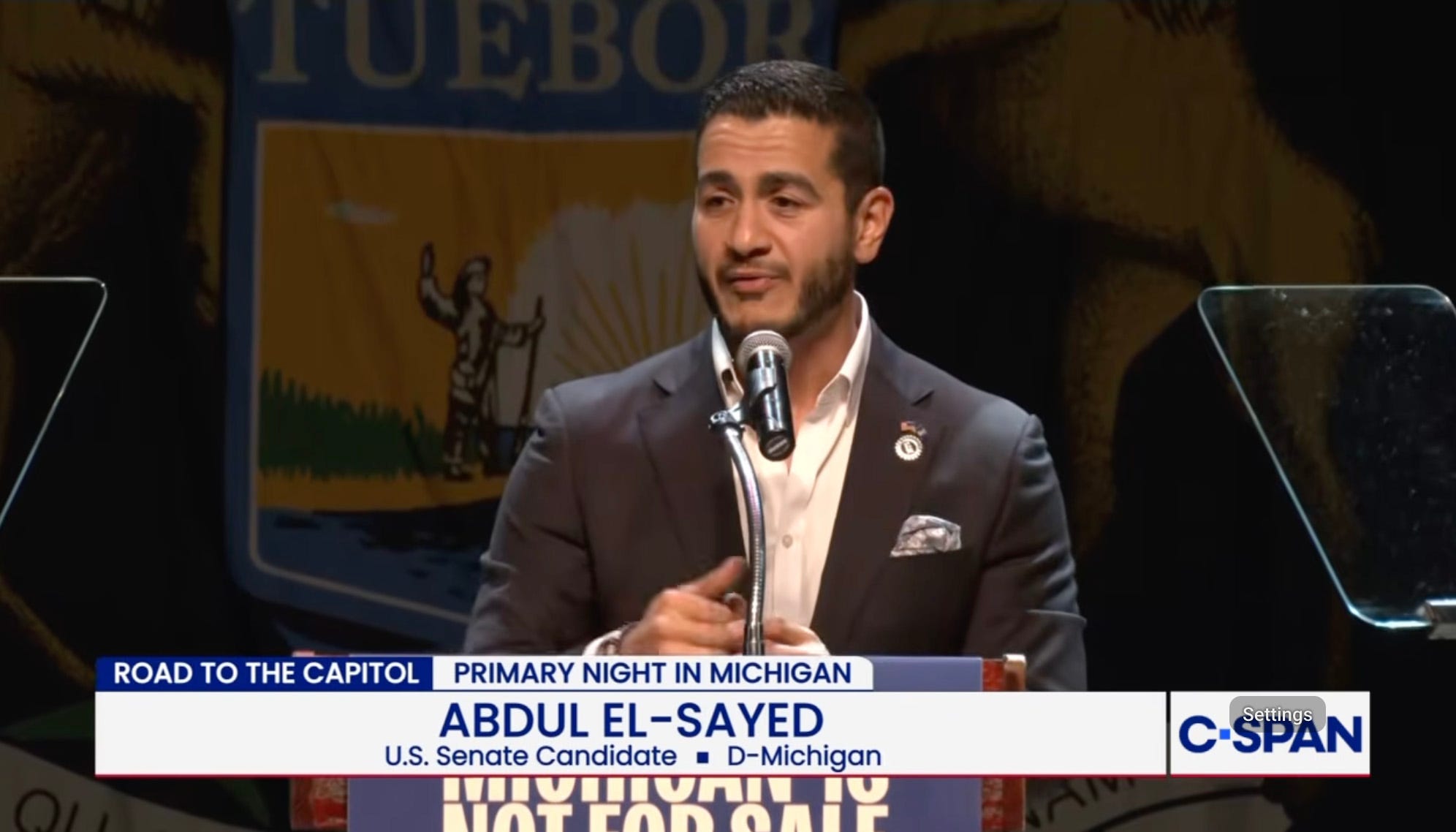
UPDATE: On Wednesday morning, the Associated Press called the Senate race for Abdul El-Sayed.
On target to be one of the most expensive U.S. Senate primary races in history, Democrats’ Michigan contest did not turn out to be the rout for physician, former public health official, and progressive candidate Abdul El-Sayed that a slew of polls suggested. By early Wednesday morning, with more than 95% of the vote counted, El-Sayed was leading Rep. Haley Stevens by less than 1.5 percentage points and roughly 20,000 votes. NBC News called the race for him, but other outlets have not as of this writing. The winner will face Rep. Mike Rogers, a loyal Trump foot soldier who has shown zero inclination to oppose his unpopular war or his government of, by, and for the oligarchs.
A spate of polls had shown El-Sayed pulling away following a final debate appearance in which he vowed to dismantle ICE — Stevens clung to the notion it could be reformed — and bashed Stevens over her reliance on AIPAC money and her vote against cutting off military aid to Israel. But by any measure, Stevens vastly outperformed polling, a caution against over-reliance on polling and assumptions about “electability” based on them. (It also suggests that pollsters failed to pick up on her strength among working-class, rural and African American voters.) If El-Sayed does hang onto win, his victory will come despite — or maybe because of — the flood of tens of millions in dark money spent on Stevens’s behalf, much of it spent by a shadow AIPAC-related group (the “United Democracy Project”).
Democrats desperate to put the primary acrimony behind them might find a silver lining: the unexpected closeness of the result seemed to have triggered some much-needed humility and magnanimity rather than chest-thumping. El-Sayed told his supporters, “However much we might disagree with our Democratic opponent, there is so much more that unites us than divides us.” He added, “Whatever happens tonight, we have a responsibility to assure that we unite to make sure that Mike Rogers never sees the inside of the U.S. Senate.”
While pundits and partisan axe-grinders told us for weeks the race turned on an ideological schism in the party, ordinary voters, even in primaries that attract the most partisan segment of the electorate, choose between real candidates, not partisan manifestos. And what motivates them is not necessarily where they precisely stand on the left-to-right spectrum. Savvy political analyst Karen Finney observed:
National coverage of Michigan has turned this primary into a proxy war over Israel and Gaza while voters are drowning in medical debt, premiums, and everyday costs. Ignoring the full dynamics erases the stakes for voters and obscures what people across MI & the country are saying about their anger over costs and daily struggle.
The real takeaway may be rather simple: Find the most talented campaigner with the most focused message who successfully channels voters’ righteous anger directed at corrupt insiders and who expresses an unambiguous commitment to economic populism. An El-Sayed victory also would be another reminder that Senate Minority Leader Chuck Schumer (D-NY) is remarkably inept when it comes to evaluating the campaign skills and the public appeal of candidates. A Stevens loss (in the wake of Maine Gov. Janet Mills’s spectacular failure to knock off Graham Platner during the primary) would no doubt add momentum to those calling for a Senate leadership makeover.
Though legacy media and the MAGA-friendly punditocracy will insist the outcome of the race is evidence of — you guessed it! — “Democrats in disarray,” this is how primaries work. They test the relative strengths of candidates in a tough battle and begin the process of forging consensus for the general election. The only issue for Democrats now is to hold the seat.
Stevens’s defenders were adamant that El-Sayed will prove to be “too far left” for the general election, but it is not clear that right-left distinctions are going to be the determining factor in November. Though Republicans will be anxious to portray El-Sayed as another “socialist,” he is not a democratic socialist, and he has not been endorsed by the Democratic Socialists of America. His economic populist message, vow to end ICE, and other domestic positions are fully within the Democratic Party’s mainstream — and align with voters across the board who reject Trump’s policy stances.
El-Sayed and his supporters have a point when they dispute a cramped definition of “electability” in today’s political environment, where not only Democrats but also independents are looking for aggressive, bold leadership. El-Sayed has shown he can energize young voters and those disaffected with both parties; if he is the winner of yesterday’s primary, he will need to build out the pro-democracy broad-tent coalition.
Meanwhile, two moderates, former Navy SEAL Matt Maasdam and onetime Ukraine ambassador Bridget Brink, split the vote in Michigan’s 7th, allowing progressive newcomer William Lawrence to cruise to victory. Though some Democrats fear Lawrence would match up poorly in a critical red-to-blue pickup opportunity against Rep. Tom Barrett (R), his message, which focused heavily on halting the influx of data centers and passing universal healthcare, excited younger voters. Again, “electability” in today’s politics may turn out to be something more than ideological inoffensiveness.
In addition, Christina Hines, an outstanding candidate and chief of the Special Victims Unit and the Appeals Division at the Washtenaw County Prosecutor’s Office, which prosecutes sexual predators, cruised to victory in the winnable open 10th Congressional District (Republican incumbent John James is vacating the seat to run for governor), stressing an anti-corruption message and universal healthcare.
Michigan’s Senate race, however, will remain the premier race in the state and among the most hotly contested Senate matchups nationwide. Democrats would be wise to embrace former Wisconsin Democratic state chairman Ben Wikler’s advice. He explained in a recent New York Times interview that whatever differences Democrats have, they are united by a “central theme ... connecting with voters about the lived experience of a country that feels like they cannot afford it — and delivering ideas about how they can change that.” Democrats do best when they make the case that, under Republicans, “our federal government works for a cabal of far-right billionaires and not for working people.”
Focusing on widely popular, unifying themes and forcing Republicans to defend Trump’s toxic record will be the key to success in Michigan and elsewhere. If El-Sayed does emerge the winner and maintains that focus, Democrats will prevail in Michigan, go a long way toward securing a Senate majority, and set the groundwork for victory in 2028, which is essential to recapturing our democracy from the clutches of a fascist, corrupt MAGA regime.
It is worth noting contests in three other states. Former Squad member and former congresswoman Cori Bush, arguably the most extreme anti-Israel candidate running in any state on Tuesday, lost decisively in her bid to recapture her seat in Missouri’s 1st Congressional District. MAGA maneuvers to impede progressives in Missouri (an amendment requiring referenda to win in every congressional district) and in Kansas (a ballot measure forcing state Supreme Court justices to be re-elected, an attack on the independent-minded justices who ruled for abortion rights) failed by double digits. Voters are tired of MAGA tactics designed to hamstring opposition to their unpopular policies.
“When you ask $60 million to come into a race for you, and then say that somehow you’re electable, I think you don’t quite understand what electability means,” El-Sayed said. “If you need a $60 million crutch, you probably can’t be elected on your own terms.”
MO also had an amendment to phase out the state income tax and replace it with increases to the sales tax (which the legislature could do in any amount, at any time) was also clearly defeated. Voters saw this GOP move for what it was - reduce taxes on the wealthy and increase them on lower income voters.