


Julia Loktev didn’t set out to capture history when she traveled to Russia in the fall of 2021, with the idea of documenting the experiences of her friend Anna “Anya” Nemzer, who was then a host at TV Rain, the country’s last remaining independent TV channel.
In the summer of 2021, Nemzer and about two dozen reporters were designated “foreign agents” by the Putin regime. Anything that they wrote, said on the air, or posted online — no matter how banal — was required to include a huge disclaimer about their officially “undesirable” status.
“They had to put it on all their work, their articles, their broadcasts, their podcasts, their Instagram cat pictures. Anywhere you appeared in public, you had to announce yourself: ‘Hi, I’m a foreign agent,’” says Loktev, a Russian-American filmmaker whose family fled the Soviet Union when she was a child.
Loktev had no inkling of what lay around the corner. But she found it disturbing that reporters were “being forced to suddenly label their work with a giant, all-caps paragraph, saying in very legalistic terms, ‘This is brought to you by a foreign agent.’”
So she began filming these journalists, most of them young women, as they continued to work amid an increasingly dire political climate, like the proverbial frogs in the slowly boiling pot.
“I thought it was going to be a film called The Lives of Foreign Agents. What I didn’t know then was that, four and a half months later, Russia would start a full-scale war, and this was all a lead-up to that,” Loktev says.
She captured that tense four-month period of steadily escalating repression in My Undesirable Friends: Part I — Last Air in Moscow, a documentary released to great acclaim in 2024, winning the best documentary prize from critics’ groups in both New York and Los Angeles. (It’s available to watch on Mubi, a streaming service that specializes in independent and international cinema.)
Loktev is back with a follow-up, My Undesirable Friends: Part II — Exile, which recently screened at the New York Film Festival and is currently playing at the Film Forum in New York. Executive produced by Meryl Streep, the film opens at the Laemmle Royal in Los Angeles this weekend, at the Roxy in San Francisco on November 1, and will be available to stream on Mubi in the near future. It follows a group of dissident journalists, many of whom appeared in Part I, as they move from country to country, attempting to continue their work despite intense danger from the Russian government — including stealth poisoning, in-absentia arrests, and other retaliatory efforts.
“During the first week of the full-scale war, Russia shut down all independent media, criminalized calling it a ‘war,’ and basically made it impossible to work in Russia,” Loktev says. “All the journalists were facing a choice: we can go to jail, we can shut up and not talk about the war (which didn’t seem like a choice at all), or we can leave the country. And so all the characters that I was filming fled in a matter of hours.”
“Russia’s turn to fascism is one of the big stories of our century,” she adds. “We tend to think ‘Well, Russia, it’s always been terrible,’ but this actually was a huge change.”
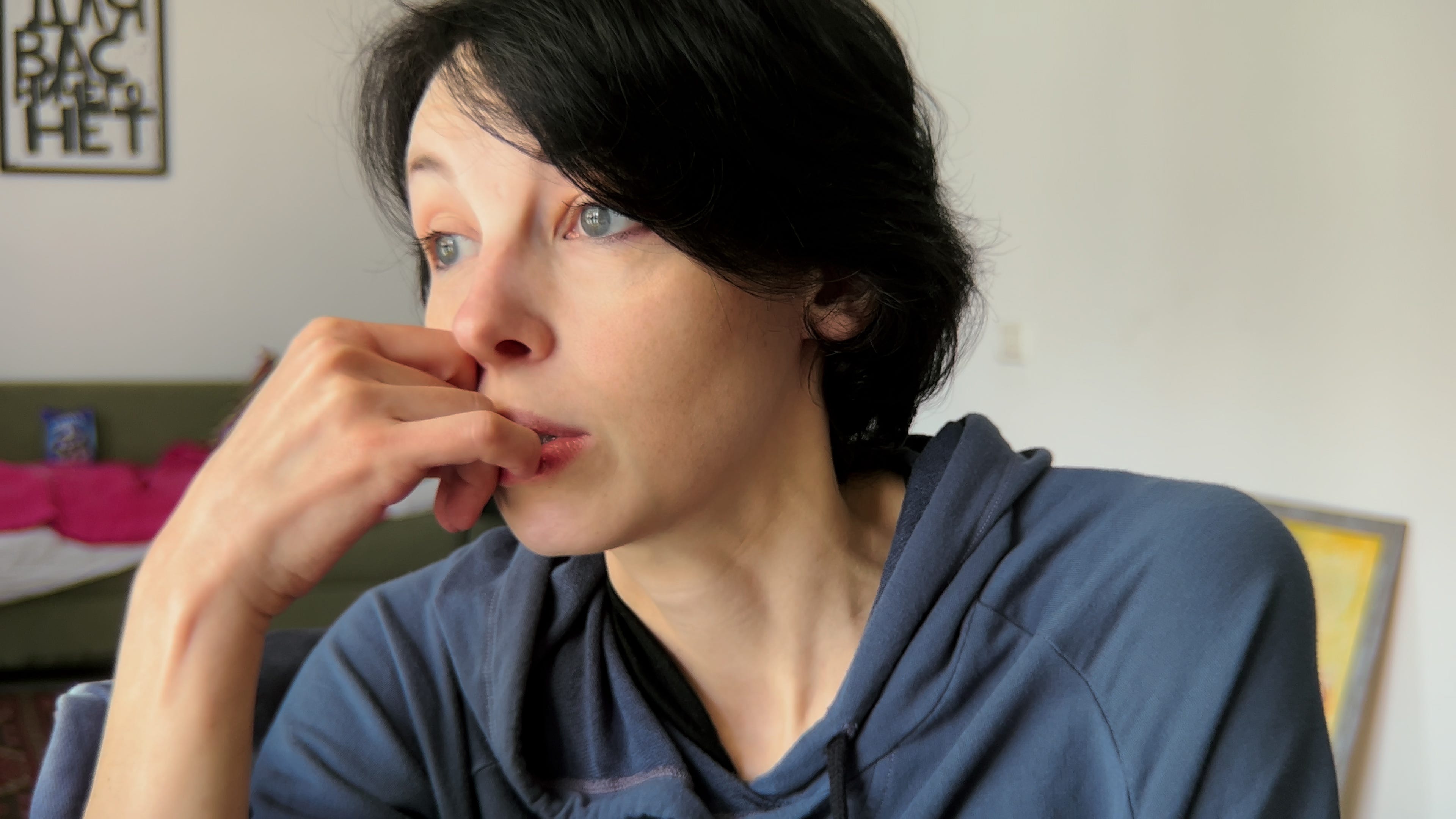
The subjects include Nemzer, co-director of the film, who hopscotches from Israel to Georgia to New York City while trying to raise her young daughter and salvage her strained marriage. Through Nemzer, Loktev was introduced to other people featured in My Undesirable Friends, including Elena “Lena” Kostyuchenko, a long-form journalist and out lesbian who worked at Novaya Gazeta, a leading opposition newspaper, until the war started.
As soon as the war begins, Kostyuchenko travels to Ukraine to report from the frontline. When she learns that Russian soldiers in Mariupol are under orders to shoot her, she and her girlfriend are forced to go on the run — where more danger awaits. “There’s no need for more Navalnys,” a concerned friend tells her. Yet Kostyuchenko longs to return to her country, rather than let Putin and his ilk destroy it.
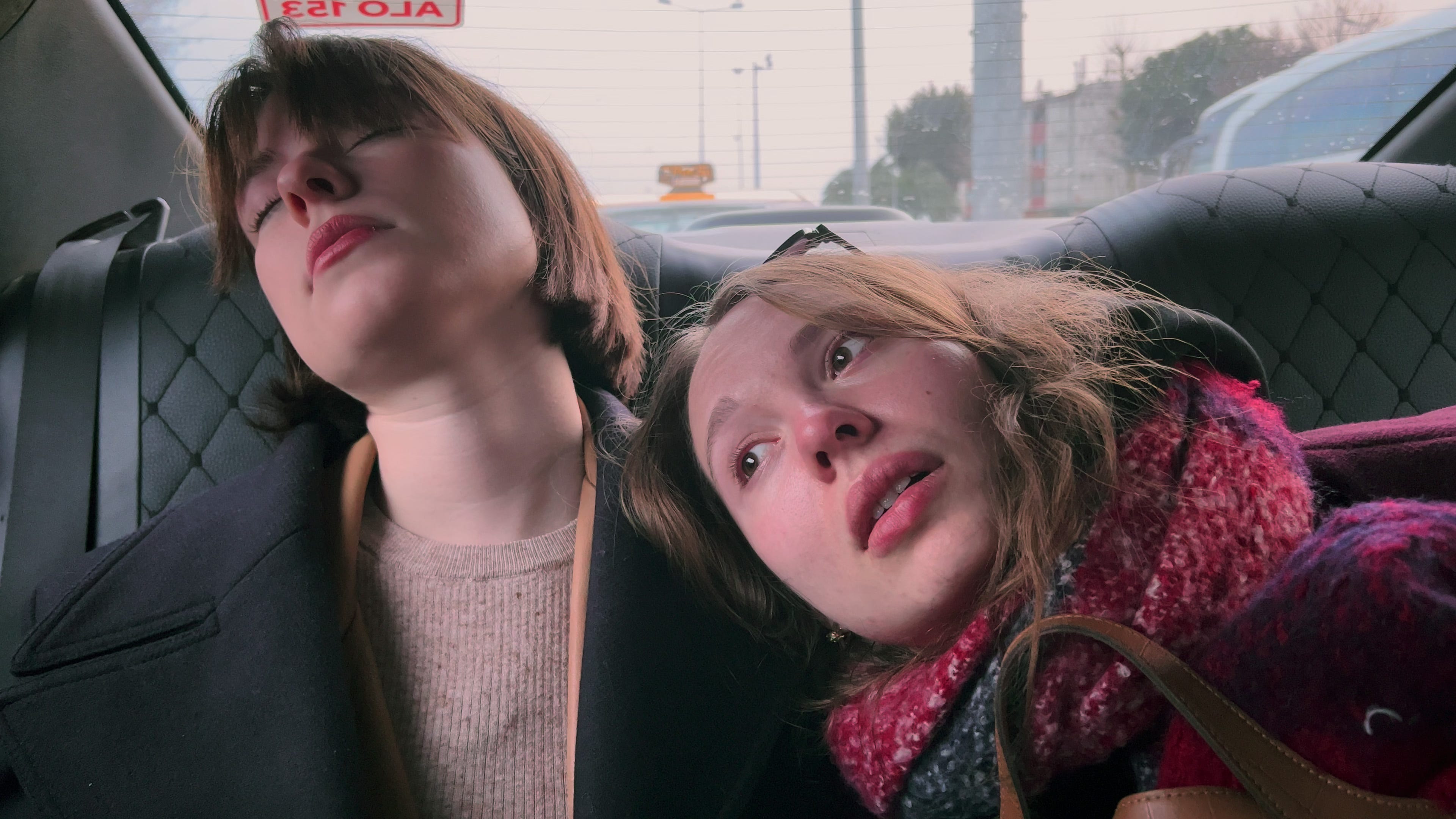
Then there’s Ksenia “Ksysuha” Mironova, a reporter at TV Rain, who initially hopes to stay in Russia to be near her fiancé, a jailed journalist awaiting trial. But within a few hours of the invasion, she is on a plane to Turkey with Valeria Ratnikova, a twenty-two-year-old anchor at TV Rain, who goes by Lera (because this is Russia, and most people have a nickname). She’s awoken at 2 a.m. to a flood of messages telling her to get out of the country.
The co-workers move around repeatedly, heading to Tbilisi, Georgia, then Riga, Latvia, as TV Rain relaunches in exile. The network doesn’t really have an equivalent in the United States, Loktev says, but it had enormous reach when it was still on the air (and still does, despite the efforts of the Russian government, with nearly 5 million subscribers on YouTube).
TV Rain “was the center of opposition life,” Loktev explains. “It was like a public plaza, but it started out as a youth channel that was much lifestyle oriented. But then protests started in Russia, and it became a very political news channel focused on the news.” When opposition leader Alexei Navalny returned to Russia in 2021, supporters watched the event live on TV Rain. “By the time I got to Russia in the fall of ‘21, there were almost no protests in the streets. But you could still go on TV Rain and talk about your opposition to the government — until you couldn’t.”
Now, the channel operates from Amsterdam but is constantly “playing cat and mouse with the Russian authorities” who try to block access to YouTube, Lektov says. Russians can’t repost TV Rain videos on social media, and granting an interview to its journalists is also considered a crime. Watching it in public would be wildly reckless, if not criminal.
“Part of how fascism works… is that it creates these uncertain, blurry areas where you don’t know what you can be arrested for and what you can’t.”
Despite an eye-popping six-hour runtime, the film — which is structured episodically, like a docuseries — is intensely engrossing. (You also can watch without having seen Part I.) Loktev allows the audience time to get to know and care deeply about the subjects. My Undesirable Friends has been called “a hangout film about authoritarianism,” a description that Loktev appreciates. An article in the New York Times might give you the facts about Russia, she says, “But you will have absolutely no sense of what it feels like to live through it, and what it feels like as a journalist, as a person who believes in the truth, to have to flee your country, what it is like for your family, for your friends. That’s what the film was about. It’s living history.”
Filming mostly on an unobtrusive iPhone, which creates a heightened sense of intimacy, Loktev follows her subjects as they wrestle with high-stakes danger but also mundane concerns, such as what to do about a beloved pet chinchilla left behind in Moscow, or setting up a Tinder profile.
Exile “affects everything,” Loktev says. “It’s about marriages falling apart. It’s about people falling in love. It’s about what to do when your parents are back in Russia, and you can’t go back when they get ill because you will get arrested. That’s what exile is made of. It penetrates every cell of your body, and every part of your life.”
While the journalists in My Undesirable Friends face oppression that is far worse than anything their counterparts in the United States have (so far) confronted, there is much that American viewers will recognize in their plight, like having to answer for the heinous actions of their country while also reporting on them. There are frustrating calls with politically brainwashed family members and allegations of “fake news,” all of which feel ominously familiar.
Lektov began making the film early in the Biden era. She and Nemzer wondered if Americans would care about something that seemed so far away, both geographically and politically. “Then the world really caught up with the film,” she says. “So much of what happened in Russia is now being echoed in the U.S.” Loktev points to two recent examples of Putin-like behavior that should serve as a warning sign: Donald Trump’s attempt to ban press from the White House for printing “purposely negative stories” about the administration; and Pete Hegseth’s claim that journalists reporting on classified information are guilty of “treason.”
“Russia did not start out by arresting journalists. It started out by pressuring advertisers. It started out by pulling licenses. It started out by threatening to sue for libel. You have the consolidation of the media and all these different pressures before journalists start getting thrown in jail,” she says. “But how do you know when that tipping point is?”
Meredith Blake is the culture columnist for The Contrarian. The second installment of her newsletter, “Culture Clash,” will arrive in your inbox tomorrow!