


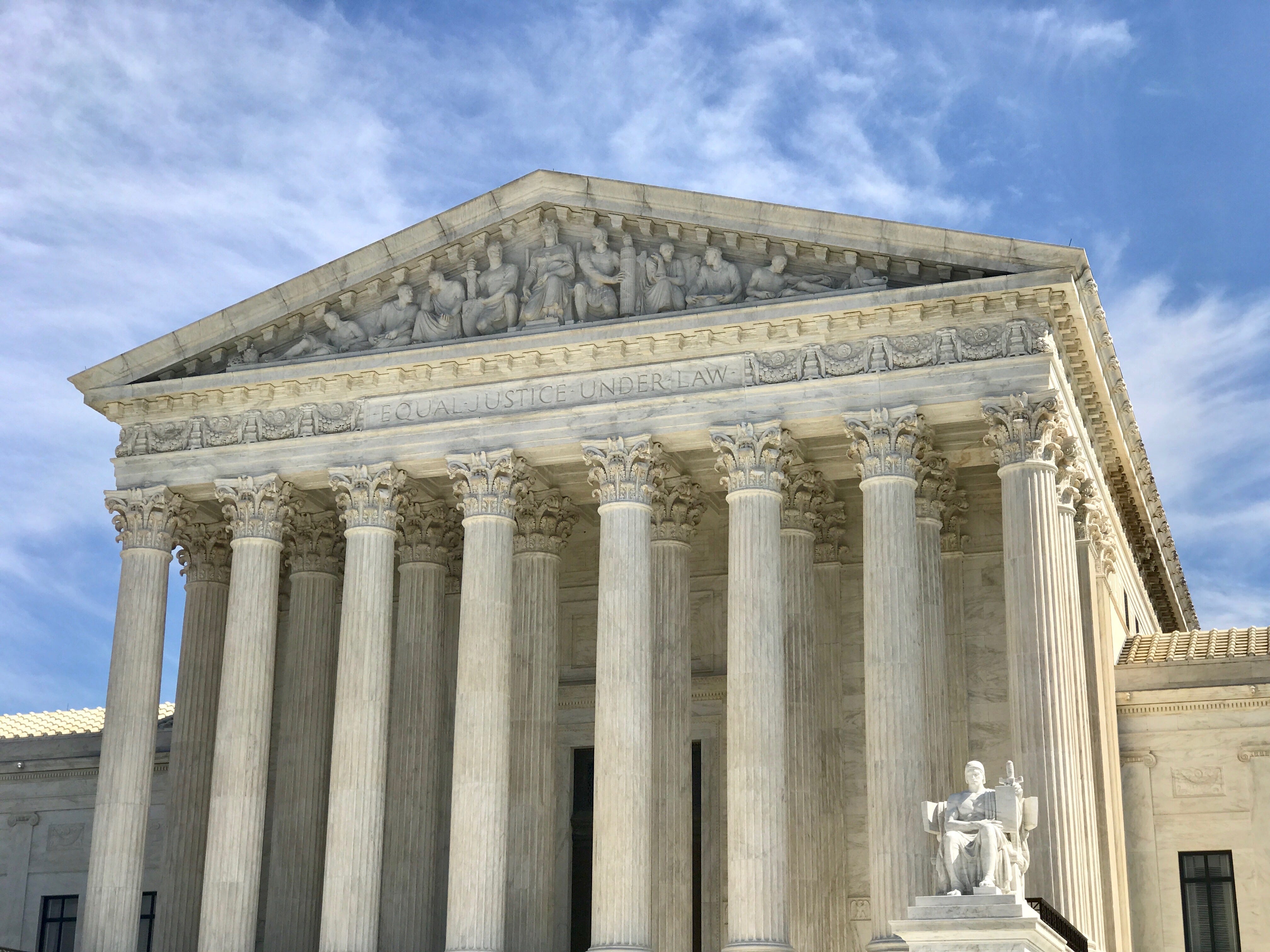
It takes a village to raze a constitutional democracy. Donald Trump and his enablers in the executive and legislative branches are certainly doing their part. But as the dysfunction over the last month makes clear, the Republican appointees on the Supreme Court are also playing a role, not least by further empowering the president. The upcoming Supreme Court term suggests they will be doing even more damage in this area and others.
Democracy & Elections
Polling suggests that voters in the upcoming midterms prefer the Democratic Party by pretty significant margins. Despite that data, there is considerable uncertainty about whether Democrats will gain control of the House of Representatives and the Senate. The Supreme Court will have had a hand in any potential gap between voters’ preferences and election results.
The Court’s 2019 decision in Rucho v. Common Cause eliminated the possibility that the federal courts might constrain partisan gerrymandering — the deeply undemocratic phenomenon in which the political party controlling the state legislature draws districts to ensure that their party remains in power, even if voters do not prefer them to the other party. Then, in April, the Court’s Republican appointees nullified what remained of the Voting Rights Act in Louisiana v. Callais. As a result of that decision, state legislatures initiated unprecedented mid-cycle redistricting that produced even more partisan and racial gerrymandering than did the actual 2020 redistricting cycle.
All of which, SCOTUS has since affirmed, is just fine. The Court greenlighted Texas’s mid-cycle redistricting, initiated after Trump’s DOJ explicitly instructed the state to target majority-minority districts, which they did. In yet another stunning but also unsurprising decision, the Court allowed Alabama to force through a redistricting map that erased a majority-Black district — a map that lower courts had repeatedly concluded reflected intentional racial discrimination.
SCOTUS also shares blame for the general confusion surrounding the upcoming midterms — the fears and uncertainty about what rules will govern voting. Back in August, the Court stayed a lower court decision that had blocked an executive order laying out Trump’s plans for election interference, including a directive to investigate and prosecute any state and local election officials the administration deemed not to be conforming to federal law. Only later did the Court enjoin one of the components envisioned by and called for by the executive order — the Postal Service regulation that threatened to throw out batches of mail-in ballots. It never touched the sections of the executive order that involved threatening election officials.
Unitary Executive Theory: A Catch Me if You Can Executive
The Court has also continued its steady expansion of the presidency, both through a theory of executive power and through facilitating a permission structure for the administration to press ahead with legally dubious policies.
Last term, the Court crowned the “unitary executive theory” king. This is the expansive account of presidential power that maintains all executive power is vested in the president, such that any purportedly restrictive laws are unenforceable and the president can violate them. That was the logic of the Court’s opinion in Trump v. Slaughter, the case that upheld Trump’s ability to fire federal officials in violation of federal law.
Surprising no one, Trump continued to violate laws after the Court issued an opinion saying he had the constitutional power to violate laws. He pressed forward with his project of bulldozing parts of the White House to make room for his desired garish ballroom. No congressional statute authorizes funds to be spent for that purpose, and no statute gives the President that power over the federal property of the White House. Trump proceeded to plow ahead anyways, and the Supreme Court elected to chastise the lower federal courts that tried to stop him.
In yet another shadow docket win for the President, the Supreme Court stayed a lower court decision against the legality of the White House ballroom Congress had not authorized. In that opinion, the Court swallowed hook, line, and sinker the administration’s preposterous national security rationale for the ballroom. Explaining why it was the lower court’s injunction, not the President’s destruction of federal property, that caused the harm, the Court wrote “The government has … presented declarations” from “the Director of National Intelligence, the Director of the Central Intelligence Agency, the Director of the Federal Bureau of Investigation, the Director of the United States Secret Service, and the Secretary of State, the Secretary of Homeland Security, and the Secretary of the Army, among others, attesting to national security and other harms that would likely arise from enjoining” the project. Essentially, the Court telegraphed to Trump: If you recite the magical words national security, we’ll let you do it.
So what did Trump do? He recited the magical words national security to justify projects that probably lack legal authority. Take his plan for a triumphal arch that veterans say will sully Arlington National Cemetery. On that proposed project, Trump declared, “At the strong request of the United States Military, and for National Security purposes, I have agreed to convert the magnificent Triumphal Arch … at the Receptive Circle adjoining the Arlington Memorial Bridge, into a top grade Military Complex/Triumphal Arch” to house a bunch of weapons.
On the subject of weapons ….
There’s More?
Looking ahead to the upcoming term, the Supreme Court is likely to do still more damage.
One of the big cases on the Court’s docket is a challenge to a state law banning AR-15s and other semiautomatic rifles. As the states and advocacy organizations defending these laws have noted, AR-15s and other semiautomatic rifles are often the weapon of choice for mass shooters. When, not if, the Court makes that weapon more readily available, it will partially own the resulting violence.
The Court has several other big culture war cases on its docket — one is yet another case where plaintiffs seek exemptions from civil rights protections for the LGBT community, in their case with a rationale of religious liberty. The Court is also being asked to assess parents’ ability to challenge state laws and policies that make licensed homeless shelters more accessible to transgender youth. To address the crisis of unhoused trans minors, some states decided to require licensed homeless shelters to notify the state child welfare agencies, rather than parents, about runaway children. These state welfare agencies are obligated to provide family reconciliation services, among other resources. But a group of parents challenged the law, arguing that it might allow a trans kid to seek shelter, obtain medical care, and decline family reconciliation services (perhaps because their family will not support them, or their ability to receive medical care). The Court will assess whether the parents are injured by this law — a claim that rests on a speculative set of inferences about how the law might cause one of their kids to run away.
The Court also added several immigration law cases to its docket. It will determine whether to block the Trump administration’s notorious practice of third-country removals, shipping people off without notice to countries they have no connection to and where they may be persecuted or tortured. Making things worse, the Court declared that the administration could continue the policy in the interim, allowing the administration to proceed with a policy that allegedly results in torture while the Court decides whether the policy does in fact unlawfully enable torture.
The Court also added to its docket a case challenging the Trump administration’s novel mandatory indefinite detention policy. The administration’s policy is to indefinitely detain, with no bond hearing, anyone who has been apprehended within the United States, not just people apprehended at the border. The same week that the Court agreed to hear that case, another person died while detained at an Immigration and Customs Enforcement facility.
The Court has still more anti-democratic challenges on the calendar, including a case to decide whether states can require voter-registration applicants to provide satisfactory evidence of citizenship before registering to vote — and whether, if so, they can implement this rule within 90 days of a federal election.
In some ways, the most damning thing to say about these decisions is not the results the Court will reach, though those will certainly be bad enough. It is that there is almost no question that the Court will reach them. We already have a high degree of confidence in what the Court will do: it will invalidate bans on semiautomatic rifles; it will allow institutions to discriminate against LGBT people; it will allow states to make it harder to vote; and it will probably allow parents to pursue some wild, speculative theory that allows them to nullify state laws protecting trans kids. We know this because of what the Court has revealed themselves to be: antidemocratic partisan idealogues. When someone shows you who they are, believe them.
Leah Litman is a professor of law at the University of Michigan, co-host of Strict Scrutiny, and author of the New York Times bestseller Lawless: How the Supreme Court Runs on Conservative Grievance, Fringe Theories, and Bad Vibes.
