


By Norman Ornstein and Thurgood Marshall, Jr.
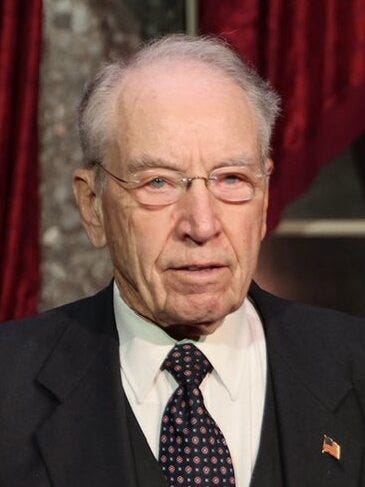
Less than two weeks ago, the nation could have woken up with ninety-two-year-old President Pro Tempore of the Senate, Charles Grassley of Iowa, as our commander in chief. Lost in the clamor over the tumult at the White House Correspondents Dinner is that nearly everyone in the presidential line of succession was in the Washington Hilton Ballroom — the Vice President, the Speaker of the House, and the Cabinet. There was no designated survivor, as we have at the State of the Union messages (and which became popularized with the TV series of the same name). The only one in the line not there was Chuck Grassley. If the attack had been more serious — if they all had been wiped out — the nonagenarian would have been acting president for the next 33-plus months. It is past time to change this process and eliminate the possibility, while bringing presidential succession into the 21st Century.
Grassley, when asked, said he would have been up to the job. Anyone watching the Senate would not be so confident. But, capable or not, this possibility would not be in the national interest. The potential raises again the real issue of continuity of government that has been unaddressed for decades, and which cries out for real reform in presidential succession.
Thurgood Marshall, Jr. dealt with continuity of government issues when he served as Secretary to the Cabinet under President Clinton. Norman Ornstein, in the aftermath of 9/11, helped create a Continuity of Government Commission to deal with the gaps in the Constitution and law involving all three branches, and helped reconstitute the Commission in 2022.
We both know that our current situation is not tenable.
The last reform of presidential succession came in 1947. President Harry Truman had travelled shortly after the war ended to Potsdam, along with his Secretary of State. With no vice president and a still-shaky level of post-war security, Truman felt that reform was needed. In 1886, Congress changed the original line and removed the two congressional leaders, the President Pro Tempore of the Senate and Speaker of the House. Truman felt that if the need came to trigger succession, it would be better to have elected representatives than unelected Cabinet members; the change he proposed flipped them, putting the speaker right after the VP, followed by the Senate figure, and then the cabinet in order of creation of the office. Truman’s rationale was that the speaker is closer to the people, but it was also the case that he had far more regard for Speaker Sam Rayburn than he did for Senate President Pro Tempore Kenneth McKellar.
After 9/11, it became clear that the Presidential Succession Act of 1947 was obsolete, starting with the fact that everyone in the line resides in Washington; the threat of a mass terrorist attack revealed a vulnerability that needed to be addressed. And at the same time, there were serious questions about whether it is either constitutional or wise to have members of Congress in the line of succession. Members of Congress are legislative actors, not a part of the executive branch, while the Constitution specifies that those in the line should be “Officers,” meaning executive officials; the workaround was to require the Speaker to resign from the House (or the Senate Pro Tem to resign from the Senate) to take the post, even if it were temporary, and to be designated as officers.
There were other problems. Congressional leaders could, of course, be from the opposite party of the president — and if the president and vice president were killed or incapacitated, it would reverse the results of voters. At the same time, there were obvious conflicts of interest involved. To pick the most pungent example, when President Andrew Johnson was impeached by the House in 1868, he avoided removal from office by one vote. Among those who voted for removal was Senate President Pro Tempore Benjamin Wade who, because there was no vice president, would have ascended to the presidency if Johnson had been removed.
There was one more glitch. In 1947, there were concerns that Congress might be out of session or the speaker might be far away from Washington, with the need to fill the presidency immediately. To keep the potential of distance from permanently violating the line, the act stated that if a speaker was not available, or declined initially to resign from Congress, that individual at any subsequent point could bump the acting president and assume the office. Of course, that created an immense conflict of interest — a speaker could suggest to the acting president that if he or she did not do what the speaker wanted, the speaker would take the White House job.
The initial Continuity of Government Commission issued a report on presidential succession recommending, among other things, that there be alternatives to the Cabinet outside of Washington, nominated by the president and confirmed by the Senate as officers, and that congressional leaders be removed from the line. The successor commission simply said that congressional leaders should be removed and the line after the vice president should be the cabinet. There were (in both commission reports) additional recommendations about issues like presidential incapacity.
Unfortunately, nothing came of either report or of any recommendations, beyond a number of process and staffing refinements. We continue to be stuck with the 1947 law. Congressional leaders are not eager to give up this potential power and role, and the willingness of the contemporary Congress to deal with a theoretical concern, no matter how problematic the existing system, is nil.
Partisanship and the threat of litigation raise more hurdles, even for something as simple as changing the norm of choosing as President Pro Tempore the most senior member of the majority party — hence the ninety-two-year-old Grassley — to someone better prepared to be president.
The White House Correspondents’ Dinner made it alarmingly clear that we need to revisit presidential succession. If Congress is unwilling to remove its leaders from the line, at minimum, the act should elucidate that first in line after the vice president should be the House leader of the president’s party, and that next in line should be the Senate leader of the president’s party, not the oldest senator in the majority.
The two Continuity Commissions had a wide range of members, spanning both parties and the widest range of ideologies; the recommendations of both were adopted unanimously. Presidential succession is not and should not be viewed through partisan or ideological lenses. Even this deeply divided Congress should be able to deal with this issue once and for all.
Norman Ornstein is a renowned political scientist, co-host of the podcast “Words Matter,” and author of books, including “It’s Even Worse Than It Looks: How the American Constitutional System Collided With the New Politics of Extremism.”
Thurgood Marshall, Jr. is a Corporate Director and former White House Secretary to the Cabinet.

An excellent article. Thank you.
I hate to be that guy, but I'm not losing sleep over the tiny possibility that we lost the whole administration.