

I have heard this language before.
Last week, Defense Secretary Pete Hegseth stood before American service members and proclaimed that American deterrence is back. He celebrated the supposed restoration of the “warrior ethos.” After boasting about American military operations from Venezuela to Iran, he offered the familiar promise: “Peace through strength.”
For those of us who served in Vietnam, these words have an uncomfortable echo. Richard Nixon told Americans in January 1973 that an agreement had been reached to end the war and bring “peace with honor” in Vietnam. Two years later, Saigon fell. More than 58,000 Americans and over 3 million Vietnamese were dead. Generations have endured the consequences.
I’ve learned to be suspicious when political leaders attach reassuring slogans to war. “Peace through strength” sounds good. So did “peace with honor.” Such words do not and did not reflect the reality on the ground. Today, American forces remain embroiled in a war that began seven months ago. In my recent piece, “Trump’s Endless War,” I asked what victory means, how this war ends, and what Americans are dying for. These questions remain unanswered.
Hegseth’s vision of the military is infuriating. Having spent part of my life in uniform, I do not romanticize what militaries exist to do. Strip away the recruiting posters, patriotic music, and euphemisms. The military ultimately has two fundamental purposes: kill and destroy. Every military occupation supports that mission. That is why discipline, standards, and leaders with integrity matter. And it is why the laws governing war matter.
If someone cannot physically perform the duties required of a soldier, Marine, sailor, airman, or any military specialty, that person should not hold that job — male or female, black or white, gay or straight. Set the standards to accomplish the mission, then enforce them. Why must Hegseth wrap that perfectly defensible proposition in adolescent masculinity?
Last year, he ordered combat requirements to return to what he called the “highest male standard only.” This year he proudly reiterated that ethos while describing supposedly gender-neutral combat. He summarized his military ideal: “No fatties, no trannies, no beardos, no weirdos, no wimps, no radicals. Just warriors.” He followed by declaring, “the ideological clowns are out” and “the patriotic cowboys are in, with testosterone testing on top.” That is not the language of a serious leader in whom we should entrust the lives of millions of Americans. It’s locker-room bravado masquerading as military doctrine. This fixation on masculinity could be dismissed as juvenile blather, if he were not describing something so consequential.
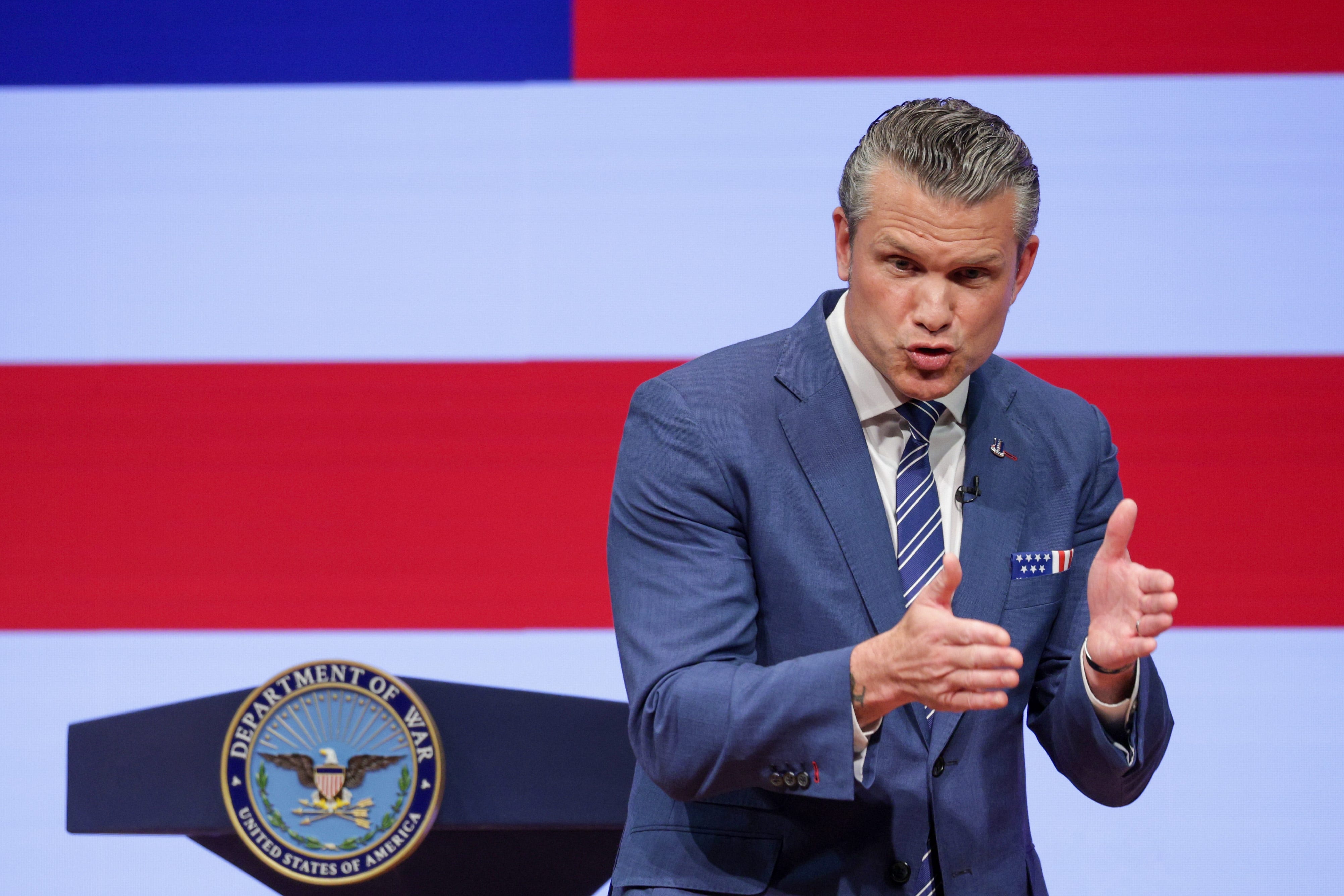
During his self-congratulatory remarks, he also bragged that he had fired roughly 10 percent of generals and admirals, with further reductions forthcoming. Indeed, Hegseth has spent much of his tenure purging qualified senior military leadership.
It’s worth noting that among those removed were Gen. Charles Q. Brown Jr., only the second Black chairman of the Joint Chiefs of Staff; Adm. Lisa Franchetti, the first woman to serve as Chief of Naval Operations; Adm. Linda Fagan, the first woman to lead a branch of the armed forces; and Vice Adm. Shoshana Chatfield, the only woman serving on NATO’s military committee. He cited “loss of confidence” as the cause for removing senior officers. But before taking office, Hegseth made clear his disregard for women in combat, and proposed that admirals and generals involved in “DEI woke” policies should be fired.
Such beliefs made absurd Hegseth’s subsequent comment that “being a racist has been illegal in our formation since 1948.” That is not only absurd given our current climate; it is also a remarkably ignorant revision of US history. What President Harry Truman did in 1948 was issue Executive Order 9981, declaring that there must be “equality of treatment and opportunity” in the armed forces, regardless of race, color, religion, or national origin. The order began the difficult process of dismantling a segregated military. It did not magically eliminate racism from the ranks. It still hasn’t.
The military has spent three-quarters of a century trying (imperfectly) to make Truman’s order a reality. In 1970, Chief of Naval Operations Admiral Elmo Zumwalt issued Z-Gram 66 on equal opportunity. Zumwalt believed the Navy had relatively few racial problems. After listening to Black sailors and their families, he concluded otherwise. And by 1972 — after racial tensions exploded aboard the aircraft carrier USS Kitty Hawk, followed by roughly 130 sailors aboard the USS Constellation, nearly all of them Black, protesting discriminatory assignments and disciplinary practices — no one could seriously pretend that race was not tearing at the fabric of the Navy.
Faced with racial turmoil in his Navy, Zumwalt was willing to put his own position on the line rather than pretend the problem did not exist. He told his lead admirals that it was their responsibility to fix it. “There is no black Navy, no white Navy,” he stated in Z-Gram 66, “just one Navy—the United States Navy.” Who knows what Hegseth would call that. But, as a sailor who served under Zumwalt, I call it leadership.
And yet, Hegseth’s most alarming quality is not his tiresome testosterone rhetoric, ignorance of history, or pathetic obsession with DEI. It is his attitude toward the rules governing war.
Last year at Quantico, Hegseth declared that we “don’t fight with stupid rules of engagement,” and promised to replace “politically correct and overbearing rules” with “maximum lethality.” Last week he celebrated the result — commanders with their hands united and American forces “unleashed.” Those words should frighten us.
Rules of engagement are not the same as the laws of war, but both exist for reasons written in blood. Rules of engagement tell our forces when and how they may use force. Laws of war establish boundaries that neither a president nor a secretary of defense can wish away based on personal ideology.
Distinction between combatants and civilians, proportionality, and taking reasonable precautions to protect civilians are not driven by political correctness. These principles exist because war unleashes human beings — armed with enormous destructive power — into circumstances filled with fear, confusion, rage, and vengeance. My Lai should have taught us that. Abu Ghraib should have taught us that. Haditha should have taught us that. Kunduz should have taught us that. The lesson gleaned from those locales is not that our military cannot be trusted. It is that we should never place American service members in situations under political leaders who treat restraint, discipline, and the law as impediments to killing people.
Hegseth invoked the 1991 Gulf War as a model of American military success. Fine. Let’s learn from it.
Gen. Colin Powell believed that if the United States went to war, it should have a clear political objective, public support, overwhelming force, and an exit strategy. In 1991, the US assembled an enormous international coalition, deployed overwhelming military power, expelled Saddam Hussein’s forces from Kuwait, and achieved its set objective. And then we stopped. The air campaign and ground war had lasted for 43 days. Once the military objective had been achieved, Powell and Gen. Norman Schwarzkopf recommended ending the fighting. President George H. W. Bush later recalled Powell telling him, “Mission accomplished. Stop the killing.”
The 1991 Gulf War is memorable because it is the exception. We possessed overwhelming military power in Vietnam. It did not produce the outcome we sought. We possessed overwhelming military power when we invaded Iraq in 2003. Saddam Hussein’s government collapsed in weeks; then came an occupation, an insurgency, sectarian violence, and years of war. We possessed overwhelming military power in Afghanistan. The Taliban government fell in 2001; twenty years later, American forces withdrew, and the Taliban returned to power.
In each case, American forces demonstrated that they could kill and destroy with extraordinary effectiveness. What military power could not do was produce the political outcome our leaders promised. There was no exit strategy. That distinction matters.
Winning battles is not the same as winning wars. Destroying an enemy’s military capability is not the same as achieving a political objective. Overwhelming force does not guarantee strategic success.
Trump and Hegseth began the war in Iran with rhetoric about our extreme military power. Hegseth boasted about annihilating Iran’s capabilities and about American dominance of Iranian airspace. Seven months on, we are still fighting. That is the difference Hegseth conveniently leaves out when he invokes 1991. Iran demonstrates that force is not a substitute for a clear political objective and an exit strategy.
Hegseth can tell us how much we have destroyed. He can tell us how lethal our military has become. He can tell us how Iran’s conventional forces have been battered. But he cannot answer the most important question: Why are we still at war?
Since my service in Vietnam, I have spent much of my life working on the causes, conduct, and consequences of war. That has taught me lessons Pete Hegseth should understand…but doesn’t. Lethality is not a strategy. Masculinity is not leadership. Cruelty is not strength. And removing restraints from warfare does not make America safer or its military greater.
A strong military requires warriors capable of rigorous discipline — and violence when their country lawfully asks it of them. But precisely because we give young Americans the power to kill, we owe them something more than slogans about cowboys, testosterone, or “maximum lethality.” We owe them lawful orders. We owe them leaders who understand restraint. We owe them missions worthy of their sacrifice. And before another president or defense secretary promises us “peace through strength,” Americans should remember that empty promise made more than half a century ago: “Peace with honor.”
Having lived through what came after those words, I no longer judge our leaders by the slogans they use to sell a war. I judge them by whether they know how to end one.
John F. Terzano is an attorney and social justice and human rights advocate who co-founded Vietnam Veterans of America Foundation (VVAF), an international advocacy and humanitarian organization. Terzano currently lives in Ludington, Michigan, where he continues to work as a social justice and human rights advocate, both locally and globally.
How much money has the Trump Crime family, which includes Netanyahu, Kushner, Lutnick, and Witkoff, made off waging war against Iran with our military? What benefit have "We the people" obtained from waging this war? How many of our soldiers have been killed? How much are we paying daily to park our airplanes, aircraft carriers, and divisions of soldiers half a world away from defending our homeland? How many innocent Iranian citizens, young girls and boys, have been murdered by our undeclared war on their cities, schools, hospitals, and homes?
Anybody? As Americans, we now just sit around and grumble while we have an illegal and murderous regime in power in our country. This regime is murdering people in boats and bombing other countries, abducting foreign Presidents for ransom, and then waging war because...? And this is when I can't complete the sentence because we are now waging war for the same reason Putin wages war. This has to stop one way or another. If not, in 50 years we'll have another American war (Vietnam) veteran writing online like me, and complaining about the current useless war started by some cowardly American President who makes a ton of false claims to create war and, in the chaos, steal foreign resources and property all for their personal profit. I am so sick of this unending cycle of greed and murder.
Threatening to annihilate a population after murdering its leaders doesn't sound like peace to me. Trump and Republicans are nothing but empty slogans.