


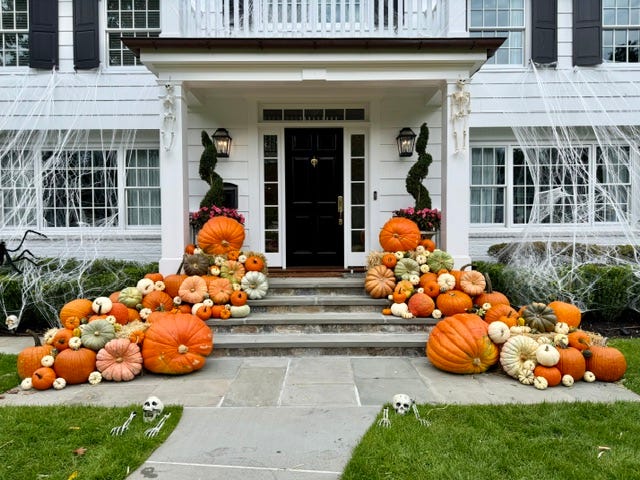
In 2009, McSweeney’s published an article with the unforgettable headline “It’s Decorative Gourd Season, Motherfuckers.” The piece used salty language to parody the enthusiasm many people feel as fall arrives, and the cozy, comforting, curious rituals they associate with this time of year.
Seventeen years later, the essay remains the most-read article on the McSweeney’s website, suggesting that aggressive enthusiasm for fall is widespread — and that “decorative gourd season” has turned into serious f*cking business.
At a time when many Americans are struggling to pay for groceries, residents of affluent enclaves like Pasadena and Park Slope are getting to the autumnal spirit with elaborate pumpkin arrangements on their stoops, porches, and entryways. In response, entrepreneurs are launching “pumpkin concierge” businesses, delivering to customers willing to pay hundreds and even thousands of dollars for meticulous, highly Instagrammable squash installations.
In the New York City area, companies like Stooped and Platinum Porches deliver and arrange dozens of pumpkins in visually appealing displays. In Southern California, there’s The Curated Pumpkin, “a concierge pumpkin delivery and design service” catering to LA and Orange County.
“There’s a lot going on in the world, right? I think this just brings a sense of comfort and hominess,” says Lynn Aglipay, who founded The Curated Pumpkin with her friend, Jackie Enriquez. Pumpkins “bring in that family, seasonal, come-together type of feel, and I think that’s super important right now.”
Gia D’Onofrio, founder of Platinum Porches in Westchester County, New York, compares the pumpkin concierge business to Christmas light installation — another seasonal activity that people with means are choosing to outsource to professionals.
“If ten years ago somebody told me they had hired somebody to put their Christmas lights up, I would have thought that was crazy,” she says. “Now I have a guy that puts my lights up.”
D’Onofrio launched her business two years ago and delivered pumpkins to more than 100 clients this year. She works with farmers in the tri-state area to source unique varieties like the Pink Doll and the Green Eggs and Ham.
Like all the pumpkin-preneurs I talked to, she was inspired by Heather Torres, a Texas mom who turned her passion for harvest-themed decor into the business Porch Pumpkins in 2020.
“She made such beautiful displays. I was like, ‘Is there anybody here in Westchester who does this?’” D’Onofrio says.
Torres now delivers packages ranging from $350 to $1650 a pop to more than a thousand clients in Dallas, Fort Worth, Houston, and Austin. She also coaches other aspiring pumpkin magnates, charging $4000 for a two-hour session.
After seeing images of Torres’s pumpkins online, Dvorah Leah Schneerson launched Stooped, a pumpkin business in New York City, this year. An entrepreneur who also does high-end custom balloon displays, Schneerson saw a void in the market.
“I kept seeing these poorly styled pumpkins. Every third house in New York had a little pile of pumpkins by their door. For lack of a better term, they were just lame,” she says. “You don’t need any sort of a background. All you really need is hustle and an artistic eye.”
The porch-pumpkin craze is part of a growing passion for fall festivities, particularly Halloween. A generation ago, it was rare for Americans to commemorate the holiday with more than a crudely carved jack-o-lantern or some witch decals in the window. But in recent years, spooky-season decoration has turned into a competitive pastime, similar to Christmas light displays.
According to the National Retail Federation, Americans will spend a record $13.5 billion on Halloween costumes, candy, and decorations this year, up from $8 billion in 2019. The following year marked a turning point in the history of Halloween novelties: that’s when Home Depot introduced “Skelly,” a $300, 12-foot-tall skeleton that quickly sold out across the country and sparked what CNBC has called “a retail arms race of increasingly elaborate creatures.” Some people leave their Skellies outside all year, dressing them in Santa and leprechaun costumes. Still others use them to stage meticulous recreations of the greatest moment in Knicks history on their lawn.
As Fordham University professor Timothy Malefyt told CNBC, “Giant Halloween displays are directed outward towards a public, and the front lawn becomes a stage, the homeowner becomes a producer, and neighbors and passersby become the audience.” Similar forces are driving the porch-pumpkin boom — namely, the urge to turn one’s home into a destination and a social media backdrop.
This naturally leads some people to up the ante. “This year, a lot more people pulled the trigger,” says D’Onofrio. “And people who bought packages last year upgraded because they thought ‘I don't need 35 pumpkins on my stoop,’ but decided, ‘Actually, it would look better if there were more.’”
Enriquez of The Curated Pumpkin says they arranged 250 pumpkins in the entryway of a lavish home in Thousand Oaks last year. “That was probably the most elaborate one so far,” she says.
As “It’s Decorative Gourd Season, Motherfuckers” captured so well, fall inspires a level of passion that few people feel about, say, spring.
Some influencers have made “autumn” their entire brand. The pumpkin spice latte, which was first introduced by Starbucks in 2003, is the company’s most popular seasonal beverage, and triggered a slew of imitations and a craze for pumpkin-spice products whose arrival on grocery shelves marks the onset of fall. Hordes of leaf-peepers flock to New England every year to check out the (possibly endangered) red and gold fall foliage which, according to The Boston Globe, soothes our brains because it symbolizes abundance.
In New York, “Fall is a happy time. It’s after the horrible heat, and we’re so happy to see the change of colors,” says Schneerson, who installed more than 40 displays in her first season of operation and estimates the average cost at about $800. “We go from extreme to extreme, we have seasons, and people love to celebrate it.”
Fall may be cozy, but the pumpkin business is labor intensive, messy, and involves a steep learning curve.
Schneerson recalls how she recently loaded hundreds of pumpkins — enough for a dozen or so installations — into a minivan with the seats removed. When they attempted to start the vehicle, it wouldn’t move.
“It was too heavy,” she says.
Meredith Blake is the culture columnist for The Contrarian