


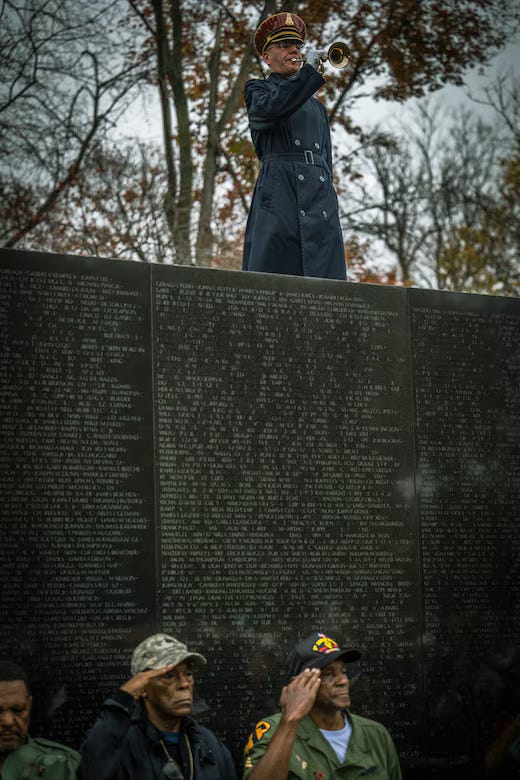
Most years, I skip reading the patriotic-holiday editorials that fill the print/broadcast media and digital airspace. Not because I lack gratitude for veterans, for those killed in combat, or for the generations who built our country. I skip them because such messages often get bent into platforms for somebody’s political argument.
Yet here I am, offering a partisan point on a solemn holiday, Veterans Day. But this year I find it difficult to pretend the context doesn’t matter: Many of the people we say we honor are serving under an administration that has been cutting down senior, combat-tested officers for partisan reasons. That isn’t abstract and it isn’t routine civilian control—it’s a purge we’ve been watching since February, and it deserves to be highlighted even on a day when I would rather just say thank you to those who served.
And this purge continues. In the past few weeks alone, Maj. Gen. James Patrick Work, the former 82nd Airborne commander who was slated to be deputy at the U.S. Central Command, which oversees troops in the Middle East, was pushed to the sidelines because, or at least suspected by many, he worked for the Donald Trump-loathed former chairman of the Joint Chiefs of Staff Mark Milley; Adm. Alvin Holsey, the four-star general running U.S. Southern Command, was pushed out after he questioned the administration’s boat strikes in the Caribbean; Lt. Gen. Jeffrey Kruse, the director of the Defense Intelligence Agency, was forced out after his analysts wouldn’t validate Trump’s claim that strikes in June “obliterated” Iran’s program; Rear Adm. Milton Sands, the Navy SEALs commander who backed bringing women in as instructors, was removed after a DEI-flavored pile-on; Lt. Gen. Douglas Sims II, the Army’s choice to lead its Forces Command, the service’s largest component and responsible for training and operational readiness, saw his promotion blocked—another action linked to being “too close to Milley”; and Gen. James Mingus, the Army’s vice chief of staff and a key driver of the service’s readiness doctrine in an Asia/Pacific conflict, was abruptly sent to retirement.
These, again, are not one-off corrections; it’s a political test applied to the people the services were counting on next.
I’ve written before that removing commanders without cause and installing loyalists is not “civilian control,” it’s politicization—and that silence from retired leaders has only encouraged it. The throughline hasn’t changed: month after month, the firings have continued, unaccompanied by real justification, and I fear that the absence of a collective response has been read in the West Wing as permission.
When you pair that with the administration’s habit of staging the military as backdrop—parades, loyalty-pageants, renaming schemes—you don’t see an armed forces revered by a president for its unselfish sacrifice; you see a military that Trump treats as a prop to shore up his insecurity and mask his shallowness. I said that about the June parade down Constitution Avenue for the Army’s 250th anniversary that was also keyed to President Donald Trump’s birthday; it’s still true.
What lands hardest for me isn’t the policy dispute, it’s the corrosion of trust inside a profession that runs on it. These are people who’ve spent decades of their adult lives—some joining the military in their teens—learning to tell civilian leaders the thing they don’t want to hear, and now they’re watching peers get punished for doing exactly that. You can replace billets; you can’t easily rebuild the quiet confidence that lets officers speak candidly in crisis. And that damage doesn’t show up in any org chart.
That’s not an abstract worry for me; it’s the world from which I came out. I’m a veteran, as were my father and grandfathers. For us it wasn’t a brand, it was just what you did. I didn’t raise my hand because I was inspired by the commander in chief—it was duty, nudged a bit by a few Hollywood war characters—and I tell my students at Georgia Tech the same thing: If you want to serve—in uniform or in the intelligence community, do it. Do it even now, when the environment feels rigged and politicized and more about proximity than merit. We will need people who remember that the oath is to the Constitution when this particular phase is over. The worst outcome would be to let the people who most believe in nonpartisan service get chased out of public life.
The hard part on a day like today is avoiding politics when politics has already been shoved into the ranks. I don’t like using Veterans Day for that either. But when a commander in chief and a Defense secretary spend the year sidelining combat-tested officers because of who they once worked for and when senior billets are treated like party jobs, the line has already been crossed from their side. Naming that isn’t exploitation—it’s standing up for the people we thank on this day.
The veterans most of us admire don’t wear their service like campaign merch. Maybe there’s a flag over the garage, maybe a unit coin on the desk. What they don’t do is turn a borrowed uniform into a TV costume or proclaim they’ve earned bona fides just because they watched a military parade roll past. That quiet kind of service—done without a camera crew, without the need to rename the holiday, without purging everyone who told the truth—is the one worth elevating today.
Last Tuesday’s elections will be read as another referendum on Trump, and there’s truth in that, but voters were still reacting to rent, taxes, and basic affordability—the things right in front of them. Former Speaker of the House Tip O’Neill’s point still holds at that level: All politics is local. Veterans Day ought to remind us of something parallel: All service is personal. It’s a choice made by an individual and a family, not a president. If we can keep that straight—that the oath outranks the office, and the institution outranks the performance—then what’s being done to the senior ranks right now can be repaired. But only if the people who know better stay in, speak up, and refuse to let this become the new normal.
Brian O’Neill, a retired senior executive from the CIA and National Counterterrorism Center, is an instructor on strategic intelligence at Georgia Tech. His Safehouse Briefing Substack looks at what’s ahead in global security, geopolitics, and national strategy.

The day Pete Hegseth had all the military brass show up in Virginia that day was a stain on our country. He made a fool of himself when he has far less military experience than any of them. His rant made him look like a total jackass. I can’t even imagine what those guys in uniforms were thinking. It was so embarrassing. Such petty bullshit from a nobody secretary of “war”.
And just think, all of these highly-trained members of our military were kicked out by a cowardly draft dodger with no morals, no brains and no sense. What a country!