



At this American Celebration time, masses will visit the National Archives to see our founding documents, originals under bulletproof glass. Those who examine the Constitution, across several cases, will see clearly the Framers’ intent. Article I, on the Congress, is detailed in its descriptions of elections and powers, and is twice as long as Article II, on the Executive, which in turn is twice as long as Article III, on the Judiciary. Length alone does not fully describe the reality that Congress is first among equals in our three branches.
Among its powers are the key ones of any government: the power of the purse, to tax and spend, and the power to declare war. A president can veto bills passed by Congress, but Congress can override the vetoes, and the president cannot override the override. The Senate has the power to accept or reject treaties made by a president, and to accept or reject nominations for executive or judicial offices. Congress can remove a president through impeachment; a president has no power to remove members of Congress. And Congress has immunity from executive harassment.
As for the judiciary, the Constitution gives very limited original jurisdiction to the Supreme Court and gives Congress the power to decide what additional jurisdiction or roles it should have, including the power to decide the size of the Supreme Court — and to create other federal courts. And, of course, Congress can impeach and remove judges and justices.
These truths should be self-evident. But not to the Roberts Court. In a series of arrogant, ahistorical, anti-Constitutional decisions, the Supreme Court has arrogated to itself the power to defang Congress, undermine democracy, and unleash a corrupt, power-hungry, vindictive president with dictatorial powers (and few, if any, constraints), destroying the delicate checks and balances foundational to our political system.
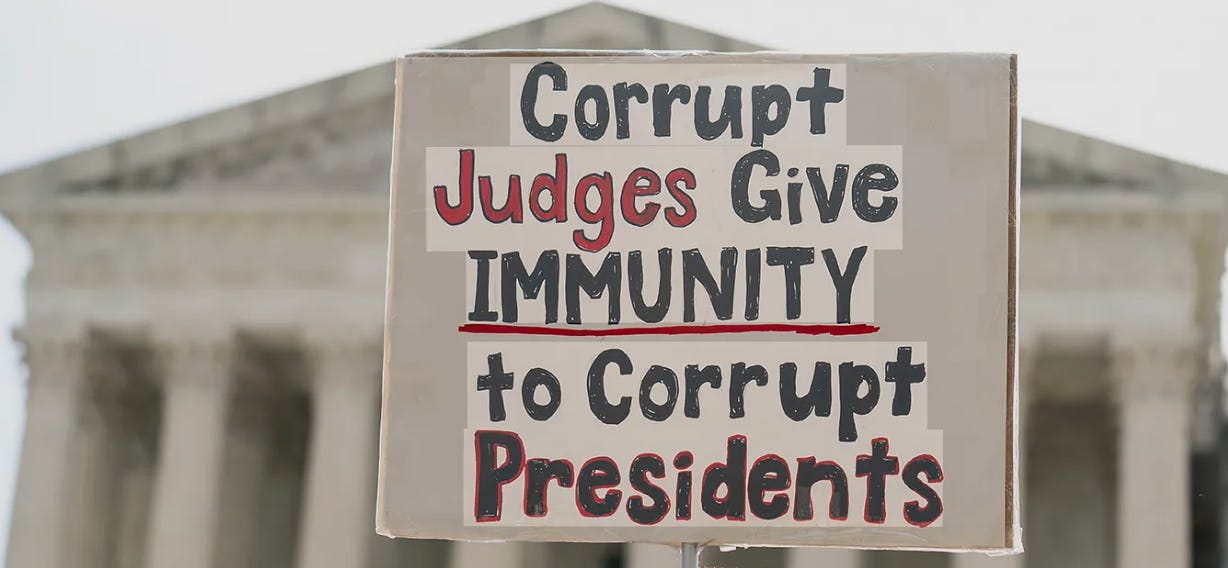
The immunity decision was perhaps the most shocking. We went for well over 200 years evolving under presidents constrained by laws and traditions not to use official powers to corrupt or endanger people or law and order. On the occasions when they did — see Nixon, Richard — the system of checks and balances responded, both Congress and the Supreme Court. The reaction of Trump when Trump v. United States was announced — glee at being granted absolute power — revealed how reckless, misguided, and anti-constitutional it was.
That was compounded by Slaughter v. Trump. By enabling a president to fire at whim members of independent regulatory commissions who had been confirmed for fixed terms by the Senate, the Court effectively destroyed the independence and balance of these commissions, the first of which was the Interstate Commerce Commission, created in 1887. The numbers were expanded under President Teddy Roosevelt in 1912 and 1913 with the creation of the Federal Reserve and the agency the Roberts Court just eviscerated, the Federal Trade Commission.
These agencies and others, from the Federal Communications Commission to the Securities and Exchange Commission and the National Labor Relations Board, were crafted with a delicate balance by presidents and Congress; independent, but with commissioners nominated by presidents and confirmed by the Senate, with a partisan balance and the ability of a president to remove only for cause. No longer. Even more unsettling, by flatly asserting that the president had total control over the executive branch, the Court threatened the existence of a career civil service and set the stage for a return to the spoils system that had plagued the country until the Pendleton Act of 1883 created the merit-based system that has been in effect for over 150 years.
Now, the powerful commissions, which include the Federal Communications Commission, can be used by presidents to intimidate, punish, and coerce people, corporations, and other entities; and the Securities and Exchange Commission, which can now give a free pass to insider trading by Trump cronies. Even before this awful decision, the chair of the FCC, Brendan Carr, misused his power to threaten broadcast entities and relax rules on behalf of Trump and his allies. Ironically, in an Alice in Wonderland twist, Justice Neil Gorsuch used Carr’s thuggery to justify giving Trump more unleashed power at the expense of Congress and decency.
This decision (blowing up the ruling in Humphrey’s Executor, which had ruled for 90 years) followed a 2024 decision, Loper Bright v. Raimondo, which overturned the Chevron doctrine. In a different galaxy, championed by Justice Antonin Scalia, this required judges to give deference (in regulatory decisions) to the expertise of agencies, as long as they followed the Administrative Procedures Act, showing careful and diligent work. Instead, the decisions could be made by judges alone, with no expertise, and enabled corporations to judge-shop to get favorable rulings.
The expansion of presidential power — and the overweening judicial power that engendered it—has come at the expense of the First Branch. But other decisions made by John Roberts and his cohorts have also undercut Congress while empowering corporations and billionaires. Monsanto v. Durnell, involving the pesticide Roundup gave chemical and agriculture companies protection against lawsuits claiming their products caused cancer or other ailments; an earlier decision, AT&T Mobility LLC v. Concepcion, denied the possibility of a consumer class action from abuses by companies in the fine print of contracts, forcing individuals to use arbitration instead of the courts.
Then there is campaign finance. John Roberts said in his confirmation hearing that he wanted to avoid 5-4 decisions and aimed to get to 8-1 or 9-0 by relying on stare decisis. It did not take long for that to be proven a lie. The landmark Citizens United was a narrow case, brought on an as-applied basis, to enable the group to air its anti-Hillary Clinton film as a documentary free from campaign finance law regulating campaign messages. Instead of deciding it on that basis, Roberts and his allies pulled it back to broaden it — without any request from the plaintiffs and without briefs or hearings — and redo it in a way that would subvert over a century of established campaign law.
Roberts then produced a majority that not only upended the Bipartisan Campaign Finance Law that only recently had been affirmed (before Justice Sandra Day O’Connor retired), but also changed many decades of law that had blocked corporations from giving money directly to candidates, thereby opening up more avenues for big money to dominate elections, putting no limits on what corporations, unions, and wealthy individuals could use for political ads “independent” of candidates. The result was an explosion of “Super PACs” and the sharply expanded involvement of billionaires using dark money to influence elections and policy.
That was followed by McCutcheon v. FEC, in which the Court removed limits on overall spending, allowing ultra-wealthy donors to write multi-million-dollar checks to joint fundraising committees, crowning the wealthiest donors the kingmakers in our politics and elections. And now a new one, NRSC v. FEC, blew up a 50-year precedent limiting coordinating spending between parties and candidates.
The result? Another gift to billionaires, allowing them to bypass direct candidate contribution limits by transferring hundreds of thousands of dollars to party committees, which can channel funds directly to candidates. Are there any checks on this, or any meaningful regulations of big, dark money domination? Thanks to the Slaughter decision, the feckless Federal Election Commission, which is the regulatory authority, is even more feckless—and can be weaponized by Trump to harass and crimp Democrats while giving a free hand to Republicans.
Of all these moves to undermine Congress and democracy, none are more serious than the repeated Roberts Court attacks on voting rights. It started with the egregious Shelby County v. Holder, where Roberts used a remarkable display of faulty logic to take away a key component of the Voting Rights Act, Section V, which required pre-clearance by the Justice Department for voting jurisdictions to change voting laws if they had shown a clear pattern of racially-based discrimination. Roberts’ rationale was that while there had been discrimination, it was no longer present, so Section V was no longer needed.
Justice Ruth Bader Ginsburg likened the logic to closing one’s umbrella during a driving rainstorm because you were dry under the umbrella.
The day after Shelby County came down, Southern states and counties leapt in to implement more discriminatory laws, which had no impact on Roberts. The Voting Rights Act had first been passed in 1965 after decades of Southern segregationists in the Senate using filibusters to block civil rights legislation. It was reauthorized numerous times, most recently in 2006, reauthorizing preclearance for 25 years after extensive debate, hearings, and fact-finding. The 2006 reauthorization passed the Senate unanimously and in the House by 390-33. Roberts gave that congressional mandate the middle finger. And waited to go even further.
Five years ago, in Brnovich v. Democratic National Committee, Alito and five others upheld two Arizona voting restrictions that banned the collection of absentee ballots by third parties and discarded ballots cast in the wrong precinct. It took a devastating swipe at Section II, with Alito rewriting the law to fit his viewpoint, proposing that just because a law creates a “disparate impact” on minority voters, it did not justify striking it. This made it harder to challenge racially discriminatory state-level voting restrictions in federal court.
The recent Louisiana v. Callais ruling effectively killed Section II, making it clear that if there were any other pretext for voting restrictions, such as partisan gerrymandering (which the Roberts Court gave a green light to in Rucho v. Common Cause), it did not matter if the result was racially discriminatory.
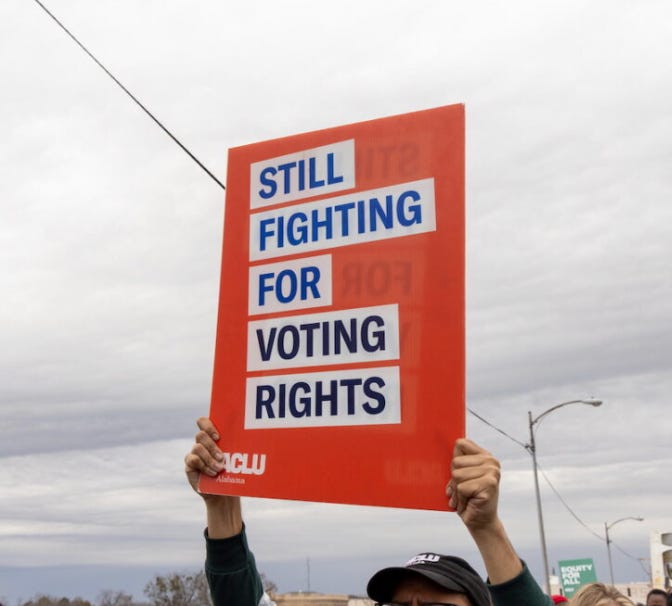
Louisiana had begun early voting under a map created after a Section II challenge that enabled two majority-minority districts. But though the Roberts Court had invented a “Purcell principle” (that no ruling should take effect close to an election — which it applied when Democrats won challenges to discriminatory maps), that “principle” was discarded to disallow votes already cast and use their prejudicial map for 2026. The most outrageous blow came two months later, in June. Even though multiple lower courts had offered voluminous evidence that Alabama had created a map explicitly designed for racial discrimination, meeting the steep standard of Callais, the Roberts Court cast aside its own standard to allow the map to be used in 2026.
After such a slew of decisions to end the Court’s term, the one that captured the most public and press attention was birthright citizenship, where — on the surface — 6 justices upheld the right. But underlying that decision was another troubling reality. Even though the Constitution and history made the right clear, four justices denied the plain language of our founding document, contorting it to fit their worldview.
A Supreme Court that flagrantly contorts decisions to geld Congress, flexes its self-aggrandizing Article III powers, and advances an extreme “unitary executive theory” that has no basis in the Constitution or the view of the Framers needs to be reined in. It is up to Congress to use its legitimate Article I powers to do so.
Of course, there are reforms on the table, starting with expanding the court to 13 members to represent the 13 circuits (there were nine when the court size was adjusted to that number). Term limits are less controversial but also a powerful antidote — especially if they start immediately, moving all those who have served for whatever single term is set — 18 years if the court has nine members; 26 if it is expanded. But there is another, more far-reaching change to consider.
That is returning the Supreme Court to the original jurisdiction the Framers established. They did not see the Supreme Court as all-powerful, arrogating to itself key legislative powers and making Congress an inferior branch. That original jurisdiction was established to enable the Supreme Court to settle controversies between states, between citizens of different states, and between states and foreign entities or persons. Here is the key clause:
In all Cases affecting Ambassadors, other public Ministers and Consuls, and those in which a State shall be Party, the supreme Court shall have original Jurisdiction. In all the other Cases before mentioned, the supreme Court shall have appellate Jurisdiction, both as to Law and Fact, with such Exceptions, and under such Regulations as the Congress shall make.
In other words, Congress can take away the Supreme Court’s appellate authority in whatever areas it wants, except the narrow ones defining original jurisdiction. This includes regulating commerce, defining or adjudicating congressional and executive powers, voting rights and elections, individual rights, and more. Congress can create a new appellate court to handle those areas, perhaps one consisting of the chief judges of all the circuits. And Congress needs to mandate a stiff, meaningful code of ethics for the Supreme Court, including creating an Independent office consisting of former judges and legal ethics experts who would recommend sanctions for violations, with the judicial conference required to explain in detail if the recommendations are rejected.
We have a rogue Supreme Court, and it is time to consider more sweeping actions to restore the balance among the branches.
Norman Ornstein is a renowned political scientist, frequent Contrarian contributor, co-host of the podcast “Words Matter,” and the author of books, including “It’s Even Worse Than It Looks: How the American Constitutional System Collided With the New Politics of Extremism.”

Very informative and well researched article. Unfortunately, you’re preaching to the choir. Not a single MAGA (even the few that can read) or republican will ever read or understand this.
What a well written article. Thank you for laying out the actions of the Robert’s court so clearly.