


Gas prices are soaring. It costs more and more to feed a family. And university commencements across the country have just sent waves of new graduates into a job market that doesn’t have room for them. The University of Michigan measures consumer attitudes and finds that sentiment currently sits at 48.9 — lower than at any point over the past 50 years.
When the economy wobbles like this, we expect our political leaders to act and make changes to relieve the pain and quell kitchen-table anxieties. But what happens when our political system is set up in ways that actually impede the ability to make economic improvements?
We need to — and can — build support for changes that would allow decisionmakers to act responsively and responsibly to address economic difficulties.
At the FrameWorks Institute, we conduct in-depth research on culture and communications, revealing the nuanced ways people think, which are key to developing narrative strategies that spur action. In our most recent report, we examine how people are thinking about our political and economic systems as we slide closer and closer to authoritarianism. We are seeing, though, that certain mindsets — deep, shared patterns in thinking — are roadblocks to the economic and political change we need.

Where We Were and Where We Are
While economic inequality is not new in America, there have been numerous points in our history when the United States has had notable wage growth and sustained economic expansion, giving a large number of Americans buying power and optimism.
Today, however, as Americans are experiencing persistent economic struggles, workers want someone — anyone! — to do something about it.
But the answer isn’t to turn back the clock or try to recreate the past. Deeply understanding how people think today can help us use narrative strategies to better explain the road we must travel going forward and get people to come onboard.
We find members of the U.S. public are profoundly dissatisfied with the status quo. They experience the system as rigged against them. It’s unresponsive to their needs, gives them little say over their lives, and leaves them shut out of power. In fact, 71% of our research participants say our political system needs major changes or to be completely reformed.
But when no one is proposing things that might actually fix it and they can’t see a meaningful path toward something better, the situation can feel hopeless and apathy can turn into disengagement.
Seeking Big Change
There is hope, though. Our research shows that Americans’ lack of trust in the system opens a rare opportunity to pursue big political reforms that could better serve working people, instead of just the elite.
And encouragingly, there is clear bipartisan opposition to the expansion of presidential power.
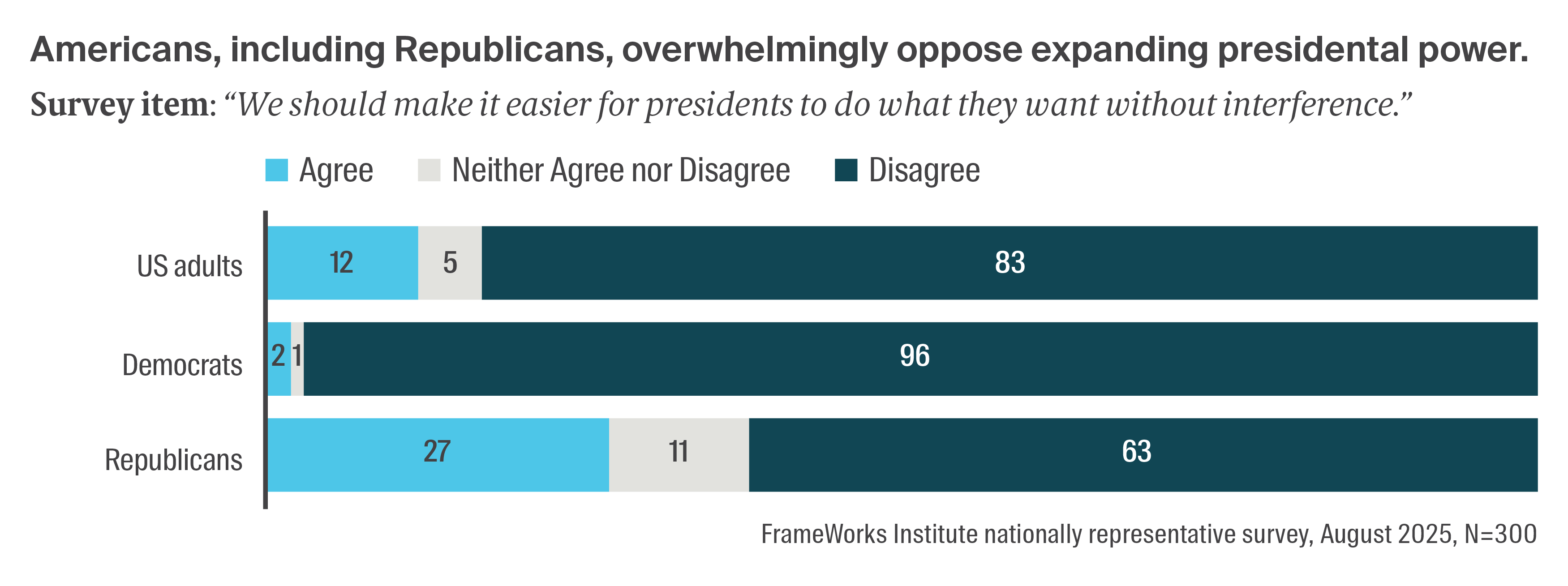
The survey also reveals that a majority of U.S. adults want to see other bold changes and support significant reforms to rebalance and fix what they see as a “rigged” system.
Respondents strongly support the following:
Establish term limits for Supreme Court justices (79%)
Do away with the electoral college (66%)
Make it possible for more parties to be represented in Congress and state legislatures (65%)
Power and the Economy
Power is inherent in any political system. But the use of that power — and who has it — shapes our everyday economic realities.
People see that the rich are getting richer while others are being left behind, no matter what they do or how hard they work. Survey respondents increasingly point to the idea that government decisions shape the economy, even if they are unclear about the specific mechanisms being used by leaders to do it.
We have a unique opportunity to harness concerns and reshape the way our political system operates. But building demand for change requires that we do a better job of showing how the economy is tied to and shaped by the political system.
The report sets out concrete ways we can connect the dots:
Trace everyday economic struggles, such as low wages and the high cost of living, to failures in our political system.
Explain that when our system protects leaders from being accountable, they have little reason to address pressing concerns like the cost of living.
In making the case for democracy reform, highlight how the existing system often fails to respond to what we want and need.
Talk about how the system too frequently does what corporations need while failing to deliver what the people need.
Our research shows that these steps work, building off existing mindsets and using narrative strategies to move people toward solutions that can benefit our democracy and our society as a whole.
We can — and must — concern ourselves with the economy and fixing the dysfunctions of the larger system in which it exists.
Helping people see the way that democracy affects their everyday lives and interests is motivating. Our focus group participants frequently complain about the economy and difficulty affording housing, healthcare and other critical goods and services. Linking democracy with these pressing economic concerns prevents it from seeming like an abstract issue and brings home its day-to-day stakes.
We don’t have to choose between talking about democracy and the price of eggs and gas. We need to do both.
Nat Kendall-Taylor is a psychological anthropologist and chief executive of The FrameWorks Institute.

Might I suggest that the last of the 4 bullet points about connecting dots be slightly modified to read, "Talk about how the system too frequently does what corporations want while failing to deliver what the people need." Having worked for corporate America for over 37 years I have seen all too clearly how often corporate leaders pressure our political system with claims of 'needs' (in a competitive economy) that are really desires to increase their own monopoly powers. My take on Senior Exec's is that they really don't like to have to compete - it takes too much imagination and too much work. They say they are eager to compete, but their real desires lie elsewhere. I'm not suggesting that we simply bash corporate leaders, we need them and we need their corporations to be successful in providing good, well paid jobs for more people. We do, however, need to rein in some of their so called demands, particularly when they are fundamentally about self enrichment rather than about improving the lives of our citizenry at large.
We don't really have to thank magas and/or ignorant/uninformed voters for this regime and its socialism for the rich.
We have to thank misogynists, racists and first and foremost women who are envious/jealous of any women who are in better positions than they are and who will NEVER vote for another woman.
I want to thank you all for gifting us with that thing in the White House, who is making life miserable for 99% of the population, but especially the lowest income 50%.