


Not even Donald Trump, his MAGA toadies on the Supreme Court, or White supremacist state legislators can figure out how to gerrymander states. Lacking the favored Jim Crow mechanism (e.g., radical redistricting) to rig the election, Republicans’ Senate prospects are looking worse by the week.
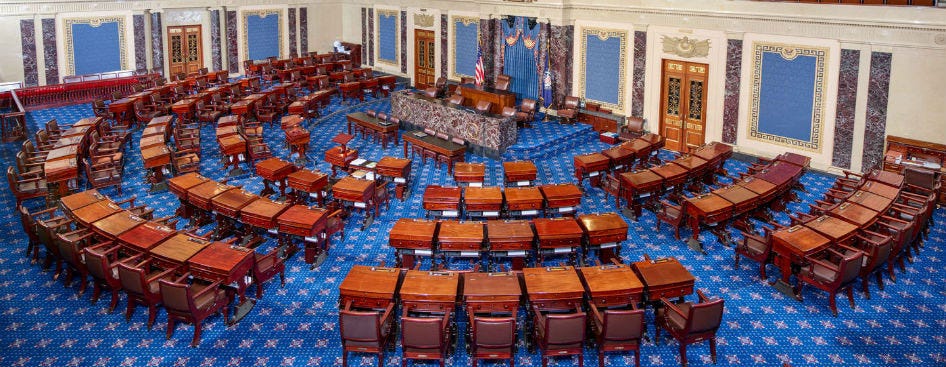
Months ago, we suggested that Democrats had a good shot at winning the Senate majority thanks to Trump’s horrific polling numbers, widespread economic angst, and Republican incumbents’ inability to deliver anything but tax cuts for the rich, paid for by draconian cuts to healthcare and food assistance. Since then, we have learned that one in five people have lost coverage under the Affordable Health Care Act, scores of rural hospitals are being forced to close, and 3.5 million have lost SNAP benefits, raising the ranks of hungry children, seniors, and families.
So it’s no surprise that, as USA Today recently reported, Democrats’ chances of winning the majority are looking even brighter. With “strong candidate recruitment effort, coupled with significant fundraising and Trump’s declining popularity and his base’s infighting,” Republicans face a strong choice of losing majorities in both houses. Put differently, Trump’s sinking poll numbers and failed agenda are dragging Senate Republicans under.
Rather than trying to appeal to ordinary voters, Republicans have doubled down on Trump idolatry. To make matters worse for themselves, Republicans are banking on unappealing candidates — MAGA extremists, Trump’s rubber stamps, and do-nothing phony moderates. Meanwhile, Democrats have found star candidates well-suited to their states (e.g., Roy Cooper in North Carolina, Mary Peltola in Alaska, James Tallarico in Texas). As a result, recent polling shows Democratic candidates statistically tied or ahead in a batch of GOP-held states (Alaska, Maine, North Carolina, Ohio, and Texas). States like Iowa, ordinarily not remotely competitive, are clearly in play.
Meanwhile, the Democratic-held Senate seats that were considered most vulnerable now look a whole lot more secure (e.g., New Hampshire, Georgia). Even Michigan, which Republicans identified as their most likely pick-up, sent a signal in the recent special elections that Republicans are in trouble. “Surging gas prices, an unpopular war in Iran, and tariffs that have hit the state’s auto industry hard have all contributed to concerns about a worsening political environment for Michigan Republicans,” the Associated Press reported. “[A] Democrat won a special election by almost 20 points in a state Senate district that Kamala Harris won by less than 1 point in 2024.”
Looking at the Senate map, a single Democratic Senate seat, Michigan, is rated a toss-up by analysts such as Charlie Cook. Democrats have no seats leaning or likely to go Republican. By contrast, Republicans have 3 seats in immediate peril, toss-up, or leaning Democratic (Ohio, Maine, North Carolina), plus a historically safe seat that merely leans Republican (Alaska). That still leaves Democrats with pick-up opportunities in Iowa, Texas, and even Nebraska (where the official Democratic candidate will drop out, aiding independent Dan Osborn, who would caucus with Democrats and is a viable candidate against incumbent Republican Senator Pete Ricketts).
Which party would you favor — the one with at most one truly vulnerable seat and scads of pickup opportunities, or the one with three candidates already in trouble and more at risk?
Nearly 5 months until Election Day is a lifetime in politics, but matters may get worse for Republicans for several reasons. For starters, contrary to Trump’s lies, inflation and gas prices in particular are soaring. The public rightfully blames Trump and his Republican doormats. In April, inflation soared to 3.8 percent, the highest in three years. There is no guarantee — and no indication — that it won’t go even higher before election day.
Second, a revived civil rights movement with massive organizing in response to Callais can certainly lift Black and Hispanic turnout not only in the South but throughout the country. We already saw a massive Hispanic turnout in Texas’s Democratic primary. If Black and Hispanic voters, many of whom have not consistently turned out in midterms, flock to the polls in November, they can boost Democrats in critical states (e.g., Michigan, Florida, Texas). The Callais backlash could well hand control of the Senate to Democrats.
Third, Senate Republicans refuse to change tactics, separate themselves from Trump (even on dreadful votes such as the $1B ballroom), or present an agenda that might appeal to working and middle-class voters. Democrats are chomping at the bit to hit incumbents like Dan Sullivan and Susan Collins, who like to pose as moderates, for passively allowing grotesque corruption and doing nothing to halt a radical, hugely unpopular agenda that ignores the key issue most important to voters: affordability.
Finally, Republicans’ negative attacks this cycle are particularly ineffective and downright moldy. They seem to assume the electorate cares about things Republicans have brushed aside, such as old social media posts. (Maine’s Graham Platner’s posts, written in the throes of his PTSD struggles, don’t hold a candle to Trump and other MAGA figures’ daily insane rantings). Republicans’ grab-bag of absurd smears fail to pass the straight-face test (e.g., painting Presbyterian seminarian Talarico as an anti-Christian lefty).
This is not to say that Democrats will have clear sailing. Republicans’ unceasing efforts to disrupt elections (e.g., purging voting rolls, requiring ballots to be returned and not just mailed on election day, redistricting in the midst of primary voting, or moving polling places with scant notification) will require Democrats to conduct massive voter education and deploy an aggressive litigation strategy. In addition, Democrats likely won’t be able to match Republicans’ massive haul of dark money (although all you need is enough money to wage effective races). The risk of either overconfidence or loss of interest is always a concern.
However, on balance, Senate Democrats will enjoy an ideal political environment (perhaps the best since 2006, when they picked up 6 seats) and the best recruits in years. They’re organizing, engaging, motivating, and turning out voters — reminding them that if they allow Trump and his MAGA white nationalists two more years of free rein, the country will be unrecognizable and perhaps unsalvageable.
And if voters needed any more motivation, they should remember that a Democratic Senate majority would bring (in addition to investigative and budget powers) an end to confirmation of atrocious judicial and executive nominees and give them the power to conduct effective, eye-opening impeachment trials (for either Trump or his cronies). That should be worth every dollar spent and hour devoted to ending Senate Republicans’ majority.
Republicans' turn away from democracy has already resulted in a collapse in their support. But that won't mean anything unless we organize in our communities to bring about something to replace them with!
Democrats need to jettison the "Reagan Democrats" from the party and return to their progressive roots -- and actually be an opposition party rather than a battered wife to the GOP abusers. Madami and AOC are perfect examples of this. They're honest, they're real, they're leading and they're changing the playing field that has been in place since the 80's.