


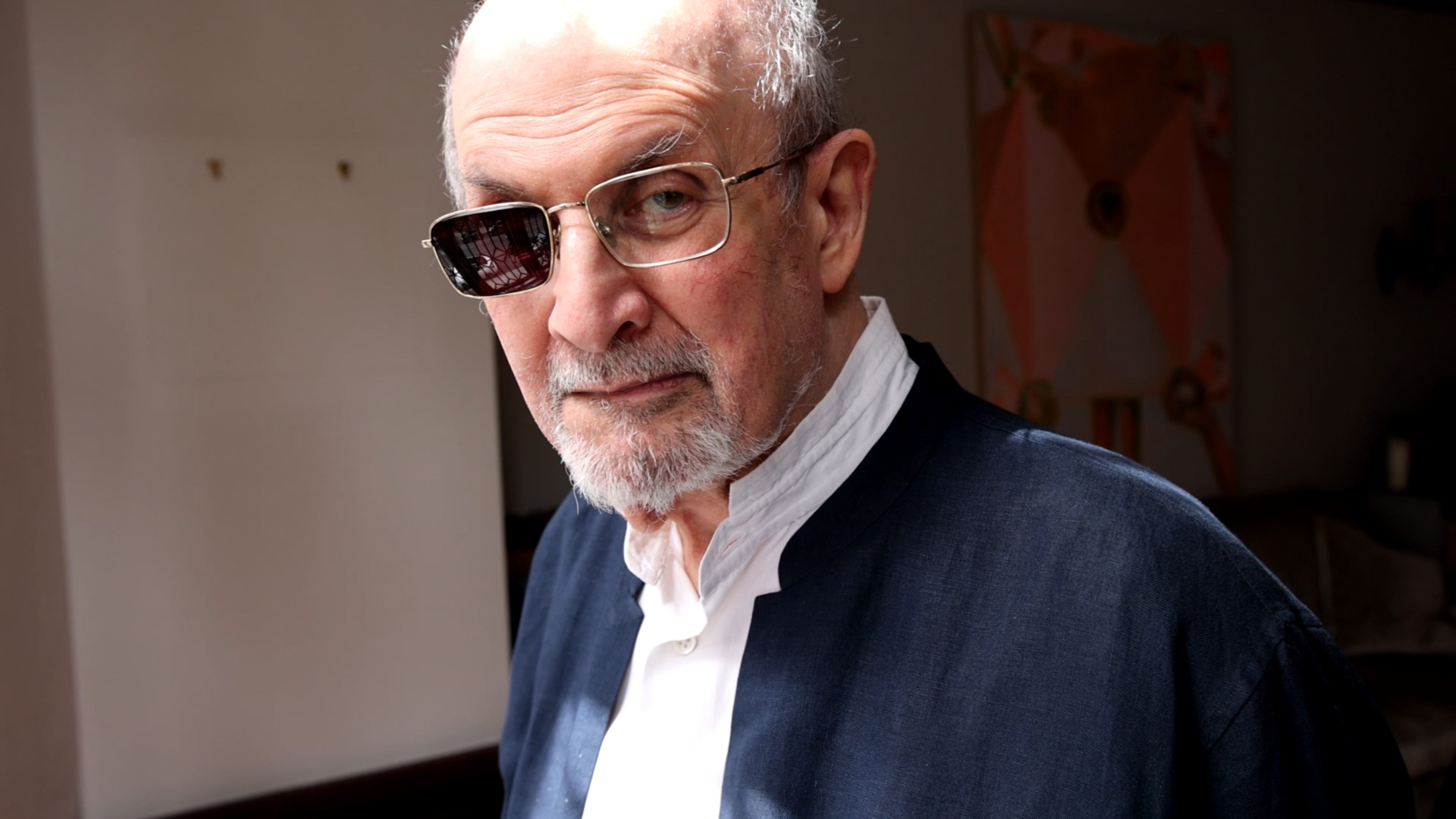
Knife: The Attempted Murder of Salman Rushdie, a documentary now in select theaters, follows Rushdie in the weeks and months after the attack, when his physical and mental recovery were far from certain. Directed by Alex Gibney, the film is a highly collaborative project. It includes narration by Rushdie, much of it drawn from his 2024 memoir, Knife: Meditations After an Attempted Murder, and footage recorded by his wife, the poet and photographer Rachel Eliza Griffiths, during his hospital stay.
A few days after the attack, the couple began recording video diaries to document Rushdie’s physical and emotional journey. “I’m not by nature somebody who keeps a journal, but in this case, it was such an intense event, and we didn’t know how it would turn out,” Rushdie tells The Contrarian during a recent Zoom chat with Griffiths. “We thought keeping some kind of a record would be useful.”
Griffiths had asked a friend to send her a camera. When it arrived at the hospital, it immediately helped alleviate the shock she was experiencing. Through her lens, we see Rushdie’s gruesome injuries — a mutilated eye, a long gash on his neck held together with staples. The footage is visceral and unflinching, but it also captures moments of surprising tenderness (as when Griffith reveals that Rushdie wants a T-shirt saying “There will be cuddles.”)
Of filming in the hospital, “It reconnected me to being a storyteller, to being an artist, to being a writer. It helped activate me,” Griffiths says. “I don’t think either of us thought, ‘Hey, we’re making a documentary.’ It was just, ‘We have the camera here to witness us’.”
“A beautiful love story” and “an awful criminal story”
Months later, Rushdie had begun to write his memoir. At Griffiths’ suggestion, he finally watched some of the footage. “We began to think that maybe there was an audience for this which was bigger than just the two of us,” he recalls. They connected with Gibney, a prolific documentarian known for tackling highly controversial subjects — like the Church of Scientology and (in another film due this fall, Elon Musk) — and shared the hospital footage with him.
“It was a terrifying moment,” Griffiths recalls. “Here’s a lot of vulnerability. Here’s also a beautiful love story, an awful criminal story, a violent story, a traumatizing story. But for me, intuitively, there was trust from the beginning.”
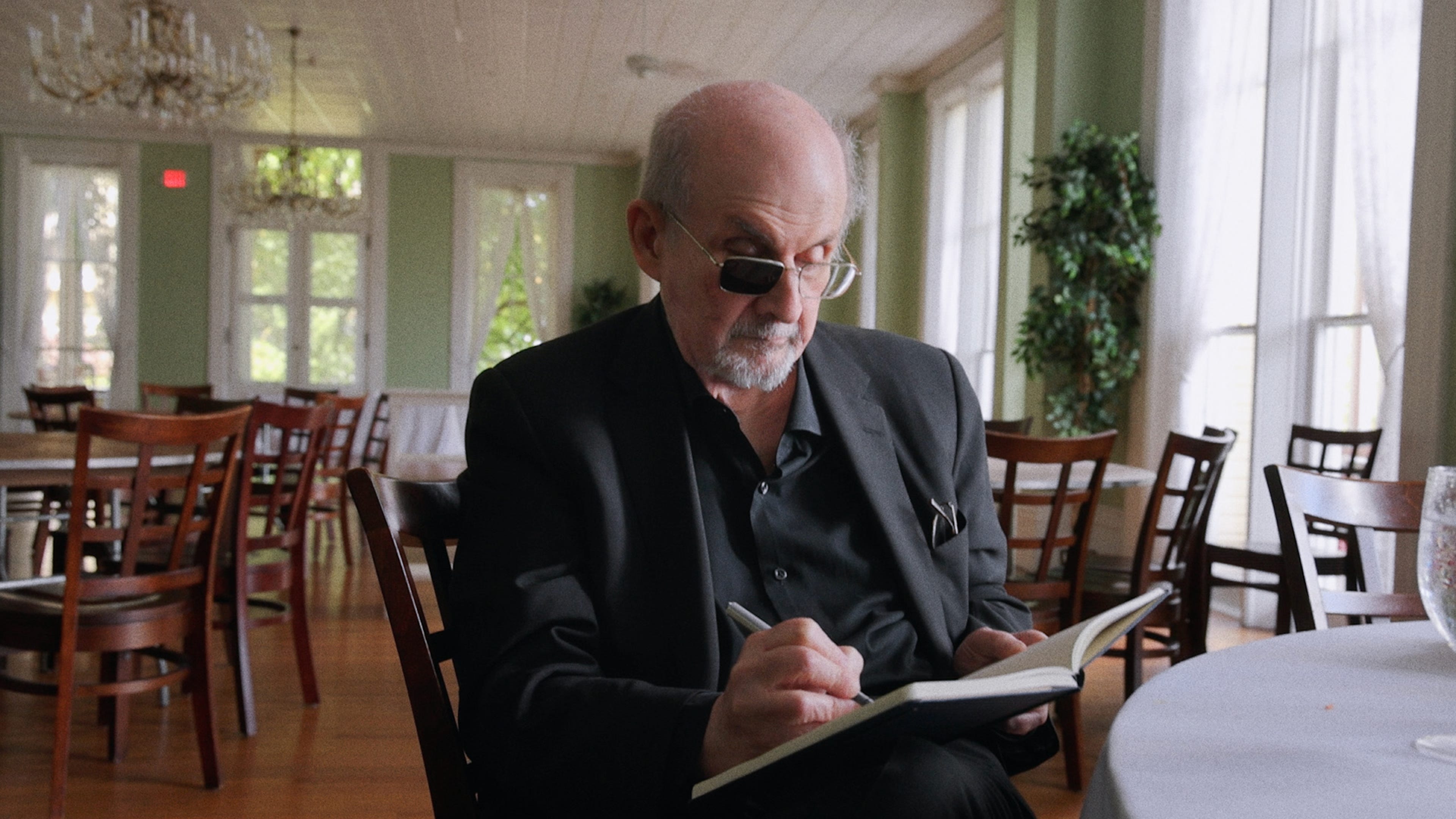
Rushdie, a cinephile, was impressed by Gibney’s filmmaking range, and also by his reference to the classic BBC series The Singing Detective, which follows Dennis Potter’s character as he recuperates in the hospital. “Around that, the series weaves a non-linear web of his dreams, his fantasies, his work, his life, all of that spinning around this narrative of a man in a bed,” Rushdie explains. (The film also features other cinematic references to Knife in the Water, Psycho, and The Seventh Seal.)
Knife tells the story of Rushdie’s recovery while another thread traces the major beats of his life story, including his childhood in a mostly secular Muslim family in Mumbai, his education in posh English schools, his writing career — which took off with the publication of Midnight’s Children in 1981 — and the global controversy ignited by The Satanic Verses, seven years later.
The magical realist novel, which fictionalized elements of the prophet Muhammad’s life, was denounced by many Muslims for its supposed blasphemy. (Interestingly, it came out the same year as Martin Scorsese’s film The Last Temptation of Christ, which was condemned by many Christians for similar reasons.) In 1989, Ayatollah Ruhollah Khomeini of Iran issued a fatwa calling for Rushdie’s assassination. Waldenbooks, the largest book retailer in the U.S. at the time, pulled the novel from their shelves; stores in Berkeley that sold the book were bombed, as was a New York newspaper that published an editorial in support of Rushdie.
It’s not clear how many of Rushdie’s most fervent detractors actually read the sprawling, 600-page novel — especially Khomeini. The author believes he was a convenient target for the Iranian regime, which had been weakened by a long war with Iraq. Khomeini “was looking for some way to rally the troops, and unfortunately, that ended up being me,” he says in the film (a scenario that sounds all too plausible in 2026.)
After the fatwa was lifted, Rushdie settled in New York, and returned to public life by embarking on what he describes in the film as “a deliberate program of high-visibility outings” — hobnobbing with celebrities at countless galas and movie premieres (with no security guards in sight). “I achieved freedom by living like a free man,” he says.
“I’m standing up in the place I fell down”
By the time of the attack, Rushdie had been living as a mostly free man for nearly 25 years. That hard-fought return to something like normalcy was shattered in less than a minute, by an unrepentant young man Rushdie refers to only as “the A” — as in “assailant,” but also “asshole.” (That young man, Hadi Matar, was sentenced to 25 years in prison for attempted murder and was also convicted on federal terrorism charges this year.)
In the final minutes of Knife, Rushdie returns to the scene of the attack in Chautauqua. “I am standing up in the place where I fell down,” he says. We see graphic footage of the crime itself, replayed from different angles, and slowed down for maximum impact.
Gibney obtained the material, which had been withheld while the legal cases against Rushdie’s assailant were pending, late in the editing process — just a few weeks before Knife was slated to premiere at the Sundance Film Festival.
Rushdie believes that including the footage was necessary. “If you’re making a film about an attack, and you have film of the attack, you should show the attack,” he says. “It’s a no-brainer.” He is also pleased with Gibney’s decision to place it near the end of the film.
“By then, the audience knows us a little bit, and so the thing has more effect, because it’s not a stranger, it’s not a stranger being attacked. It’s somebody you’ve gotten to know for the last hour and a half,” he says, comparing it to Truman Capote’s description of the murders near the end of In Cold Blood. “Withholding that was very powerful.”
What stands out from the footage — other than the terrifying speed of the attack — is how many people from the audience intervened to stop the assault and assist Rushdie.
“If those people had not run up on that stage, Salman would not be alive. He would not have made it because the attacker wasn’t going to stop attacking,” Griffiths says. “There are human beings who know what’s at stake… and they run toward it, not away from it.”
‘‘I just know which side of the fight I’m on”
The horrific crime put Rushdie back at the center of the conversation around free speech and religious extremism — a position he occupies with some ambivalence. During a talk with The Atlantic’s George Packer in March, Rushdie expressed mild irritation at being treated like “free speech Barbie,” as a symbol for a particular cause rather than a working writer with things to say.
In our conversation, Rushdie elaborates about the source of his frustration.
“It’s only that every time a free speech event occurs — which is, at the moment, almost all the time — my phone rings. You know, ‘What’s your comment?’” he says. “My comment about free speech is that I’m in favor of it. But beyond that, I don’t have a huge amount of original thinking to offer. I just know which side of the fight I’m on.”
Speaking of that fight: The film lands at a moment when free speech is under renewed assault and the Trump administration is using the levers of federal power to silence critics in the media and entertainment.
“We are seeing books being banned, media being banned, the right to to speak being censored… This film, suddenly and sadly, is quite timely,” says Griffiths. “I’m proud that the film contributes to a very necessary conversation all of us need to be having about what kind of society we want to have.”
“Back in the chair”
Neither Rushdie nor Griffiths allowed the attack to silence their voices. It did, however, alter their perspectives.
Although Griffiths navigates what she calls “a complex post-traumatic stress disorder,” she has found joy in returning to work. She channeled some of the experience in The Flower Bearers, a memoir released this year.
“There’s a real beauty, when you’ve been in a state of shock and hyper-vigilance, to come back into your life,” she says. “I have a sense that at any moment these things can be shattered and taken from you.”
In Knife, Rushdie admits that while he was recovering, he worried that “the creative artist inside me had been damaged and that I might not find him again.” But the brush with death ultimately compelled Rushdie, now seventy-nine, to write with an even greater sense of urgency. He published Knife, which he says he had to write in order to move past the attempted assassination, and a short story collection, The Eleventh Hour. He is currently working on a novel.
“I feel like I’m back in the chair,” he says. “‘Don’t waste your time’ is really my motto now, because when you’re given a second chance at life…what do you do with it? My message to myself was ‘Get on with it.’ Use it. Do the things that are most important to you, and forget about everything else.”
Meredith Blake is the culture columnist for The Contrarian