

Republicans controlling the Missouri legislature had a plan to split a Democratic leaning U.S. House district in Kansas City, Missouri, and surrounding suburbs with the intent to ensure that the entire metropolitan area on the Missouri side elects Republicans to the U.S. House. Their new map would have left Democrats with a realistic shot at only 1 of Missouri’s 8 U.S. House seats; hundreds of miles to the East in St. Louis.
A nice scheme perhaps, for Republicans, but the Missouri Supreme Court has ruled the new map cannot be used unless and until a voter referendum approves of it. Last Friday, the United States Supreme Court made the correct ruling and refused to allow federal courts to intervene, allowing Missouri law as interpreted by Missouri courts to control elections in the state.
That’s the way it should be.
Under the Elections Clause of the Constitution, “The Times, Places and Manner of holding Elections for Senators and Representatives, shall be prescribed in each State by the Legislature thereof; but the Congress may at any time by Law make or alter such Regulations.” The Tenth Amendment provides that “The powers not delegated to the United States by the Constitution, nor prohibited by it to the States, are reserved to the States respectively, or to the people.”
In other words, states make rules governing elections unless Congress says otherwise. The federal courts have no power to make up new rules for elections. The rules are fixed in statutes passed by Congress or in the Constitution. For example, a statute providing that Election Day is the first Tuesday in November, and amendments providing that the right to vote shall not be abridged because of race (the 15th Amendment) or sex (the 19th Amendment) and that the voting age is 18 (the 26th Amendment). There is no federal statute or amendment that says a state must use the same district map for U.S. House elections that was used in primaries. Which map to use and when are questions for states to decide, unless the map is unconstitutional – for example, when there is intentional gerrymandering on account of race.
In Missouri, a district map was fixed in 2022 by Missouri law, giving Republicans control of 6 out of 8 Congressional seats. This is a far greater proportional representation in the Missouri House delegation than the 58.5 percent of the vote the Republican Party got in Missouri in the 2024 presidential election. In 2025, the Missouri legislature approved a new, even more pro-GOP map, which would give Republicans a very likely shot at winning 7 of the 8 House seats, by splitting a Democratic leaning district in and around Kansas City, Missouri. But the Missouri Supreme Court has ruled unanimously that, under Missouri law, the new map cannot be used until it is approved in a valid voter referendum. If the voters approve of the new map, it can be used in 2028. But that precondition of a voter referendum never took place, leaving the underlying legislation (the 2025 map) invalid.
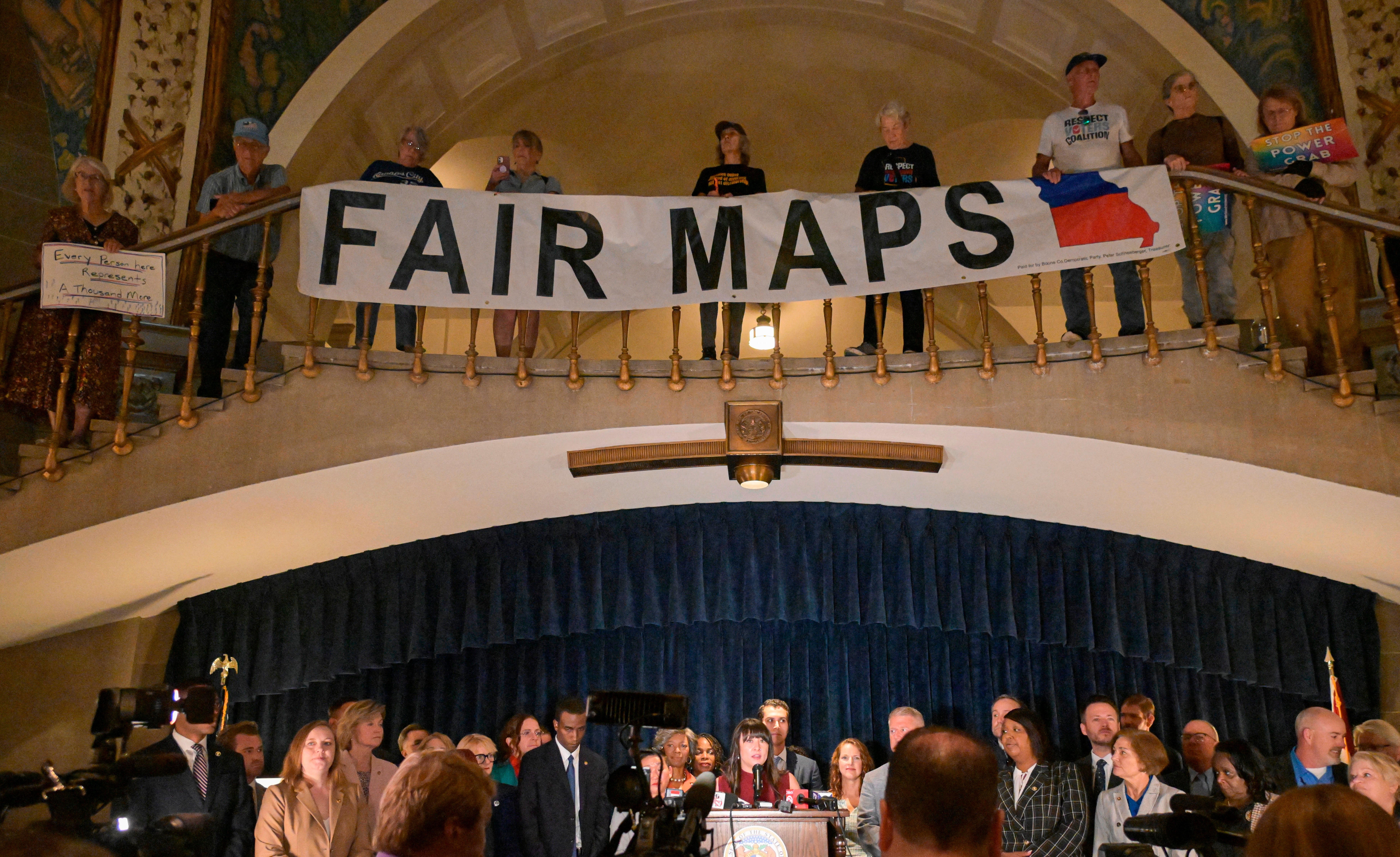
The Missouri Supreme Court has the last word in interpreting Missouri law. Mail-in ballots have already been sent out using the current map. But Republican political operatives — not happy with the 6 out of 8 House seats they have under the 2022 map and eager to claim 7 of the 8 House seats — have been trying to persuade federal courts to force Missouri to use the 2025 map splitting the Kansas City metropolitan area down the middle.
Fortunately, the U.S. Supreme Court will have none of it. It has once before rejected the challenge and has upheld the Missouri Supreme Court’s interpretation of Missouri law. That’s where this matter should have ended. Yet lawyers kept looking for new arguments to respond to the Missouri Supreme Court’s final decision. They persuaded the U.S. Court of Appeals for the Eighth Circuit to enter an order changing the map six weeks before Election Day. Fortunately, the Supreme Court reversed the Eighth Circuit’s order.
The Supreme Court has finally put a stop to this chaos and let Missouri run Missouri’s election, as clearly stated in the Constitution. The fact that Republicans in the legislature were able to force Missouri voters to use their new map for primaries earlier this year, before the Missouri Supreme Court ruled, does not mean that the Missouri Supreme Court’s interpretation of Missouri law is wrong. The old map will be used this November, and the Kansas City, Missouri area district will remain intact.
Missouri voters, some of whom already received and mailed in their ballots, now will be allowed to vote as planned. The People of Missouri pick their representatives in Congress, as Article I, Section 2 of the Constitution provides: “[t]he House of Representatives shall be composed of Members chosen every second Year by the People of the several States.” Missouri’s state legislature was not permitted to alter this process by failing to complete the proposed redistricting with the referendum vote by the people that is required under Missouri law. That referendum is on the ballot in November, and Missouri voters can decide then if they want the new map or the old.
In short, the Constitution says the “People” choose their representatives in Congress. First the Missouri Supreme Court, and now the U.S. Supreme Court agreed, soundly and finally.
Richard W. Painter is the S. Walter Richey Professor of Corporate Law, University of Minnesota Law School, and former Associate Counsel to the President and chief White House ethics lawyer for President George W. Bush.
E. Thomas Sullivan is the President Emeritus and Professor Emeritus of Law and Political Science at the University of Vermont and a former Law School Dean and Provost of the University of Minnesota for 15 years.
Painter and Sullivan co-authored the Cambridge University Press book The U.S. Presidency: Power, Responsibility and Accountability.
[The institutional references and titles are for identification purposes and do not reflect the opinions of the institutions mentioned.]