


I first came to the Senate in early 1970—55 years ago! I worked for George McGovern, but most of the time I was working for a coalition of five senators seeking an end to the war in Vietnam—including three Republicans, Jacob Javits and Charlie Goodell of New York, and Mark Hatfield of Oregon. In 1976, I became staff director to a Senate committee tasked with reforming and realigning its committee system. It was chaired by Adlai Stevenson (III) of Illinois but had six senators from each party. Together, I worked with Republicans Bill Brock of Tennessee, Bob Packwood of Oregon, Barry Goldwater of Arizona, and particularly closely with Pete Domenici of New Mexico.
Over the decades, I worked and was friends with dozens of Republican senators, from Alan Simpson to Dick Lugar to Olympia Snowe to John Cornyn and Fred Thompson; from Howard Baker to Nancy Landon Kassebaum. The issues on which we worked ranged through ethics, Senate rules, voting and elections, oversight, broader committee and internal reform, and more. I even worked with Susan Collins on civil service reform. On campaign finance reform, I collaborated especially closely with John McCain.
Many, if not most, were fierce partisans (hard to be fiercer than Al Simpson). But while they all were loyal to their party’s presidents and tried to support them, they were just as loyal—if not more—to their own institution, and fiercely protective of its prerogatives. All had high scores on the norm first coined by the late political scientist Donald R. Matthews as “institutional patriotism.” When I called Alan Simpson after he retired and after 9/11 and asked him if he would co-chair a commission on continuity of government, to ensure that Congress and our other branches could function in the aftermath of a devastating terrorist attack or other catastrophe, he did not hesitate, and spent a huge number of hours and days on the work, over several years.
One story best illustrates that point. Our committee on committee reform was either the fifth or sixth assignment for its members. They had a thankless task at best, a dangerous one in reality. The charge was to reduce and streamline the number of committees and subcommittees and realign the jurisdictions. That meant taking power and benefits from the most powerful of their colleagues, who regarded their assignments and jurisdictions like their babies. They would not forget who was trying to diminish them. Of our twelve members, around half actually did a fair amount of work. One was the aforementioned Pete Domenici, then a freshman.
One night, late at work with Pete, I said to him, “Senator, you have so many assignments directly related to your constituents, and you are in a competitive state. Why are you so devoted to this?” His response was that getting elected to the Senate was the greatest honor of his life, and he had pledged when he won and was sworn in that he would work tirelessly to leave the Senate a better place than it was when he came in.
That comment had a big influence on me, and has since helped shape my work on our democratic institutions. I thought of it again as I watched the farcical “oversight” hearing of the Senate Judiciary Committee on the Department of Justice and Attorney General Pam Bondi. I have sat through many hundreds of such hearings, many contentious, and I have never seen anything like this one. Bondi refused to answer any serious or substantive question from Democrats and instead responded with planned character attacks—all vile and many false—on each member. It was summed up eloquently by California Democrat Adam Schiff, who gave a long catalog of the questions Bondi would not answer, then asked his Republican counterparts why they were not treating an oversight hearing as a legitimate and necessary part of their core responsibilities.
There was no response from them, either during the character assassinations of their colleagues, the contempt Bondi showed for the Senate, or in their own questions for her. The FBI oversight hearing with Kash Patel was not quite as bad, but was a parallel to this one. In either case, it was frankly gobsmacking to see the utter abdication of responsibility and lack of institutional patriotism displayed by every single member, acting more as lackeys of the Trump cult than members of the United States Senate.
That same day offered another example of a Senate majority giving up its core powers and responsibility in fealty to Dear Leader. Unhappy with the way in which Senate Democrats were using the rules to slow walk many of Trump’s executive nominees (using the same tactics they had employed over and over during the Biden presidency), Majority Leader John Thune went back on his pledge to leave the rules around the filibuster intact. He used the so-called “nuclear option” to allow multiple confirmation votes to be bundled en bloc with one up-or-down vote.
But he did not do this for five or ten people, after they had each been through robust confirmation hearings to examine their fitness for the positions, along with thorough scrutiny of their backgrounds, as would be standard for the Senate. He brought up 107 nominees, most with no vetting, and got his party line vote. The nominees included cringeworthy ones like Herschel Walker and Sergio Gor for prime ambassadorships. As White House personnel director, Gor’s top priority was a loyalty test to Trump, not a test of competence or experience. God knows how many of these 107 have competence, relevant experience, or the most fundamental standards of ethics.
The advice and consent responsibility is a core one for the Senate, an essential part of the checks and balances the Framers built into the system. That John Thune and his colleagues went along with stripping away its essence is quite a measure of their disdain for the Senate and its independent role.
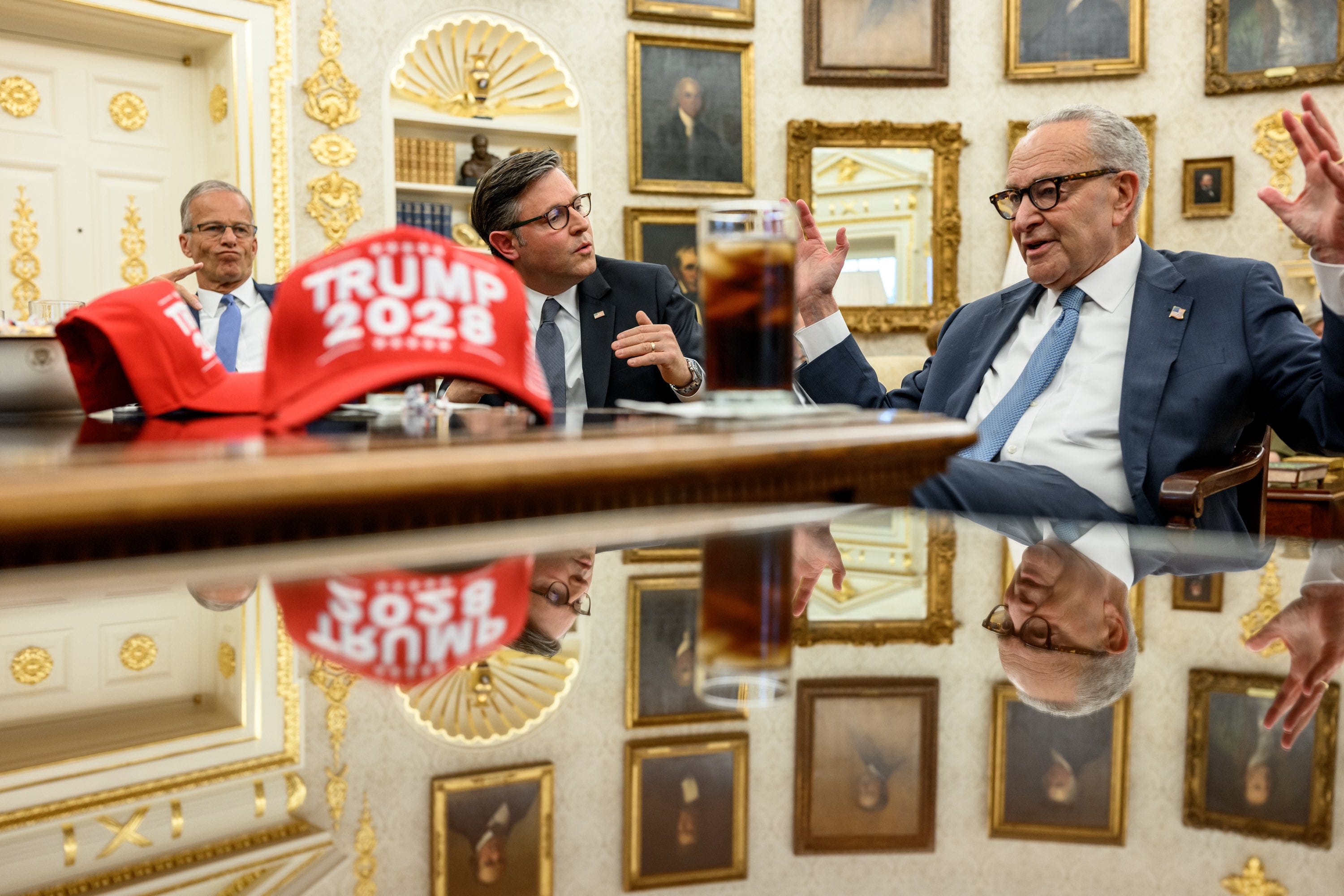
Of course, the most significant guardrail the Framers put in place to insure against a tyrant was the first branch, Congress. Though both House and Senate have failed miserably in that role, it is especially disheartening and infuriating that the Senate, with its six-year terms and historic pride in its special role, has become a poster child for failure at doing its fundamental job. There is not a single Republican in the Senate now who could fill the shoes of a Lugar, McCain, Simpson, Snowe, Baker, Kassebaum, or Domenici. Senate Republicans are not the only guardrail failure. But in no small part, thanks to the current crop, our democracy and freedoms are hanging by a thread.
Norman Ornstein is a political scientist, co-host of the podcast “Words Matter,” and author of books, including “It’s Even Worse Than It Looks: How the American Constitutional System Collided With the New Politics of Extremism.”

I'm a retired attorney who has done some work in Constitutional Law, and I completely agree with you Mr. Ornstein. With each passing day and the next outrageous lie and act by this demagogue - WITH HIS PARTY'S APPROVAL- I feel like I'm sleepwalking in 1930's Germany. German conservatives then prevailed upon President von Hindenberg to appoint Hitler Chancellor, thinking they could control him and take advantage of his popularity. We know how that ended.
I never thought that one of the Country's two political parties would be taken over by such evil men. I don't use the word "evil" lightly, in fact I've never used it in reference to any American political leader - until now. Political leaders who cowardly sit in a corner nodding approval to an evil power-drunk wannabe-autocrat, tacitly enabling his illicit consolidation of power, are to my mind evil. Hitler rose to power because many of those who knew better and in a position to do something, decided to cower from the bully - until it was too late. History will be very unkind to cowards like Mitch McConnell, John Thune, and Mike Johnson.
Many on the right think making reference to Hitler and National Socialism is alarmist and exaggerated. But consider: if you teleported Trump back to 1930's Germany, and gave him all of the power that Hitler was able to consolidate, would he take it? I think the answer is obvious. He'd probably proceed to cancel elections because of "insurrections" happening in blue cities, he'd need just one Pam Bondi to tell him that the Constitutional prohibition against a third term didn't apply to him because of "exceptional circumstances," he'd think he was absolutely, vitally needed to combat "communists" and "liberals," and he'd stifle legitimate political dissent and use the power of his office to cow his critics. I think Trump is an evil man.
Looking at all that golf in the oval office makes me want to throw up.
As to fascist senators, I'm amazed any of them have children, what with no balls.....