

By Frederic J. Frommer
The NCAA college basketball tournament has seen its share of drama, upsets, and powerful storylines.
But when it comes to historical significance, none can match the 1966 championship game, when Texas Western became the first all-Black team to grab the title, stunning college powerhouse Kentucky 60 years ago this month.
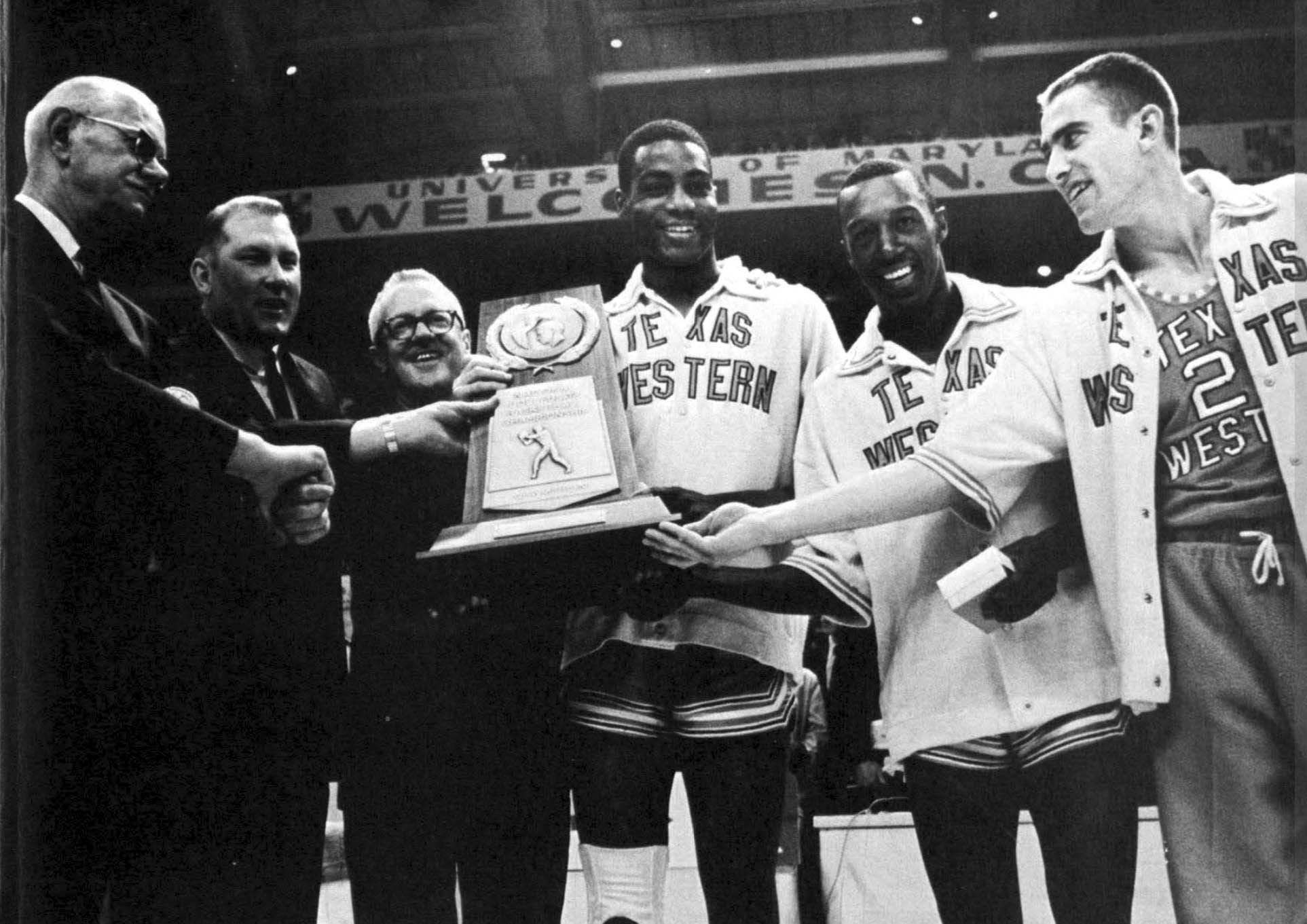
On March 19, 1966, Texas Western, coached by Don Haskins, beat a Kentucky team led by legendary coach Adolph Rupp, 72-65. Both Texas Western and Kentucky entered the game 27-1, but Kentucky was ranked No. 1; Texas Western was ranked third.
“Texas Western’s cagers are big and strong and fast and the school’s image — as painted by publicist Eddie Mullens — is like a Wild West show,” the Baltimore Sun wrote in a preview of the game. “More colorful than a taxi convention in Disneyland.”
Haskins received tens of thousands of letters in hate mail, which he didn’t tell his players about.
“There were bags and bags of nasty, racist ignorant letters,” he wrote in his memoir (with Dan Wetzel), Glory Road, My Story of the 1966 NCAA Basketball Championship and How One Team Triumphed Against the Odds and Changed America Forever. “We were just this little ole school in dusty West Texas that no one had ever heard of, and now people all over the country hated us because we had black student-athletes.”
“We were walking around with the medal indicating we were the 1966 NCAA champions,” recalled Nevil Shed, a Black reserve on the team. “He was walking around with another brand on him for allowing these players to play. Remember, society wasn’t ready for that.”
Many of the major college basketball teams were all-white back then.
Glory Road would be turned into the 2006 film by the same name, starring Josh Lucas as Haskins and Jon Voight as Rupp. Haskins died in 2008.
“It was a thrill for me — I’m kind of a young punk — and to play a game with Mr. Rupp is quite an honor, let alone win it,” the 36-year-old Haskins told reporters after beating the 64-year-old Rupp, who had been coaching Kentucky since 1930.
“I wasn’t out to be a pioneer when we played Kentucky,” Haskins told the Los Angeles Times years later. “I was simply playing the best players on the team, and they happened to be black.”
Texas Western’s starters were Bobby Joe Hill, Orsten Artis, Willie Worsley, Harry Flournoy, and David Lattin. Worsley would go on to play one season for the New York Nets of the old American Basketball Association. David Lattin played five pro seasons — two in the NBA and three in the ABA.
“It was a little man who filled the hero’s assignment for Texas Western,” the New York Times reported in its game story. “He was Bobby Joe Hill, who used his cut-and-go skills to run around and through Kentucky. The 5-foot- 10-inch junior from Detroit dropped in some of the fanciest shots of the tourney and scored 20 points. He also was a demon on defense, often taking the ball away from Kentucky players.”
The team’s other top scorers included Lattin (with 16 points) and Artis (15).
The Times made no mention of the historic racial makeup of Texas Western’s starting lineup.
Kentucky’s all-white starters included Pat Riley, who scored 19 points but had a poor shooting night of 8-for-22.
In a book review of Glory Road, Gerald Eskenazi wrote that the game “has taken its place among the defining events in the history of athletics. It was as if the American sports world had experienced an epiphany, reminiscent of the moment Jackie Robinson first wore his Brooklyn Dodgers uniform, or the day Joe Louis knocked out Max Schmeling.”
As the Texas Western players marched out of the University of Maryland Cole Field House, they chanted, “We won this one for LBJ,” the Texan who was president at the time. Lyndon B. Johnson had signed the Civil Rights of 1964 and the Voting Rights of 1965. (Texas Western changed its name to the University of Texas-El Paso a year after its historic title.)
The game helped change recruiting in college basketball, leading to more African Americans on college teams.
Haskins’s formative views on race were influenced during an incident in his childhood growing up in segregated Enid, Oklahoma, where he played with his best friend, a Black kid named Herman Carr, who was the best basketball player in town.
“We played a lot of one-on-one,” Haskins told Adrian Wojnarowski for an ESPN story years ago. “We found out at a young age that there wasn’t much difference between us, except for color. Well, one day we went to the fountain in front of the feed store to get a drink. And there it said, ‘coloreds only,’ and ‘whites only.’ That was a hell of a note, that he couldn’t drink from the same fountain as me.
“I ended up going to Oklahoma A&M, and Herman went to the Army. We lost touch for a few years, but got back together at a function for me in Enid, where Herman came down and sat right beside me. There was a day when that wouldn’t have worked, but that experience had a lot to do with what happened in the rest of my life.”
Frederic J. Frommer, a sports and politics historian who has written for the Washington Post, the New York Times, the Atlantic and other national publications, is working on a book on ‘70s baseball.
Absolutely great story, especially in these days of the orange dumpster and his Rasputin whisperer Stephen Miller. Thank you so much.
I watched the game at age 15. It was huge.