


Until now, the most controversial moment in Ed Sheeran’s career was probably his head-scratching cameo in an episode of Game of Thrones. But that changed this week, when socially conscious rapper Macklemore was removed as the opening act on Sheeran’s tour because of statements he made in support of Palestinian rights during concerts at MetLife Stadium in New Jersey this month.
Billionaire Robert Kraft, who owns the New England Patriots and Gillette Stadium in Massachusetts, played a key role in rallying opposition to Macklemore for his supposed “antisemitism.” Other venues that reportedly objected to his presence on the bill include AT&T Stadium in Texas (where chronic antisemite Kanye West is scheduled to play in November) and Raymond James Stadium in Florida (where “Ye” played this summer).
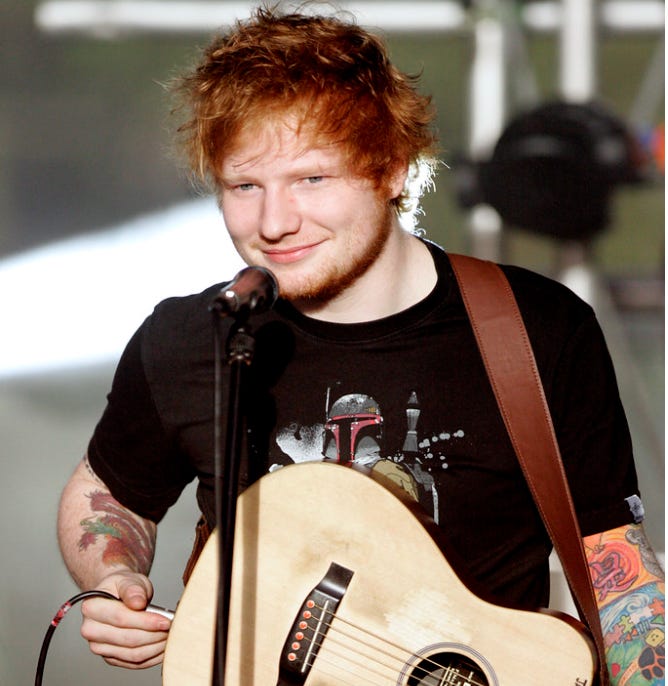
The debacle has put Sheeran, the milquetoast popstar known for hits like “Perfect” and “The Shape of You,” in an uncomfortable position at the center of the discourse around Israel, Gaza, and free speech. On Tuesday, the famed ginger posted a carefully bullet-pointed statement on Instagram in which he claimed “I am not complicit,” and insisted that removing Macklemore from the tour was not his decision.
Sheeran also explained that he has avoided saying anything publicly about “the devastating conflict” in Gaza — not because he doesn’t have opinions, but because the people who go to his shows “do not expect a political forum.”
Comments on the post were turned off, suggesting that Sheeran (and his team) knew the statement would not be well-received.
And it wasn’t.
By late Tuesday night, all the remaining musicians who were scheduled to open for Sheeran had backed out of the tour in solidarity with Macklemore.
“Artists must not be silenced when they speak up for the oppressed,” said singer-songwriter Finneas on Instagram.
The debacle has thrown Sheeran’s tour into chaos and resulted in a rare PR crisis for a musician who is usually about as incendiary as a bowl of oatmeal. But it has demonstrated one thing: despite what Sheeran would like to believe, being apolitical is not really an option for an artist with a global platform in 2026.
That’s because many of the artists who do opt to speak out in this climate, particularly on Gaza, face severe consequences, disproportionate backlash, and bad-faith allegations of antisemitism.
On Saturday, Israeli filmmakers Yuval Abraham and Rachel Szor received a special jury prize at the Venice Film Festival for NAZA, a documentary about the Israeli military’s targeting of civilians in Gaza. The directors, who won an Oscar last year for their film No Other Land, also received a record-setting 25-minute standing ovation.
They are now being denounced as traitors by Israeli officials.
In a post on Sunday on X, culture minister Miki Zohar vowed to “act immediately to revoke the Israeli citizenship of these despicable creators for treason against the state.” On Monday, he formally petitioned the government to revoke their citizenship “for breach of loyalty to the state and collaboration with the enemy,” and to find out how the directors were able to uncover information about intelligence operations. The film includes interviews with two dozen anonymous whistleblowers.
“Freedom of expression is not a license to betray the state,” Zohar said. “Anyone who acts against Israel during a war must know that there will be a price to pay.”
Prime Minister Benjamin Netanyahu, who is up for reelection in October, denounced the film as “shocking” and antisemitic. “We are fighting global antisemitic incitement, and when it comes from within us it is intolerable,” he said in a video posted on Telegram.
This opinion is not monolithic in Israel: more than a thousand members of the country’s filmmaking industry signed a petition in support of Abraham and Szor. “The central role of art and journalism is to hold a mirror up to the society in which they exist, to create discourse and discussion without assumptions, even when the reality is difficult,” it read.
In recent weeks, Mark Ruffalo has also been accused of antisemitism because of his opposition to the Israeli government. The Task star has long been one of the most outspoken progressives in Hollywood, and lately he has been vocal about his opposition to both the war in Gaza and Paramount’s possible acquisition of Warner Bros. In August, he shared an Instagram story about Paramount’s ties to Oracle, the tech company co-founded by Larry Ellison, father of Paramount CEO David Ellison, and the war in Gaza, which he called “a genocide… built on an apartheid system of oppression powered by Oracle.”
In a statement to Variety, Paramount accused Ruffalo of trafficking in “antisemitic tropes.”
“Words like ‘genocide’ and ‘apartheid,’ applied to a corporate transaction, aren’t just wrong — they’re a bridge too far, and they cheapen the very real suffering those words are meant to describe,” it read.
If anything, though, Paramount was cynically using the very real problem of antisemitism to stifle dissent and bolster support for a potentially devastating corporate merger.
(It’s worth noting that last year a United Nations commission determined that Israel is, in fact, committing genocide in Gaza.)
Hundreds of Jewish artists, including filmmaker Joel Coen and playwright Tony Kushner, signed an open letter in support of Ruffalo and denouncing the “weaponization” of antisemitism.
“Enough with the false and dangerous weaponization of charges of antisemitism against those who are brave enough to point out the obvious: that the assault on the Palestinian people and the assault on our liberties at home are deeply interconnected, and there is nothing antisemitic about recognizing that fact.”
The letter also described the Paramount-Warner Bros. merger as “part of a larger project of tech-driven domination, a project Larry Ellison and his partners have never been shy about trumpeting — and one they themselves have explicitly linked to their support for the ongoing depredations being visited on the people of Palestine and their silencing of critics of those horrors.”
In his statement Tuesday, Sheeran defended his apolitical stance by arguing “there are different approaches to being an advocate for change.”
He is not wrong: the dear, departed Dolly Parton rarely weighed in on electoral politics, choosing instead to make her worldview clear in her music.
But Sheeran has a naive idea of what constitutes “politics” in an era of rising authoritarianism and chilling encroachment on free speech. It’s not (just) about the slogans you chant onstage or the candidates you endorse — it’s about the choices you do and do not make. That includes the artists you choose to support, the companies you choose to work with, the lines you choose to draw in the sand, and the billionaires you choose to sing for.
Meredith Blake is the culture columnist for The Contrarian
Great article, Meredith.
To the Israeli government, the Krafts, the Ellisons and all the other billionaires who are trying to use the hammer of "antisemitism" on all people speaking out against the ongoing genocide of Palestinians everywhere, your ploy is not working. On the contrary, your trying to silence anyone speaking out against Israel will create more anti-Israel comments.
As so many others and I have pointed out, anti-Israel is not the same as antisemitism. In fact, there are many American Jews who are against what Israel and Israelis (on the West Bank) are doing, in large part to keep Netanyahoo out of prison.
Ed Sheeran, you are a coward.