


As I walked the cobblestone streets of Rome with a local Italian film crew last month, we kept passing signs “Io voto sì” (I’m voting yes) plastered next to signs with a clear “NO” in all caps. My camera assistant told me he’d be driving four hours each way to his hometown in Tuscany to vote “no” on a proposed overhaul of the judicial system, which many news outlets categorized as not just a referendum on the judicial system in Italy but a referendum on the prime minister herself: Giorgia Meloni. Italian voters rejected the referendum, which Meloni backed.
Elected in September 2022, Meloni, the country’s first female prime minister, has been described as being “to feminism like a fish on a bicycle: harried, precarious and out of place.” In her first official communication as prime minister, her office used the masculine term “Il Presidente” instead of “La Presidente” — underlining the belief that the job belongs to a man, or that masculine linguistic terms, not feminine ones, are gender-neutral. This wasn’t exactly surprising, given that the political party she has led since 2014, the neofascist Fratelli d’Italia (Brothers of Italy), is a literally gendered name.
A month after Meloni’s election, Molly Jong-Fast wrote for The Atlantic a piece titled “The Far Right’s Fake Feminist Gambit.” She characterized Meloni’s campaign as an example of “political genderwashing,” defined as “hiding repressive and even authoritarian agendas behind a front of women’s empowerment.” She explains how Meloni “leans all the way into her identity as a woman and a mother” in order to “trick voters into supporting something they would otherwise not.”
It is now all too clear how MAGA and the Trump Administration capitalize on the same approach — from Marjorie Taylor Greene to Karoline Leavitt to Pam Bondi to Erika Kirk. Thanks to women like these, you can get men and women alike to elect fascists “if you find a pretty blond mom to lead it.” Jong-Fast concludes: “Somehow, genderwashing has created an army of women fighting for the chance to oppress one another.”
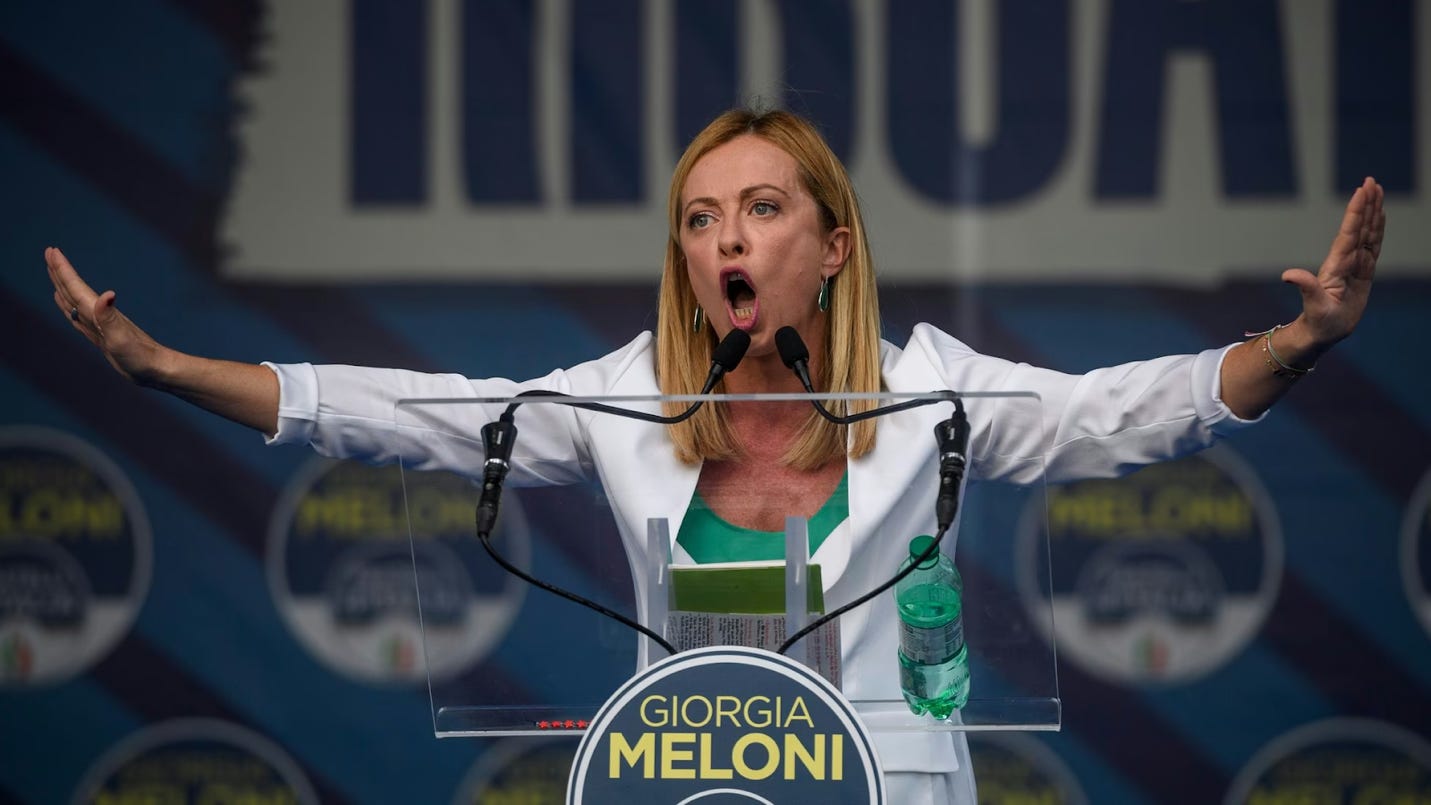
Unfortunately, the lead photo selected for the article shows Meloni speaking at a podium on the campaign trail, mouth wide open, looking angry and aggressive. The photo’s color is dark with high contrast, which is unflattering and seems menacing. We can rightfully call out antidemocratic, antifeminist, regressive women leaders while upholding our own feminist values while we do so.
Meloni isn’t the first woman head of state to reject feminism. In 1870, Queen Victoria of England who, at the time, ruled one-fifth of the global population, said “Feminists ought to get a good whipping” and “women … would surely perish without male protection.” Margaret Thatcher, the first female prime minister in Europe, told an adviser, “I hate feminism. It is a poison.”
Hadley Freeman of The Guardian reminded us more than a decade ago: “Women aren’t always good for other women because the gender of a person matters a lot less than that person’s actual beliefs … the Daily Mail has more female bylines than any other UK paper and is not exactly a totem of gender equality and female-friendliness.”
This judicial referendum was, by most accounts, the first big loss Meloni has suffered during her 3.5 years in office. Until this point, Meloni was in control of the third-longest government in the history of the Italian Republic — a political victory considering how frequently Italian leaders are ousted. The Italian government is a bureaucratic labyrinth, and when she tried to institute sweeping, alarming consolidation proposals to the judicial branch in the March referendum, she was shot down by voters.
Many said this wasn’t just a vote on a policy; it was also a vote of no confidence in Meloni. Would journalists, pundits, photo editors, and readers have the same attitude if Meloni were a man?
As a camerawoman (yes, I’m choosing a gendered job title here), I wonder if some of the written and visual coverage of the referendum was tinged by sexism?
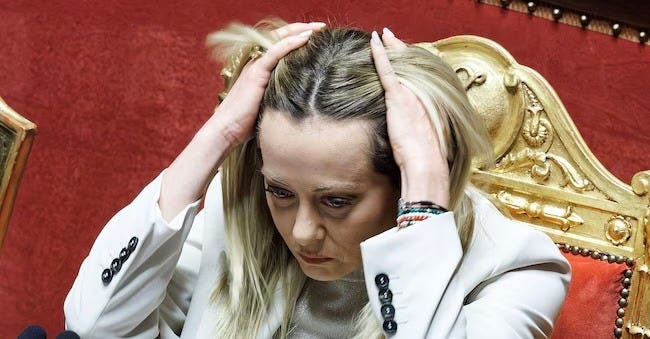
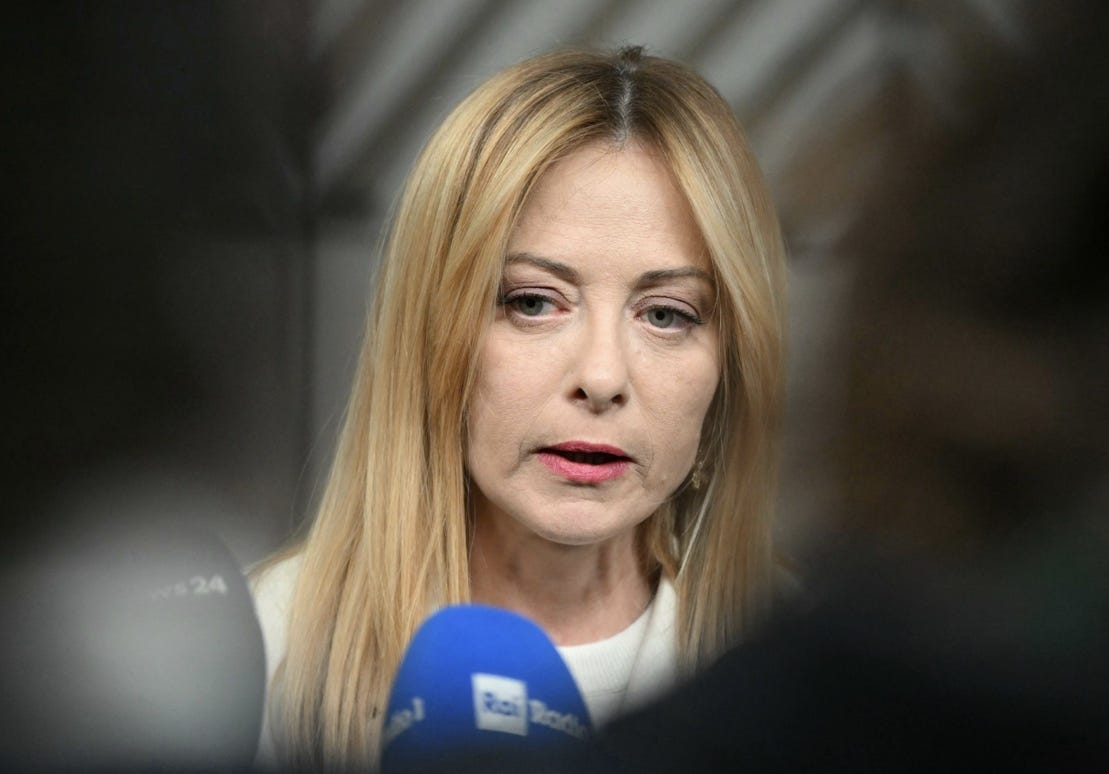
While Italians are renowned gesticulators, Meloni is disproportionately portrayed with an angry or unflattering expression, mid-speech so her mouth is open, or in the middle of a dramatic gesture.
In the Italian outlet Il Sole 24 Ore, she is portrayed with her hands in her hair — as if she’s pulling her hair out. Her eyes are downcast, dark circles exacerbated by adding additional contrast. This shot looks like it belongs in a tabloid, not the Italian financial newspaper of record.
The imagery in a recent article in the left-leaning magazine Jacobin isn’t quite as bad, yet portrays her in a “dirty shot,” a camera term for seeing an object in focus through a blurred foreground: as if we ought to see her from behind the shoulders of men looking at her. Further, her expression is pained, she is not looking at the camera, and in fact, is glancing to the left of the screen, which, in Western cultural contexts, psychologically indicates looking backward, toward the past. She looks resigned, weak, with microphones in her face.
If I were an Italian citizen, I wouldn’t have voted for Meloni and would instead have been in the street marching in Rome’s No King’s protest on March 28. I am a pro-choice, feminist, married, queer person, and Meloni is firmly opposed to many of the civil rights I hold dear (for now) in the United States. In fact, I am Italian: my great-grandparents had to flee Rome in the middle of the night with nothing but the clothes on their backs because they were leaders of the resistance against Mussolini.
But that doesn’t mean I don’t also demand that our journalistic portrayals of Meloni are fair, not gendered. Showing her defeated, weak, face contorted with anger or resignation reinforces the stereotype that women are “too emotional” for political office. For leadership. For authority. As Queen Victoria wrote to her uncle, “We women are not made for governing.”
Meloni may not want to acknowledge how many feminists built the stairs she climbed to smash the highest glass ceiling in Italian politics, but that doesn’t mean that a generation of girls — and kids of all genders — isn’t now growing up with the reality that a strong woman stands behind the prime minister’s podium.
After the referendum, my film crew and I joked that Meloni’s rise to the head of far-right Italian politics is sort of a win for feminists. That a woman can be the head of a political party named “brothers” is some kind of ironic victory at the very least. Equality, right?
Azza Cohen (she/her) is an award-winning documentary filmmaker who served as Vice President Kamala Harris’s official videographer in the White House. She recently founded a production company with her wife, Kathleen, and is writing a book about visual sexism from a cinematographer’s perspective. Uncover and address visual sexism alongside Azza every other week here on The Contrarian and on Instagram and Bluesky. The New Yorker distributed her film “FLOAT!” in 2023.

“Somehow, genderwashing has created an army of women fighting for the chance to oppress one another.” Azza, I'm so glad you included that quote in your article.
It is the best statement I've ever read depicting exactly why no woman will ever become president of these United States.
If I had been an Italian citizen I wouldn’t have voted for her either. Her ties to Berlusconi in her youth is too close to comfort for me. She calls herself a conservative and denies being a fascist but her beliefs are very far to the right. Though, I agree the photos of her are not necessarily an accurate representation of her as a leader.