


As Americans absorb the fallout of recent strikes against Venezuelan civilians, we must draw our attention to how Pete Hegseth is using visuals to drum up support for his deadly war machine.
Let’s explore two parallel visual narratives around Defense Secretary Pete Hegseth. First, I’ll focus on how mainstream media photographs him: dignified, stern, and authoritative. Second, I’ll explain the propagandistic visuals his department is using to depict military strikes that experts warn might be illegal: distant, dehumanizing, and aestheticized, like video game footage. Together, these visual strategies reveal how images construct legitimacy and normalize what is arguably extrajudicial violence.
No matter the publication—from the Washington Post to the New York Times to Fox News to the BBC to The Hindu—the photographs chosen of Hegseth look strikingly similar. He is consistently photographed from eye level or low angles, center-framed, projecting strength and confidence. Unlike the smiling photographs often chosen for women Cabinet members, Hegseth appears with a serious, deliberative expression: the look of a warrior, if you will.
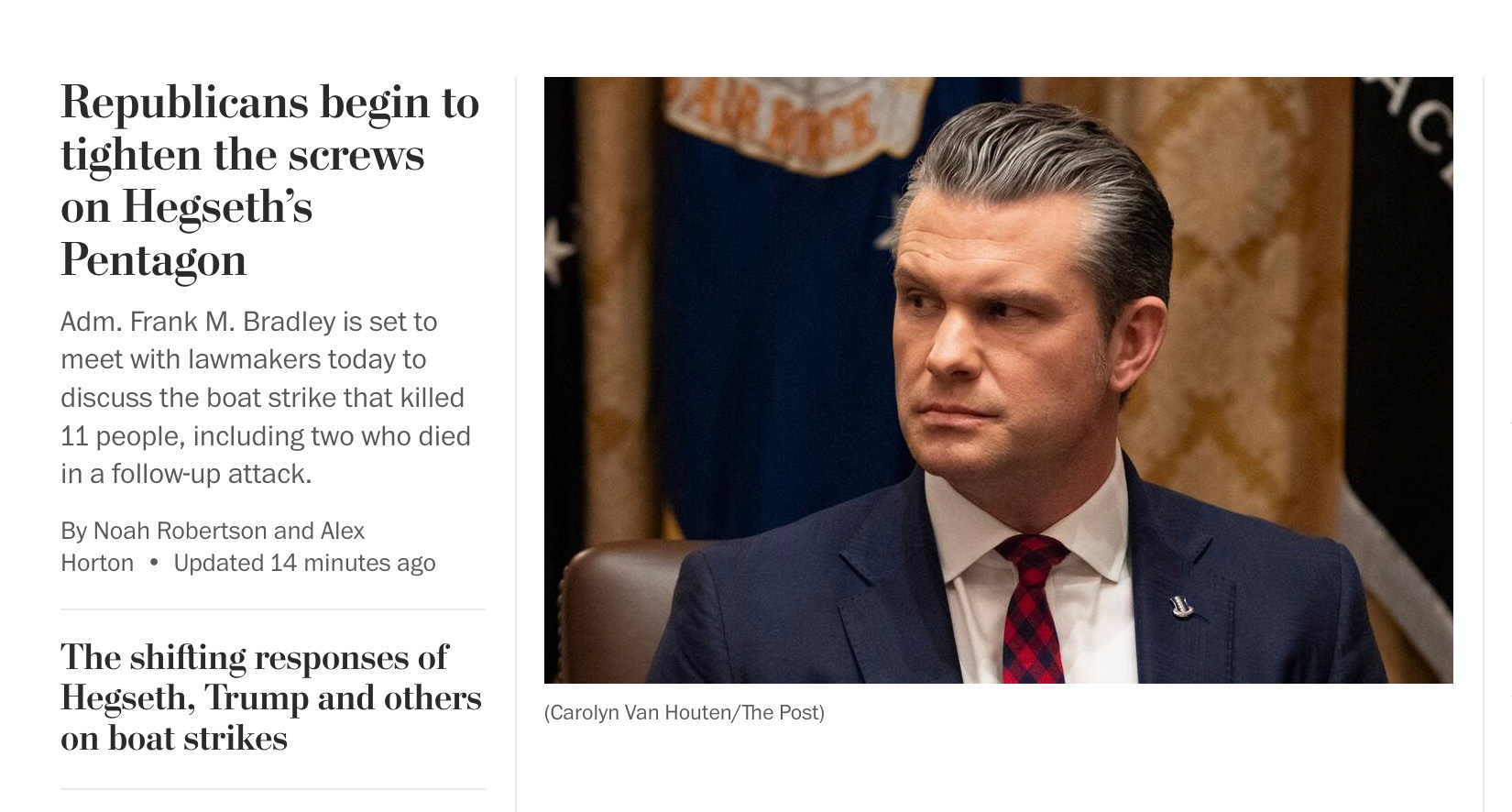
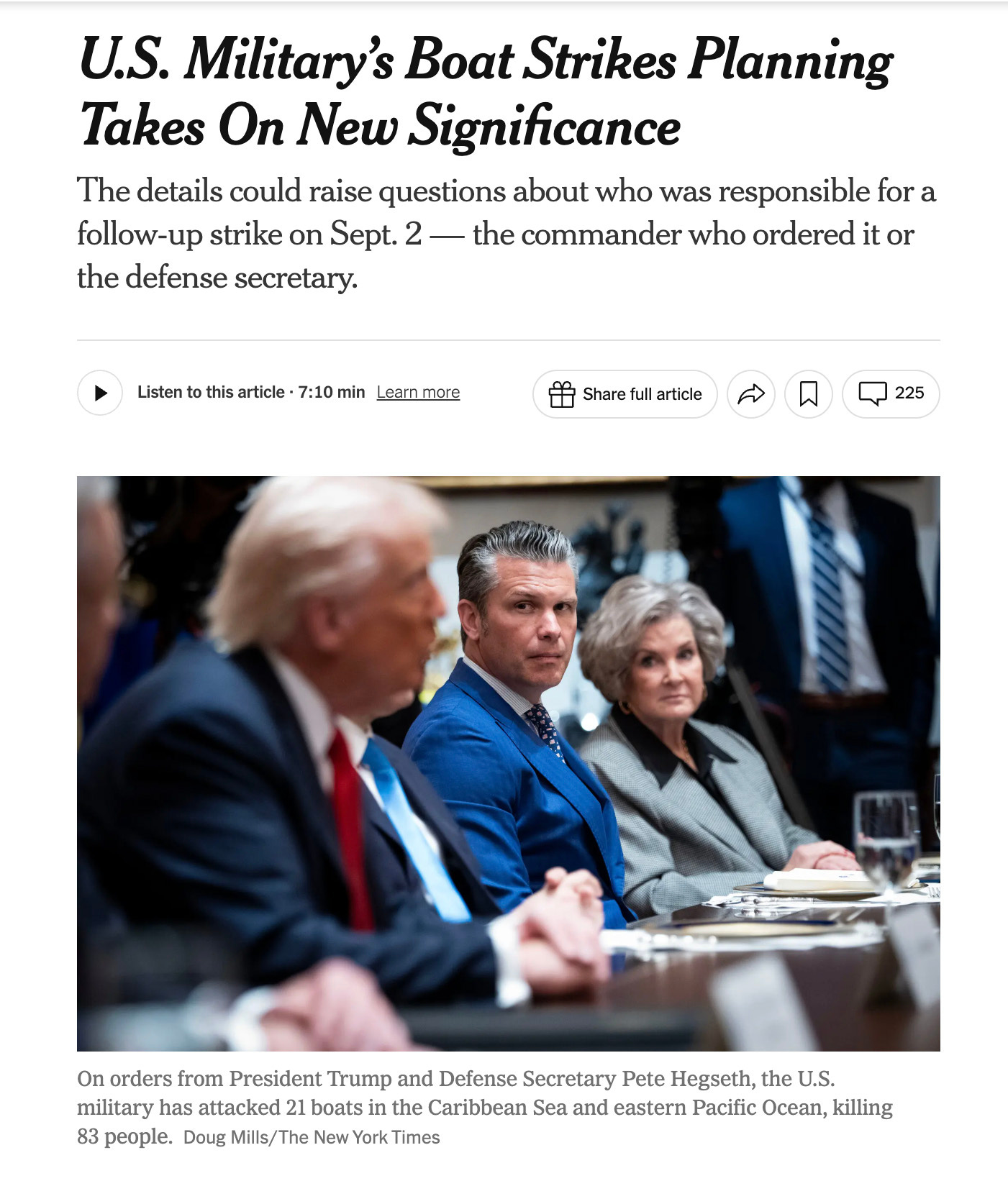
Here’s the thing about Hegseth: the man is a television veteran, so it does make some sense that he photographs well. He knows his angles better than most. Vanessa Friedman, the New York Times’ chief fashion critic, analyzed Hegseth’s style at his confirmation hearing, describing his look as “clean-cut” and “offering an argument of its own.” Her piece articulated light criticism, but the accompanying photograph told a different story. In the photograph, his expression is contemplative, strong, and powerful. The lighting hits his face softly, flattering his skin tone without distortion. He’s positioned next to a microphone as if about to speak. It made him look strong. Serious. Ready. Dependable. The photograph sold him even if the words did not.
This disconnect between critical text and flattering imagery appears across mainstream coverage. While journalists write important critiques of Hegseth’s actions, the images speak louder than the words; in our clickbait news era, readers may skim an article or even just a headline, but the picture leaves a lasting impression.
The uniformly dignified visual treatment of Hegseth stands in sharp contrast to how other political figures—particularly women—are portrayed. As I’ve documented in previous Split Screen columns, women politicians are routinely shown mid-gesture with mouths open, in unflattering lighting, or with expressions that can be read as emotional or angry or chaotic rather than authoritative.
Hegseth rarely receives such treatment. Instead, nearly every image reinforces his authority. The low camera angles literally make viewers look up at him. The centered framing suggests he is the natural focal point. The stern expression codes as competence; the photographs ask us to take him seriously.
Worse than the visual treatment of Hegseth is how his department is creating startling imagery: alarming propaganda videos depicting military strikes that legal experts warn could violate international law.
On the official Defense Department (unironically renamed the “Department of War” by the Administration) Instagram account, a disturbing pattern has emerged: videos showing strikes against civilian Venezuelan boats alleged to be trafficking drugs. These aren’t dry military briefings or after-action reports. They’re produced as spectacle: showing the strike, the explosion, the fires. The death.
The caption on a disturbing video from Oct. 29 reads in all caps: “THE WESTERN HEMISPHERE IS NO LONGER A SAFE HAVEN FOR NARCO-TERRORIST.” Another announces: “FOUR NARCO-TERRORISTS KILLED IN STRIKE.“ One particularly calculated video appears in black and white—a visual choice that makes contemporary military action look historic, almost like a relic from another time. Perhaps a time before international law and human rights conventions established rules about extrajudicial killing.
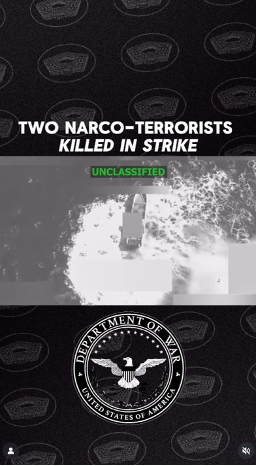
The language, too, is propaganda. “Narco-terrorists” is a dehumanizing term designed to strip the people on those boats of their humanity, their legal rights, their status as human beings entitled to arrest, trial, and due process under law.
The most disturbing aspect of these videos is their visual construction. They look like video game footage. The camera angle is high and distant, showing the boats as small objects on vast water, explosions as abstract blooms of fire and smoke. The distance is deliberate—it creates emotional detachment from the horrific human toll.
Imagine if the video wasn’t so far away. If these individuals were trafficking drugs, they should have been arrested and tried in a court of law—not executed from the sky by a foreign military force without trial, without defense, without diplomacy, without the basic legal protections that distinguish democracies from authoritarian regimes.
The video game aesthetic isn’t accidental—it’s designed to make killing feel normal, even entertaining. It’s the visual language of first-person shooter games applied to the United States government’s official account for actual human deaths. The explosions are framed as achievements, complete with triumphant, all-caps captions announcing kill counts. This represents a dangerous evolution in how our government visually presents military action.
The combination of Hegseth’s dignified media portrayal and the Defense Department’s propagandistic strike videos creates a coherent visual narrative: a strong, serious leader conducting necessary operations against dehumanized enemies. The mainstream media’s flattering photography legitimizes the man, while his department’s Instagram videos normalize the violence.
The Instagram videos particularly reveal how social media has changed military propaganda. These aren’t press conferences or official statements that could face journalistic scrutiny. They’re direct-to-public content designed to bypass critical analysis entirely. The videos appear in the same feed as vacation photos and celebrity gossip. Military strikes become just another piece of entertainment content.
Worse still, it’s working. I hate to read the comments, and hate it even more to share, but the videos are working as intended. While some comments question or denounce the killing, many more celebrate these videos and the strikes themselves.

This is how democracies slide toward authoritarianism: not through sudden dramatic changes, but through gradual normalization of what should remain shocking. And visuals are at the forefront of that narrative.
It’s time for us, as readers and citizens, to stay skeptical and question both editorial choices in mainstream media and the propagandistic visuals presented by our government. When we see military strikes presented as video game spectacle, we should recognize it—and call it out!—as visual indoctrination designed to manufacture consent for potentially illegal violence.
Until next time, keep your eyes sharp and your lenses sharper.
Send examples of visual propaganda you’ve noticed to submit@contrariannews.org with the subject line SPLIT SCREEN.
Azza Cohen (she/her) is an award-winning documentary filmmaker who served as Vice President Kamala Harris’s official videographer in the White House. She recently founded a production company with her wife, Kathleen, and is writing a book about visual sexism from a cinematographer’s perspective. Uncover and address visual sexism alongside Azza every other week here on The Contrarian and on Instagram and Bluesky. The New Yorker distributed her film “FLOAT!” in 2023.

maybe bc I am currently filing WWII & Korean War letters and photos - I do not see the face of leadership in any of the photos of Hegseth. I see an arrogant, brash man that appears angry vs competent; distracted versus discerning.
The only "news" media I give any consideration to anymore is The Daily Show and Last Week Tonight with John Oliver. If you want true honesty and journalistic integrity those are about the only shows worth watching. And they consistently dig up photos that show the true character of these ghouls.
Most other media are either MAGA suck-ups or afraid to offend anyone.