


Images have the power to normalize the extraordinary. When military personnel appear on the streets of Washington, D.C., the visual record doesn't just document events, it also shapes how we understand them. We are watching in real time how the military takeover of D.C. is being sold to the American people through provocative photographs and videos. As a cinematographer who studies the politics of visual power, I want D.C. residents and concerned citizens across the country to not take these images for granted.
Let’s analyze the images together.
The deployment itself raises significant questions. According to data from D.C.’s Metropolitan Police Department, violent crime in D.C. was down 27% in recent periods, contradicting official justifications for military intervention. An analysis by Nick Turse for The Intercept put the price tag at about $1 million per day to deploy the National Guard in D.C. But beyond the policy debates lies a crucial visual dimension: How are these deployments being promoted and marketed visually by the administration, and what messages do those images send?
Official Government Imagery: The Aesthetics of Authority
The White House and Department of Defense social media accounts suggest careful visual strategies for presenting military deployment. In official Instagram posts, we see compositional choices seemingly designed to create specific impressions of strength and legitimacy.
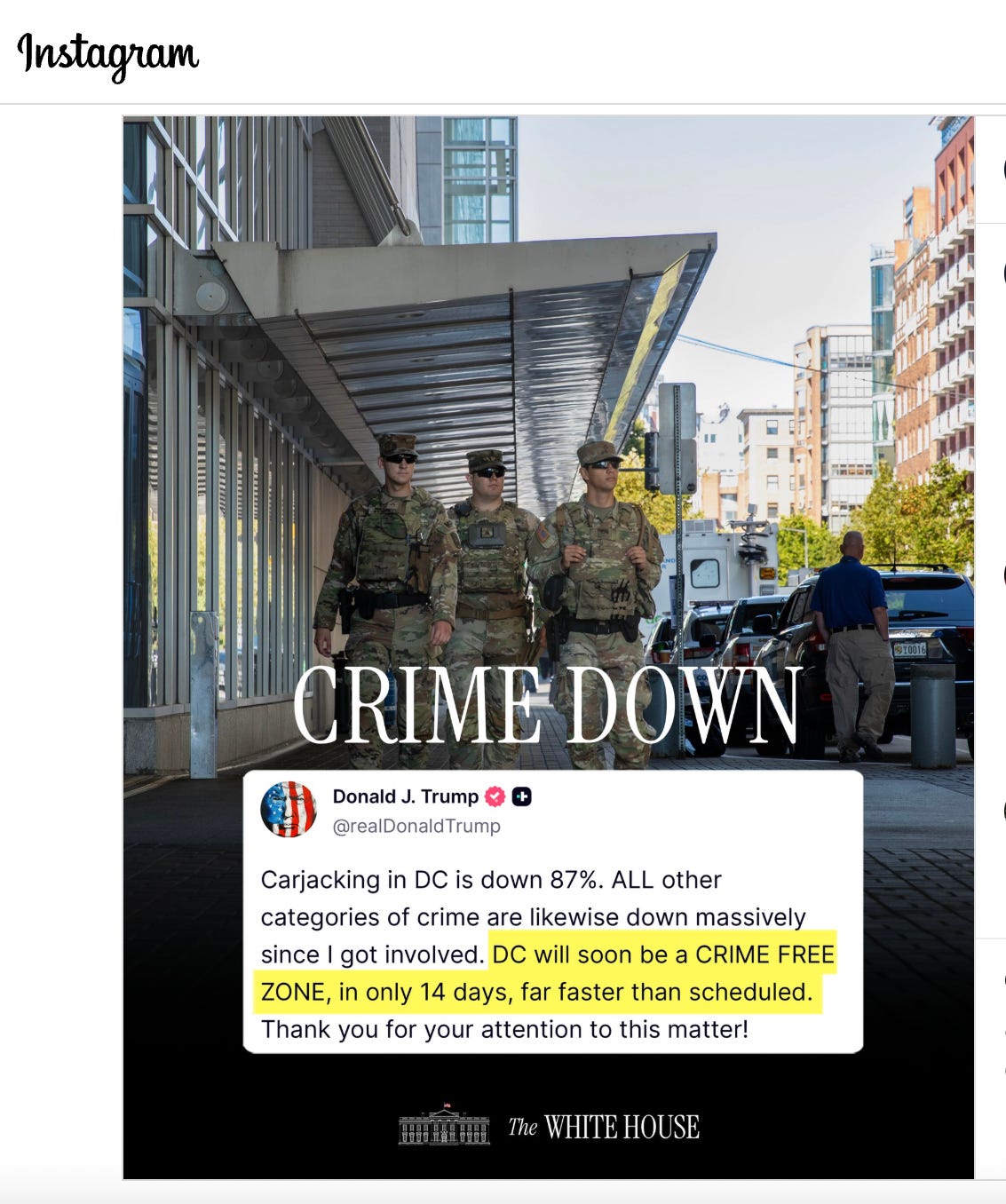
One striking image from the White House Instagram shows three soldiers walking toward the camera. The photography uses a low angle that makes the soldiers appear tall, authoritative, and powerful. Their gaze is directed toward the right side of the frame—a visual technique that, as I've discussed in previous columns, suggests forward movement and progress in cultures that read left to right (like ours). The compositional choice frames military presence as positive momentum. They are centered in the frame, mid-stride, looking purposeful. They are walking towards the camera—like they’re coming to save you.
A Defense Department post shows armored vehicles and soldiers positioned outside Union Station. The iconic transportation hub serves as backdrop, creating visual association between military presence and civilian infrastructure. The way the soldiers are posed is oddly—perhaps intentionally—reminiscent of wartime photography.

Consider how it looks similar to this July 2011 photograph, also by the Department of Defense, of American soldiers at Joint Base Balad in Iraq. Soldiers posing in front of an armored vehicle, looking directly into the camera. The image conveys power. By posing soldiers with wartime equipment in front of an iconic civilian location, the Department of Defense is sending a disturbing, warlike message.
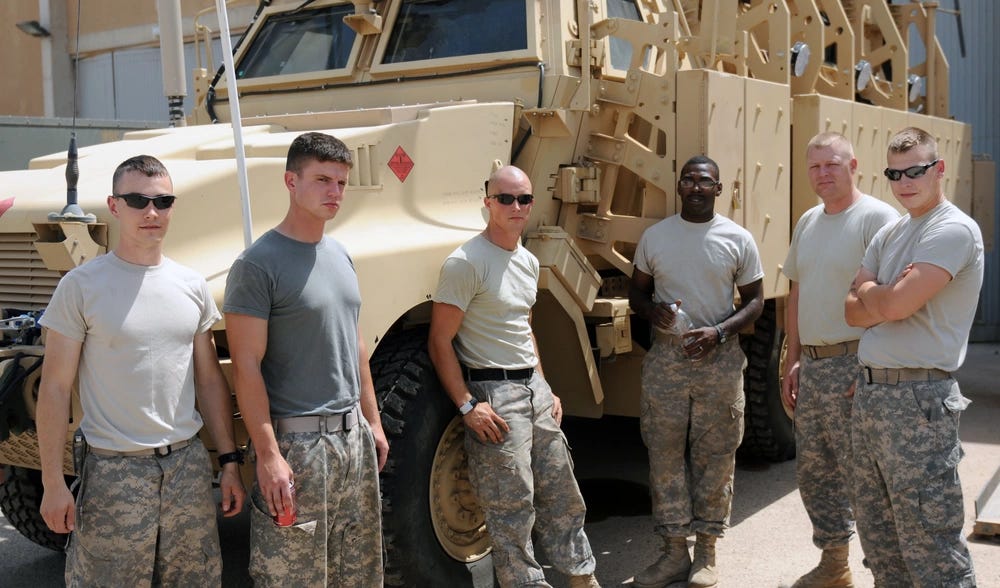
These images employ classic techniques of authoritarian visual rhetoric: low camera angles that emphasize power, strategic positioning at symbolic locations, and compositional elements that suggest legitimacy and progress. The photography doesn't simply document military presence; it actively argues for its appropriateness and necessity.
Counter-Narratives in Independent Photography
Independent journalists and D.C. residents are creating different visual records of the same events. AP photographer Jacquelyn Martin has used clever compositional techniques to tell a different story of this moment. For example, she captured National Guard members walking toward the Capitol. At first glance, this is a straightforward composition: the Capitol in the middle, framed by soldiers in motion. You see a bicyclist framed between soldiers, a classic element of street photography. On closer examination, I find the composition not just aesthetically pleasing, but metaphorically brilliant. This image articulates the symbolic weight of military personnel approaching the seat of democratic government. The soldiers are encroaching on normal civilian activities (the biker, the walker). The photograph, to me, evokes a sense of unease. It gives me pause and demands my skepticism.
In this image of federal agencies making an arrest in the Petworth neighborhood of D.C., Martin captured the agents and the person being targeted. You see a gun drawn and the facial expressions of all the people in the scene. This isn’t just another camera angle – it is a different perspective. Martin’s photographs help us ask questions.
The contrast in visual approach between official government imagery and journalists like Martin reveals how photography can—and must!—construct multiple narratives about events. Official imagery emphasizes strength, protection, and legitimacy. Journalists can emphasize the disruption, the human impact, and the departures from democratic norms. This is why professional photographers and citizen journalists are important.
The Psychology of Visual Normalization
Perhaps the most concerning aspect of current imagery is its potential to normalize extraordinary circumstances through repetition. The more we see authoritative images of National Guard personnel at Metro stations, outside government buildings, and in civilian spaces, the more normal it begins to feel.
Images that initially seem shocking or concerning become familiar through repetition, reducing their emotional impact and political significance. Think back to the first time you saw an image (or the actual thing) of the soldiers in D.C. How did you feel? What did you think? We must fight back and continue to question what we are witnessing.
Visual Resistance Through Context
Photographers and editors can counter normalization through conscious choices about context, framing, and presentation. Images that emphasize the extraordinary disruption, that center civilian reactions, and that use composition to question democratic spaces being altered can help us resist rather than normalize.
The images of military deployment in D.C. will outlast the deployment itself. Photographs of military personnel as protectors of civilian spaces tell one story. Photographs of them as disruptors of civilian normalcy tell another. Both might be factually accurate, but they construct different political meanings through visual emphasis and compositional choice.
Ask questions about the photographs? Who is the photographer, and what is the goal? Does this image make me feel safe, uneasy, inspired, concerned? What do you see in these photographs? The visual record being created today shapes tomorrow's assumptions about the role of the military in our daily lives.
Anyone creating and sharing images—from official government photographers to independent journalists to residents with smartphones—is participating in a larger conversation about democratic norms and acceptable governance. If you see soldiers and tanks, take out your phone and document it. For history. For all of us.
As Melissa Wasser of the ACLU wrote for MSNBC, “The aim is clear: Make fear the norm. If we don’t call it out, this playbook will be used again and again.”
The camera doesn't just capture reality—it constructs political possibility. The images of military deployment in D.C. (and in Los Angeles this summer and potentially, awfully, elsewhere) will either normalize authoritarianism or preserve democratic accountability. That outcome depends partly on how conscious, how outraged, and how skeptical we remain.
Until next time, keep your eyes sharp and your lenses sharper.
*Send examples of visual politics you've noticed to submit@contrariannews.org with the subject line SPLIT SCREEN.*
P.S.: I like to include gender breakdowns of my research. For this article:
Total unique researchers: 2
Female researchers: 1 (50%)
Male researchers: 1 (50%)
Azza Cohen (she/her) is an award-winning documentary filmmaker who served as Vice President Kamala Harris's official videographer in the White House. She recently founded a production company with her wife, Kathleen, and is writing a book about visual sexism from a cinematographer's perspective. Uncover and address visual sexism alongside Azza every other week here on The Contrarian and on Instagram and Bluesky. The New Yorker distributed her film “FLOAT!” in 2023.

The pictures of National guard troops in DC remind me forcibly of what I saw in Prague in the early1970s, not that long after Russian troops and tanks had rolled into the city to crush Prague Spring. There were armed troops everywhere, on almost every street corner,clearly meant to intimidate citizens and visitors alike. Not so coincidentally, this was shortly after my cousin and her family, including her journalist husband, were given 48 hours to leave Czechoslovakia because the regime didn’t like what he had written. Scary times, then and now
Too easy to become inured or desensitized to the abuse & aggression.
This is how bullies, despots & domestic abusers operate.
This isn’t just ‘absurd’ - it’s propaganda & incitement to ‘legitimized’ violence.
— buff young men strutting their stuff.
They aim to incite feelings of physical superiority & righteousness of cause.
— and throw in a few uniformed POC to imply that racism isn’t a large part of their motivation.
Face it — no caucasians are being rounded up & deported!
— and Trump is enticing/PAYING white Greenlanders/ S. Afrikaners to migrate here.
Meanwhile American farmers are seeing their crops wilt or die because their hardworking South American labourers have been rounded up & deported.
— and houses aren’t being built or repaired, patients in nursing homes properly cared for, children nannied, houses cleaned, meals served … because Trump hates colored people. 🔥