


The seismic devaluing of human creativity across the entertainment industry has reached a tipping point and crystallized in the form of Tilly Norwood: Hollywood’s first “AI actor.” Created by Dutch producer Eline Van der Velden’s company Xicoia, which “aims to shape the future of entertainment by featuring hyper-realistic digital stars,” this artificial creation represents not innovation but exploitation, not creativity but extraction, not the future of entertainment but the death of an entire industry’s soul and possibly ours along with it.
Let’s be clear: “Tilly Norwood” is not an actor. It is a digital puppet designed to replace human artistry. SAG-AFTRA didn’t mince words in a statement: Tilly Norwood is “a character generated by a computer program that was trained on the work of countless professional performers—without permission or compensation. It has no life experience to draw from, no emotion…. Creativity is, and should remain, human-centered.”
Yet Van der Velden is shopping this creation to Hollywood talent agencies, claiming to “want Tilly to be the next Scarlett Johansson or Natalie Portman.” Van der Velden recently announced that agencies were circling. It’s not lost on me that the first “AI actor” was modeled on two women who started acting at a young age and were devastatingly hypersexualized. The audacity would be laughable if the stakes weren’t so high.
Constructing a compliant woman
The visual presentation of Tilly Norwood reveals everything about the ideology driving this project: young, conventionally attractive, white, and designed to embody every Hollywood stereotype of female compliance and appeal.
Actor and model Michael Aurelio identified the core issue immediately: “Pretty telling that the [industry’s] first venture into this was to create a teenage girl they could control.”
The Instagram account for Tilly Norwood—which has accumulated over 40,000 followers—performs an elaborate pantomime of life for a young female struggling actor. Posts show the creation “drinking” coffee, “shopping” for clothes, “preparing” for auditions. One caption reads: “Seen: a girl romantically browsing racks. Unseen: her bank account begging her to go home. #ThriftingChronicles.”
The comments section (open on only a single post before being shut down) reveals how audiences actually perceive this performance: “cosplaying as ‘broke’ to be relatable is wild,” one user wrote. Another: “Wow a computer robot pretending to have the lived experience of human poverty is simply such a great use for this technology.”
This demented visual construction extends to Tilly’s actual “performances.” Images from the creation’s reel appear strikingly similar to iconic shots from Wonder Woman and Romeo & Juliet.
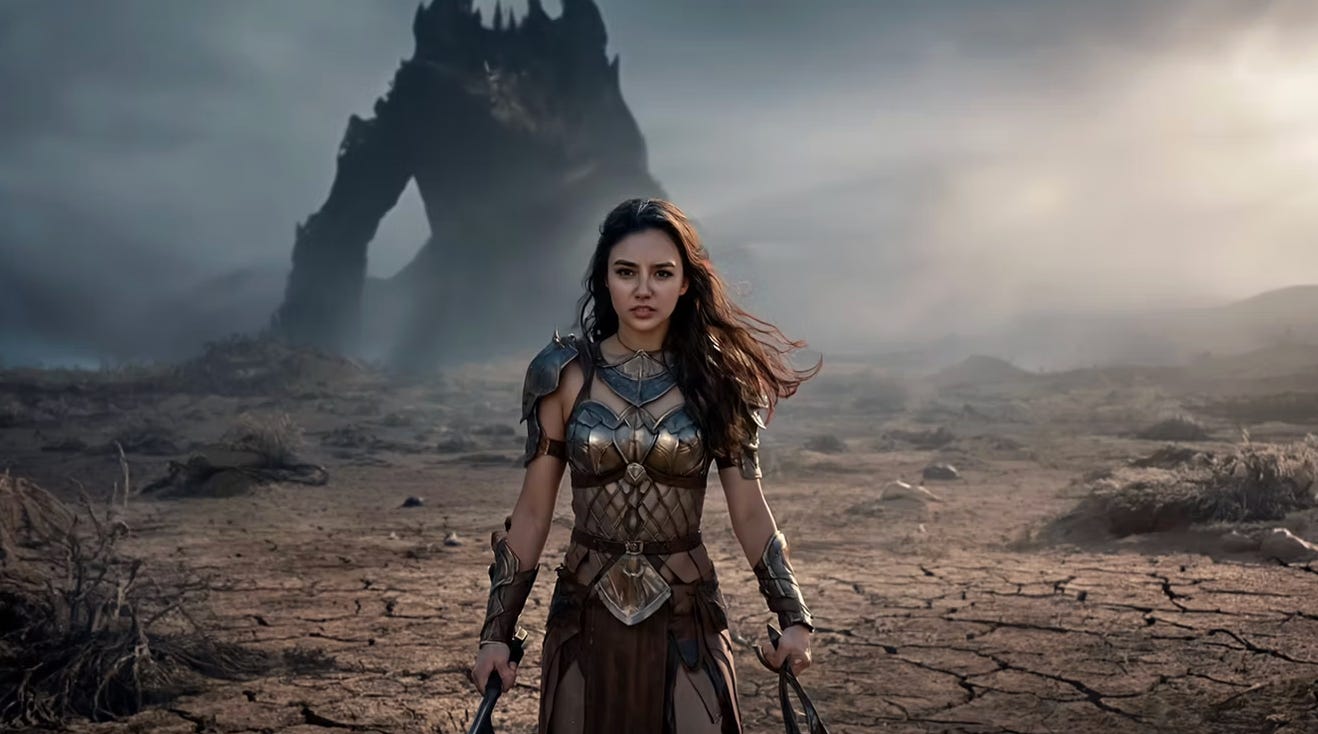
Sometimes the image has freckles, sometimes it doesn’t. The creation can’t maintain visual coherence because it is not a real human being with a real body. What’s more, per Aurelio’s comment, the more malleable the creation, the better to allow studios to serve audiences whatever they perceive they desire.
In a “comedy sketch” titled “AI Commissioner,“ featuring an entire cast of AI-generated characters, a male bot jokes, “She’ll do anything I say; I’m already in love.” Another comments, “Girl-next-door vibes.” The visual and verbal construction of Tilly Norwood makes explicit what Hollywood has long practiced: the desire for young female performers who are controllable, compliant, and devoid of agency.
The labor nightmare disguised as innovation
The “advantages” of AI performers that Van der Velden and her supporters celebrate aren’t benefits; they’re a catalog of labor violations and human rights abuses waiting to happen.
The creation never gets sick or stuck in traffic. It doesn’t need parental leave to recover from birth or bond with a new actual human life before returning to the set. The creation will never age, complain, or need a second take. It can star in a film, perform its own stunts, and simultaneously appear as every extra in the background. It doesn’t need lunch or bathroom breaks, pay raises, or union representation. An AI performer doesn’t need to consent to nude scenes or bring on a pesky, costly intimacy coordinator. Consider the implications for bodily autonomy, sexual exploitation, and what young people might see on screen.
This isn’t innovation. This is the mechanization of human creativity and the elimination of labor protections that workers fought generations to establish. It’s the ultimate fantasy of capital: workers who never resist, never organize, never demand dignity or fair compensation.
Irresponsible journalism and dangerous framing
Some outlets have been dangerously complicit in anthropomorphizing this technology. Indiewire described Tilly Norwood as “she” and “a dewy teenage girl.” Variety’s use of “ingenue“ recalls Taylor Swift’s song “Nothing New,” which expresses her concerns about women’s disposability in the entertainment industry, the inevitability of being replaced by the next young thing. She writes: “Are we only biding time ’til I lose your attention? And someone else lights up the room? People love an ingenue.”
When the far-right is fighting a gender war to define not only what a woman’s place is but what a woman is altogether, the stakes of framing Tilly Norwood as an idealized version of a human woman couldn’t be higher. When we call AI creations “actors” or “performers,” use gendered pronouns, and describe them with the language of human experience, we legitimize AI not only as actors, but as people — perfected.
The hollow defense of “just another tool”
Van der Velden has responded to the backlash and defended her creation by calling AI “not a replacement for people, but … a new tool, a new paintbrush. Just as animation, puppetry, or CGI opened fresh possibilities without taking away from live acting, AI offers another way to imagine and build stories.”
This defense collapses under the slightest scrutiny. Animation, puppetry, and CGI created jobs. They require animators, puppeteers, digital artists, and entire teams of skilled workers. These technologies augmented human creativity and created new employment sectors.
This isn’t craftsmanship. It’s theft dressed up as innovation.
Hollywood’s ethical reckoning
Hollywood hardly has a reputation as an ethical industry. The #MeToo movement exposed systematic sexual abuse and exploitation. Labor violations are routine. #OscarsSoWhite revealed entrenched racism in industry gatekeeping. The introduction of AI “actors” represents the next frontier of exploitation—one that threatens the foundation of creative labor itself.
Paramount chairman David Ellison has already committed to “thoughtfully integrate [AI] into every aspect of our work” to “maximize efficiencies.” The fact that Ellison and his father, AI tech mogul Larry Ellison, are looking to buy Warner Bros. suggests this isn’t a hypothetical future but an immediate threat.
The reactions from working actors reveal the stakes. Melissa Barrera wrote: “Hope all actors repped by the agent that does this … drop their a$$. How gross, read the room.” Natasha Lyonne called for boycotts: “Any talent agency that engages in this should be boycotted by all guilds.” Emily Blunt said, “That is really, really scary…. Please stop. Please stop taking away our human connection.”
Yet some industry insiders are dismissing the concern as “overblown.” One agent representing A-listers told Variety: “Only one producer has brought it to my attention, so whatever hysteria there is seems to be under control.” In confirming that they would not represent Tilly Norwood, major agency Gersh kicked the can down the road: “It’s going to keep coming up, and we have to figure out how to deal with it in the proper way. But it’s not a focus for us today.” This complacency enables dystopia. Gersh will slide in once AI actor representation has become normalized. By the time the threat feels urgent to everyone, the infrastructure for replacement will already have been built.
The crossroads
We stand at a crossroads. The path forward requires collective action. Agencies must refuse to represent AI creations. Studios must commit to human-only casts. Unions must strengthen protections against AI replacement. And audiences must refuse to watch content that replaces human performers with digital simulations.
Van der Velden asked for Tilly Norwood to be judged as its “own genre.” Fine. Let’s judge what it represents: corporate exploitation of creative labor, technological unemployment disguised as innovation, and the theft and mechanization of human art and experience.
The dystopia isn’t coming. It’s here. The question is whether we’ll normalize it or fight it.
Azza Cohen (she/her) is an award-winning documentary filmmaker who served as Vice President Kamala Harris’s official videographer in the White House. She recently founded a production company with her wife, Kathleen, and is writing a book about visual sexism from a cinematographer’s perspective. Uncover and address visual sexism alongside Azza every other week here on The Contrarian and on Instagram and Bluesky. The New Yorker distributed her film “FLOAT!” in 2023.

Yuck. I wanna see real humans working their art/craft to the best of their abilities at any given time.
It takes real talent to be creative and it takes time to see what really works and what doesn’t. Anyone who learns to use AI could be labeled as an actor or whatever but it’s just a way to achieve creative theft from the real talent.