


Virginia’s 2025 gubernatorial race between Lt. Gov. Winsome Earle-Sears and U.S. Rep. Abigail Spanberger is historic. If Earle-Sears wins, she would be the first Black woman elected governor of any state since Reconstruction. Either would be the commonwealth’s first female governor. In addition to its gravitas for aspiring women candidates, politicos see this race as a bellwether for the 2026 midterms and a referendum on the Trump administration.
It’s pretty exciting when you think about it: Two qualified women competing for one of the nation’s most prominent governorships, just outside of Washington, during a contentious political moment. There just aren’t that many examples of two women running against each other for governor in American history. According to the Rutgers Center for American Women and Politics, only 10 gubernatorial elections have featured women as both major party candidates, and five of those were in 2022. The first, in Nebraska in 1986, felt revolutionary. Trudi Mariscal told The New York Times at the time: “I voted for Helen Boosalis but I still think it’s great to have a woman for Governor…. Maybe someday we’ll even have a woman President.”
Sigh.
Nearly 40 years later, we’re still celebrating the novelty of women candidates. Worse, we’re still seeing the same patterns of visual diminishment that have plagued women candidates for decades. After seeing frustratingly sexist images of their first and only debate, I wanted to analyze coverage and put it into context.
Side by Side
The Washington Post‘s coverage of the Virginia governor’s race provides a stark study in how editorial image selection shapes perception of women candidates. Before their recent debate, the Post published this article with authoritative, serious photographs of both candidates. The images treated Spanberger and Earle-Sears with visual dignity:
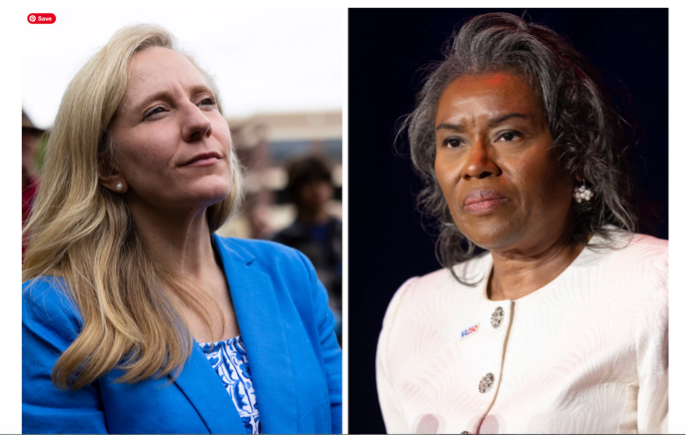
Both women were shot from eye-level angles, the camera position that conveys equality and respect. In each photograph, the candidates’ eyes were open and their mouths were closed. Their facial expressions were serious, not smiling. Their hair looked professional, not blowing in the wind or disheveled.
These were images of two serious candidates for serious office.
Then came the post-debate coverage from the very same outlet, and the visual narrative changed dramatically. The photographs accompanying the debate analysis showed both women with their mouths open, appearing to scream into their microphones. Earle-Sears’ brow was furrowed, her forehead shiny. Her eyes were narrowed and her mouth agape. Her hand was raised and it wasn’t clear where she was looking. Spanberger didn’t look much better—her mouth open, her finger pointed somewhere off-camera, like a mother scolding a child.
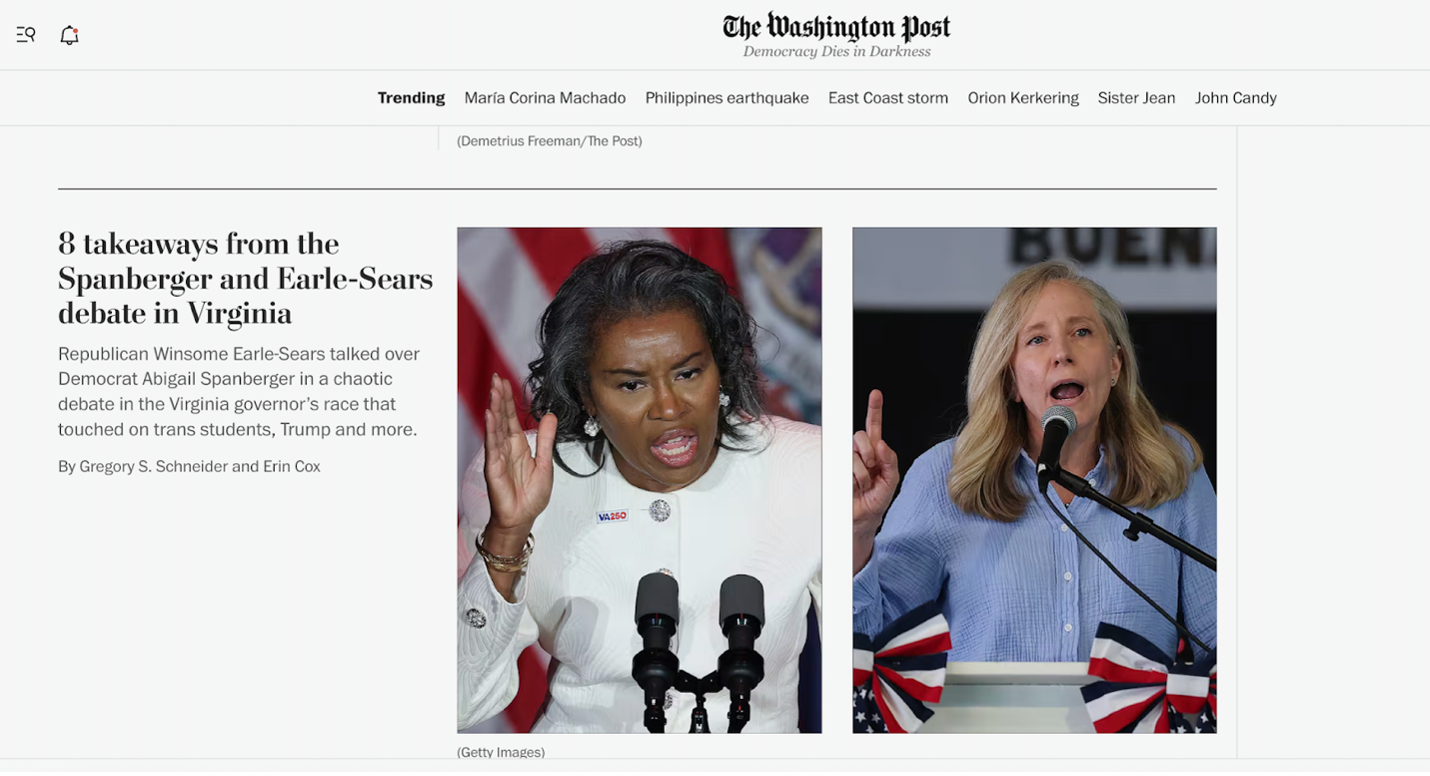
The shift is jarring. Before the debate: authority and composure. After the debate: chaos and shrillness. Though I don’t think there was sinister intent in publishing these photographs or a specific reason the unflattering images were chosen after the debate (except, well, clicks), we should analyze how and why these images are problematic.
Let me be clear: I’m not saying that it’s sexist to photograph women talking, debating, or even arguing passionately. Debates are inherently confrontational, and capturing that energy is part of documenting political discourse. Not every photograph of a woman with her mouth open or her hand raised constitutes visual sexism.
I’m also not claiming that male candidates never receive unflattering photographic treatment. They do. If we conducted an exhaustive search, we could certainly find unflattering debate photos of male candidates throughout history.
But identifying visual sexism isn’t about proving that no unflattering photos of men exist. It’s about recognizing that the deck is already stacked against women candidates in ways that make these visual choices more damaging, more frequent, and more politically consequential.
When women are shown with mouths open, brows furrowed, and fingers pointing, it reinforces existing stereotypes about women and their emotions. Context matters enormously here. When the image of a man mid-expression is used, he’s seen as passionate, dynamic, strong. When the same is used for women, she’s seen as bossy or unstable.
Had photo editors chosen a more composed image—closed mouths, hands down—readers might see gravitas instead of volatility. The power of the press lies not just in capturing images but in selecting which ones to publish. Photographers shoot hundreds of frames during any debate. Editors choose which images will represent the entire event. That choice is never neutral, and for women candidates, this choice unfortunately reinforces rather than challenges existing biases about female leadership.
The visual framing isn’t happening in isolation. During the debate, Earle-Sears referred to her opponent as “Abigail” at least 20 times rather than “Representative Spanberger” or “Congresswoman Spanberger.”
This is an old trick used by male politicians and journalists to undermine female candidates. First-name-only references suggest familiarity, informality, or lack of authority. You rarely hear male candidates referred to solely by their first names in formal debate settings—it’s “senator,” “governor,” “congressman.” When Earle-Sears didn’t say “Abigail,” she said “Miss Spanberger.” Using “Miss” makes her sound younger, rather than convey the authority she has earned through her career in the CIA and in Congress. When Earle-Sears, herself a woman candidate, deploys this technique against another woman, it demonstrates how deeply ingrained these diminishment tactics are. Sexism preys on all of us; we must be vigilant for its snares with words and with images.
Making history, and yet
There’s something profoundly frustrating about watching history being made while watching historical patterns of sexism repeat themselves. Virginia is one of only two states with a gubernatorial election in 2025, both considered a referendum on this political moment. Virginia is home to a large number of federal employees (or, sadly, former), many of whom are currently furloughed because of the government shutdown. And regardless of which candidate prevails, Virginia will finally have elected a woman governor.
Yet even in this milestone moment, we still see visual framing that emphasizes emotion over authority, chaos over competence.
The fact that one candidate is Black adds another layer of complexity. Visual representation of Black women in politics carries additional historical weight, as I’ve explored in previous columns about first lady Michelle Obama, Vice President Kamala Harris, Rep. Shirley Chisholm, and others. The way Earle-Sears is photographed matters for both racial and gender representation.
What Coverage Could Look Like
The pre-debate photographs prove that dignified, authoritative visual coverage of both candidates is entirely possible. Those images exist. Editors have access to them. After the debate, they chose to lead with images that emphasized confrontation and emotion over substance and leadership.
Different editorial choices might have shown both candidates in composed moments during the debate or used split-screen imagery showing them addressing policy questions, or photographs that emphasized their executive bearing rather than their most animated gestures.
I don’t think these standards are impossible. In the news industry, we’re always running up against the clock to file, to fact-check, to publish, and to post. I don’t deny that, as I write this piece right up against a deadline myself. But taking an extra minute to check for visual sexism is time well-invested. The future of our country depends on it.
Trudi Mariscal’s 1986 hope that “someday” we’ll have a woman president still hasn’t been realized. But we can start by demanding better visual coverage of the women who are running, debating, and governing today.
Until next time, keep your eyes sharp and your lenses sharper.
*Send examples of visual sexism to submit@contrariannews.org with the subject line SPLIT SCREEN.*
Azza Cohen (she/her) is an award-winning documentary filmmaker who served as Vice President Kamala Harris’s official videographer in the White House. She recently founded a production company with her wife, Kathleen, and is writing a book about visual sexism from a cinematographer’s perspective. Uncover and address visual sexism alongside Azza every other week here on The Contrarian and on Instagram and Bluesky. The New Yorker distributed her film “FLOAT!” in 2023.

Excellent analysis, from the viewpoint of an old white guy with two truly smart daughters (smarter than me).
Thank you for your inciteful analysis of visual sexism. I frankly think Earle-Sears is weird and I can't see any universe where I could seriously entertain voting for her, but I realize that most of the pictures I have ever seen of her make her look weird, regardless of her views. Thank you for reminding me of the built-in sexism that permeates everything we do.