

By Shalise Manza Young
“Southern trees bear a strange fruit
Blood on the leaves and blood at the root
Black bodies swingin’ in the Southern breeze
Strange fruit hangin’ from the poplar trees…”
Strange fruit is hanging from Southern trees. It’s not accurate to say “again,” because that indicates it stopped for a time, and the reality is it likely never has.
Yet it is hard to deny that it isn’t happening more frequently now. Alarmingly, disturbingly more frequently.
Ninety years after Jewish teacher Abe Meeropol wrote the poem that would become the legendary Billie Holiday’s most well-known recording, a protest song so powerful that the federal government ended her career, Black people across social media are reviving its lyrics and the painful picture they paint.
Because strange fruit is hanging from Southern trees.
Reportedly, at least seven Black people have been discovered hanged this calendar year; in almost all of them, local law enforcement quickly ruled them suicides before an autopsy had been performed and without any real investigation into the circumstances.
The most recent was last week in Roanoke Rapids, N.C. — just days after a still unidentified Black man was found hanging in downtown Raleigh, N.C., on Aug. 15. In that case, police said within hours that the death was self-inflicted.
The man was found at 3 o’clock in the afternoon. In broad daylight. Near where a Caribbean fest was happening. And officials insist evidence — which the public hasn’t seen — shows it was a suicide.
To be clear: Black people do die by suicide. I’m not saying they don’t. Lack of access to mental health services, a stigma surrounding needing care, a long-held belief that prayer and not necessary care can take problems away, the desperation of poverty — there are many reasons why members of the community come to that determination, just as people of other backgrounds do.
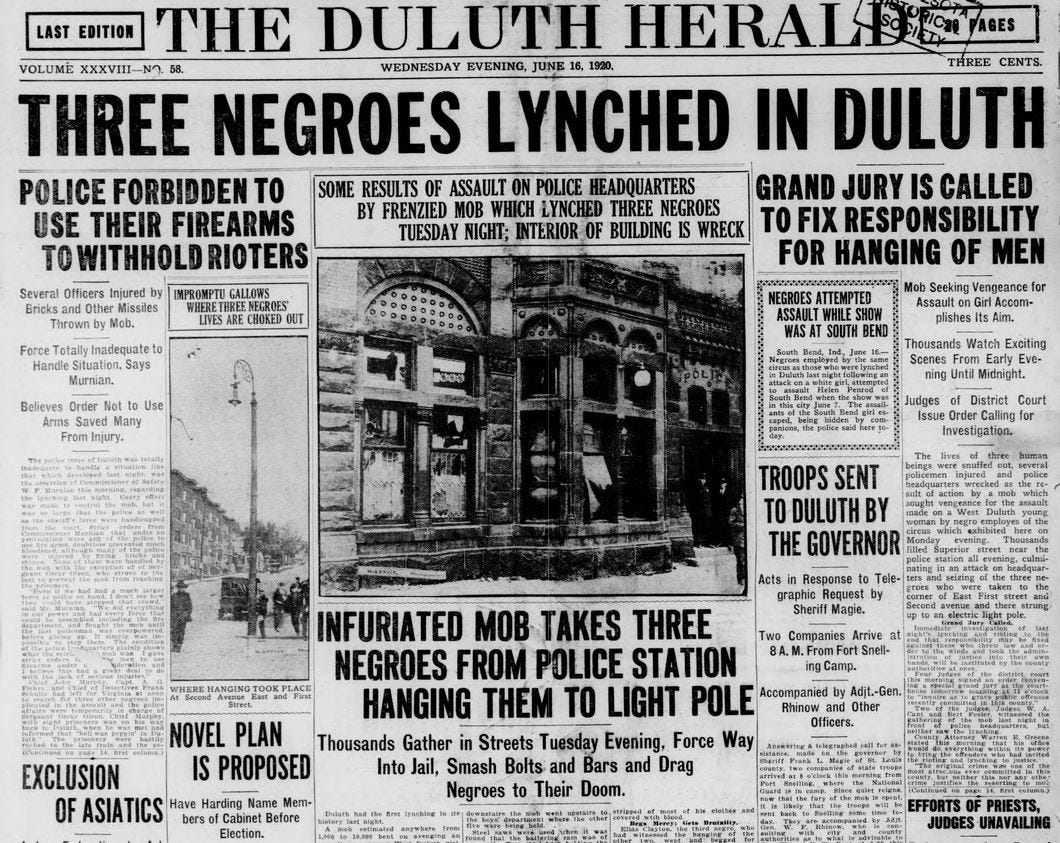
But there is a long, dark history of lynching of Black Americans in this country, primarily in the former Confederate states, though such deaths are not strictly confined to those places. The Equal Justice Initiative documented at least 4,400 racial terror lynchings from the post-Civil War Reconstruction Era through the end of World War II, many of them treated as though they were community picnics with hundreds or thousands gathering to watch the torture and killing.
And there is a long, dark history of law enforcement showing indifference to such killings at best, and at worst taking part in them. Police in Tulsa, Oklahoma, had an active role in the 1921 massacre of Black citizens, just as they had in the East St. Louis massacre a few years earlier.
To this day, Black people are killed by police for all manner of “infraction,” from selling loose cigarettes on the street to possibly passing a counterfeit $20 bill, to being in their mother’s lap in a car in a Walmart parking lot after she was falsely accused of stealing diapers.
Those are just the fatal actions. Earlier this year, a trove of vile, racist text messages from a Massachusetts state trooper included one telling a fellow cop that he planned on “tying up a [n-word] and dragging him from my bumper through the streets,” and he is hardly alone among police officers in blithely sharing such ideas.
Data continuously show disproportionate negative outcomes for Black Americans across all areas: healthcare, arrests and sentencing, education, employment — the list goes on.
All of which to say, there are centuries of evidence explaining why Black people and those who support them doubt that these hangings were suicides based solely on the word of state actors. This is especially true for Mississippi, which EJI found had the highest number of racial terror lynchings during the time frame it studied, with well over 600.
You’d be hard pressed to find in those historical cases in Mississippi anyone held to account for killing another human, though you can find the story of 14-year-old George Stinney, put to death by the state after he was found guilty of killing two young white girls by an all-white jury that deliberated for 10 minutes. George was so small he was seated on a Bible so he could be strapped into the electric chair. He did not kill the girls.
Mississippi’s approach seemingly hasn’t changed much: Jackson County officials are frustrating many by appearing to be dragging their feet in investigating the July 4 death of Nolan Wells. That same county is where 29-year-old mother Tasia Fortune was found behind an abandoned house earlier this month, so high up in a tree a fire truck was needed to recover her body. Police have detained a person of interest, but there are no concrete answers yet as to how or why Fortune died.
How did she climb that high? Was a ladder found on the scene? There are similar questions still unanswered in the 2025 death of Tory Medley — he was found hanging from at a golf course in Brookfield, Wisconsin, 10 miles west of where he lived in Milwaukee. Medley did not own a car.
With the incredibly invasive Flock cameras that are in the news and an increasing number of stories of police officers using them to stalk ex-girlfriends or ex-wives and a sheriff in Texas using them to track down a woman that left the state for abortion care, many are wondering why they aren’t being used to solve actual or potential crimes such as these deaths.
Over and over, commentators and others, including YouTube star Ms. Rachel (who has been giving an absolute masterclass in how white people with major platforms can be not just allies but accomplices), have declared, “Black people don’t hang themselves from trees” because of the horrific way it was used to terrorize our ancestors, and possibly our contemporaries: the civil and human rights organization JULIAN published a report titled “A Crimson Record” which found over 70 deaths across seven Southern states from 2000-2025 that the group considered modern-day lynchings.
Sadly, it is possible that at least some of these were deaths by suicide.
But taking the current stories and the frequency of the headlines as a whole, it’s beginning to feel like there’s a new terror campaign in progress.
Shalise Manza Young is an award-winning writer focused on the intersections of race, gender, politics, and sports. She is the director of track and field at Phillips Andover Academy. She and her family, including Contrarian Pet of the Week Coco, live in Boston. You can find her on Bluesky @shalisemyoung.
Yes — It’s tragic that we’re being schooled in real time on the horrific civic and emotional responses of our Nation in the 1920’s. I’d believed we were beyond this — and perhaps most of us are: but there’s a loud subset that accepts no accountability for the ICE actions; for the murders of people clinging to their boats after being attacked by our country; for the withholding of approved funds in countries needing food and medical supplies; for murdering people after calls for help with mental health issues; for robbing the coffers of money designated for health care and medical research, for trying to dismantle public schools and deny their successes; for not releasing the Epstein files and any information related to it; and for denying the rights and privileges of all people — including THE VOTE.
It’s hard to ‘like’ this but it cannot be repeated often enough. There is no way these people were not murdered, and that “police” in those areas are happy to collaborate. This makes me sick—again. I’m 76 and lived through the Civil Rights Movement. I made the mistake of thinking things were better. Well, maybe in some ways, but this hideous hatred is still there. I am sick that this Facist regime has given them permission 👹