


“I am not yet convinced that any access to men in power gives a man more truth or light than the politics of a coffee house”—Jonathan Swift
Why does it feel like a particularly bad news week?
It might just be because I have been unusually busy this past week or it might be because I have been in bad-news overload, but I took a step back from the internet, the radio, and social media. It’s delightfully calming. I wouldn’t quite call it bliss, because I know all too well what’s hovering ominously just outside of my field of vision: destruction, cruelty, lies, war. But instead of obsessively doomscrolling every one of my social media feeds or clicking on news clips and headlines, I’ve been welcoming summer and ushering in high season at my hotel, making jam with the first of the summer fruits, overseeing a photoshoot, and researching the history of whipped cream (really). And this morning, I suddenly realized that I hadn’t been latched onto world events and U.S. politics like I usually am.
I’m heading to Paris for the weekend, and the idea of meeting friends at a café, sitting on a terrace in the warm sunshine, drinking café au lait or eating a salad while discussing everything, from our kids and our work to the best museum exhibits and—why not—politics energizes me. I feel like this is exactly where these kinds of discussions should be held—somewhere public, vibrant, noisy and full of life, face to face, genuinely connecting with real people in real time.
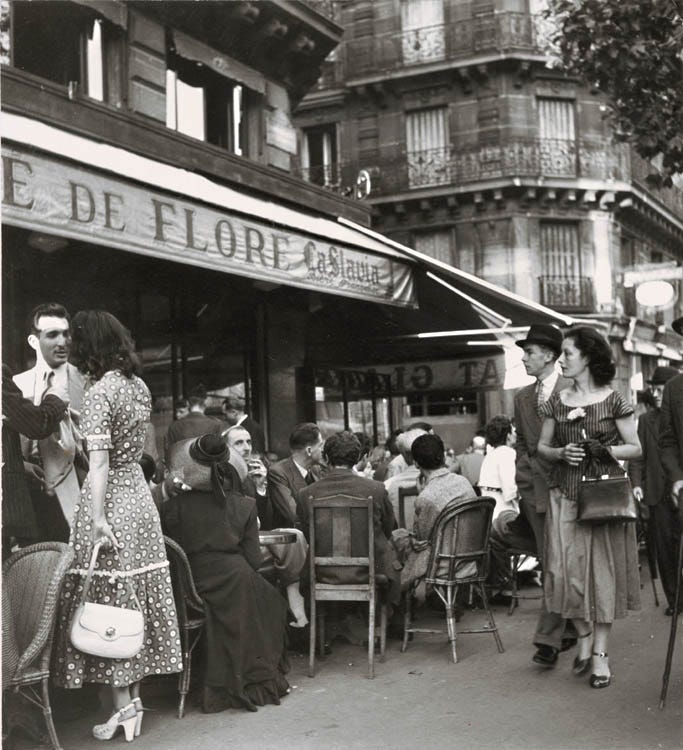
The first café opened in Paris in the second half of the 17th century, and the café quickly became a cultural and social institution. By the end of the century, most likely with the establishment of the famed Café Procope in 1686 and Café de la Régence in 1688, Paris witnessed the birth of the café culture. While hot coffee and rich food nourished the elite and workers alike, the café itself became a gathering place for intellectuals and artists, politicians and philosophers. This new social spot fostered an open atmosphere of conversation, fueling creativity, new ideas, and political change, once the sole domain of the upper class. From the elite environments of “salons,” where artists, writers, and intellectuals gathered in the homes of the upper-crust of Paris, this more democratic space reflected a society in transition. In the centuries that followed, this café culture of open dialogue and spirited debate among the clinking of cups and saucers, the rattling of forks on crockery would flourish, becoming a defining feature of Parisian life.
But it was more than a gathering place for luminaries and revolutionaries: For migrant workers and the poorer residents of the city—many of whom had arrived in Paris for work, feeling alone, isolated, far from home and loved ones—the café served as a community square, a place to connect socially with the familiarity of shared language, customs, and stories from home. They could eat and drink, sing, and chat together in the warmth and light of the café, or simply read the local papers and pamphlets, or get the current buzz from home from their fellow compatriots. By the 20th century, locals found themselves elbow to elbow with the great writers and thinkers of the day—Jean-Paul Sartre and Simone de Beauvoir, Albert Camus and Ernest Hemingway, F. Scott Fitzgerald and Gertrude Stein. Meeting face to face—or simply being surrounded by voices, movement, and everyday life—sparked thought and ignited creativity while keeping abreast of the latest news and gossip.
And, of course, certain cafés became the refuge of French Resistance members, serving not only as places to plan their operations but also as vantage points to observe and gather intelligence on the enemy. Today, we can follow in their footsteps, recognizing the power of public get-togethers to connect, organize, inform, and inspire change.
Now, as then, the Parisian café is a place to meet, talk, debate, observe, and be observed. To forget the world while being surrounded by it, while being firmly planted in the middle of it. As Victor Hugo wrote: “A café is a place where you can sit and watch the world go by, and where the world can sit and watch you think.” It’s here, gathered with friends around small tables, that we attempt to solve the problems of the world. We are simultaneously acutely aware of everyone around us—watching their movements, their expressions, their expansive gestures, trying to pick up bits of their conversations—yet somehow oblivious to their presence as we raise our own voices in animated debate, our arms sweeping through the air in expressive motions that amplify our words.
So much better than social media.
“There were many like us in Paris at that time who loved life and art and Paris itself. We drank coffee and wrote and talked and argued.”—Ernest Hemingway, A Moveable Feast
Summer has arrived again, the perfect season to step outside and gather with friends—and even strangers—face to face, in real life. It’s a time for lingering at cafés, watching the world go by, and letting everyday worries slip away. And if there’s no café nearby, any spot will do: a picnic blanket in the park, the stoop of your building, on the beach or local bar or restaurant. And if you can’t get world events and life’s problems out of your head, take a clue from Voltaire, Denis Diderot, Jean-Jacques Rousseau, Honoré de Balzac, and Sartre and change the world outside, in the sun, over a drink and a plate of something. It’s so much nicer and, I love to think, much more effective than social media. Or sitting on your couch alone yelling at your tv.
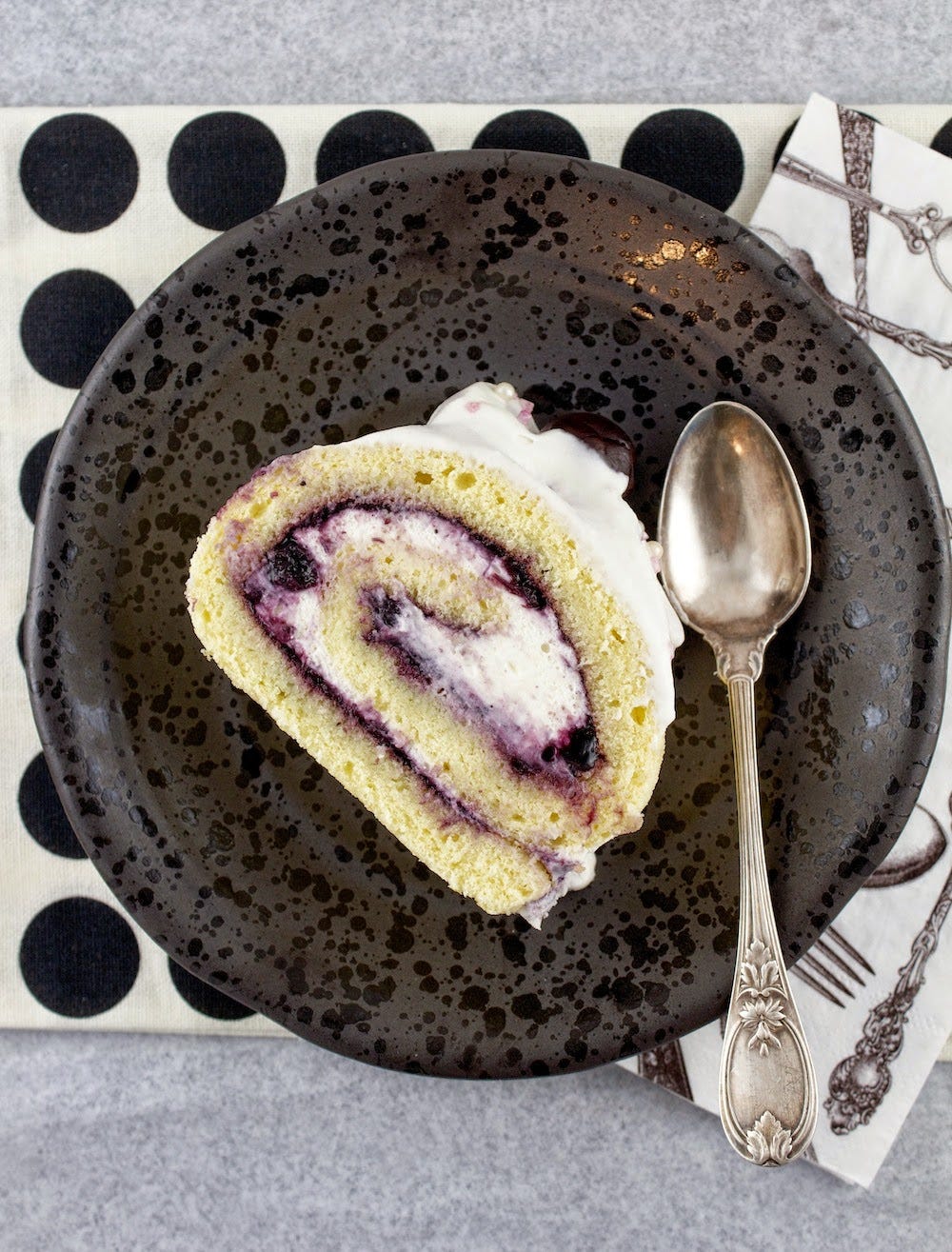
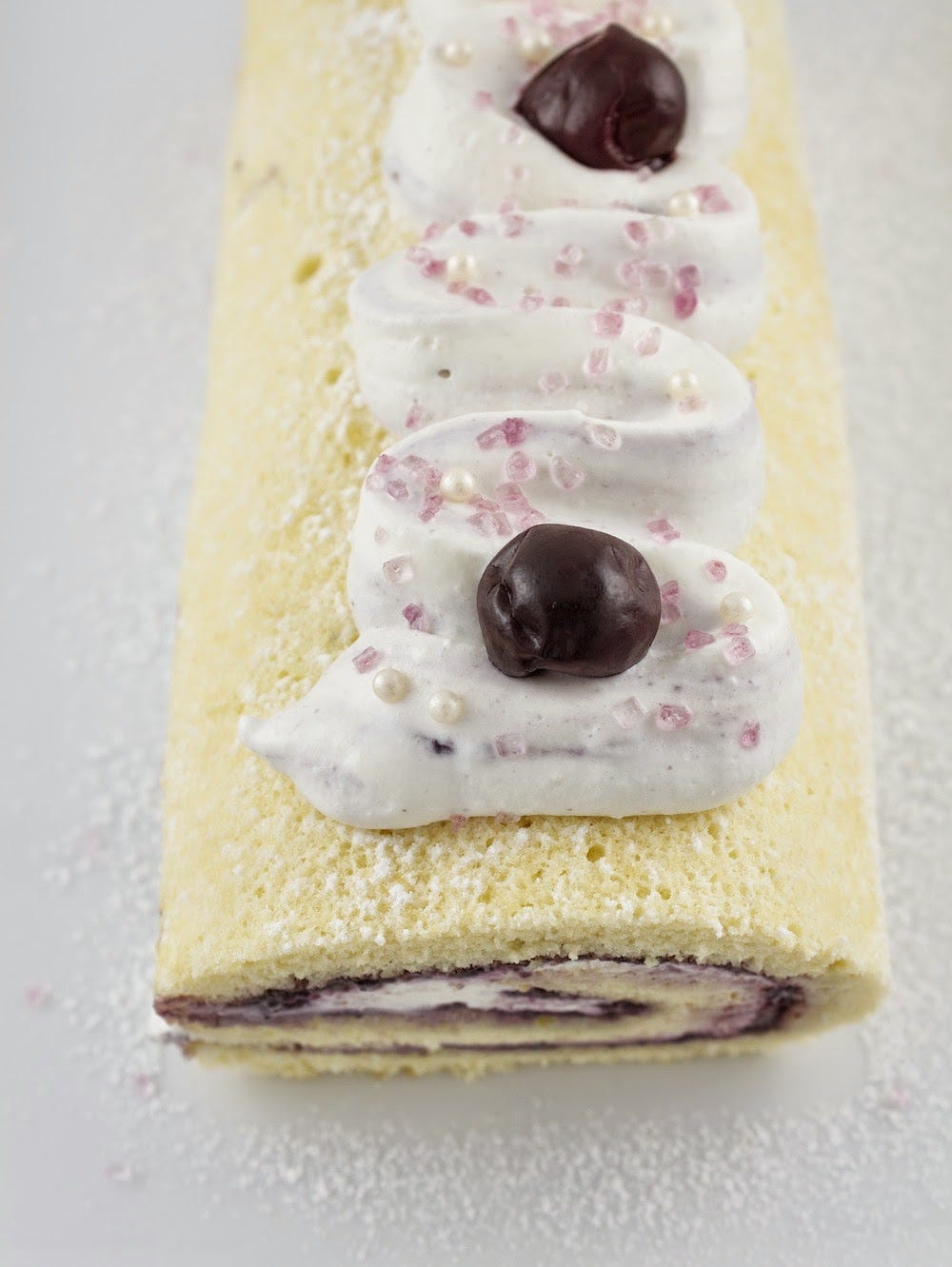
Summer salads are great, but cake is better. This is my favorite warm weather refreshment, light cool, and satisfying, a delicate vanilla sponge wrapped around a chilled mascarpone-thickened whipped cream and the sweet fruitiness of my jam-du-jour. If you know your way about a jelly roll or bûche, you can dab the baked genoise with a liqueur-spiked sugar syrup (maybe Grand Mariner or amber rum) before spreading on the jam and cream.
Mascarpone Whipped Cream
2 tablespoons cold water
½ teaspoon powdered unflavored gelatin
½ cup (125 ml) chilled heavy whipping cream
½ cup (125 grams) fresh mascarpone cheese
¼ teaspoon vanilla
Powdered or icing sugar to taste
1-2 tablespoons cream cheese or ricotta, only if desired
Genoise
4 large eggs, separated
½ cup (100 grams) sugar
½ teaspoon vanilla
⅘ cup (100 grams) flour
Powdered/confectioner’s sugar and a sifter or sieve
Finish
About 6.5 oz (185 g) jam or jelly of your choice
Powdered/Icing sugar
Colored sugar decor
Prepare the Mascarpone Whipped Cream
Place the 2 tablespoons cold water in a small saucepan; sprinkle the gelatin over the surface of the water and let sit for 5 minutes to soften, pressing the gelatin under the surface if you can.
Place the pan over a very low heat to warm the water and melt the gelatin – you want to heat the water for about 3-4 minutes without allowing it to come to a boil or to boil away: allow the water to heat, then, holding the pan just off of the flame/heat, swirling and whisking almost constantly, allowing the bit of water to stay heated for long enough to allow the gelatin to melt.
After 3-4 minutes, remove from the heat and allow to cool for a few minutes or until barely tepid to the touch.
Beat the heavy cream in a chilled bowl until thick, soft peaks hold.
Continue beating as you pour the gelatin water into the heavy cream in a very slow stream. Scrape it all into the cream.
Beat in the mascarpone and the vanilla.
Add and beat in enough powdered or icing sugar to taste; as the jelly or jam is sweet, I usually only very lightly sweeten the cream. If you like, you can also beat in a couple tablespoons of cream cheese or ricotta instead of the mascarpone if you like a slightly cheesecake flavor.
Place this cream in the refrigerator to chill for at least an hour to overnight to allow the gelatin to add body to the filling.
Prepare the Genoise
Preheat the oven to 375° F (190° C).
Line a 15-1/2 x 10-1/2 x 3/4 inch (40 x 27 x 2 cm) jelly roll pan with parchment paper. Have a clean dish towel larger than the jelly roll pan as well as a large, clean flat baking sheet ready.
Separate the eggs, placing the yolks in a large mixing bowl and the whites in a very clean medium-sized bowl (I prefer plastic). If you like, add a tiny pinch of salt and 2 drops of lemon juice to the whites to help stabilize them.
Add the sugar to the yolks and beat with an electric mixer on high until thick, creamy and pale, about 3 minutes. Beat in the vanilla.
Using very clean beaters, beat the whites until peaks hold and the meringue is dense.
Fold the whites into the yolk/sugar mixture gently but firmly using a spatula, a third of the whites at a time, alternating with the flour (preferably sifted into the bowl) in two or three additions. Do not over mix/fold but do make sure there are no clumps of whites visible and no pockets of flour.
Spread the batter evenly in the parchment-lined jelly roll pan and lightly smooth the top.
Bake in the preheated oven for about 15 minutes or until puffed and golden and the cake springs back when lightly pressed.
Remove from the oven. Immediately slide the parchment paper and cake together onto the second large flat baking sheet.
Invert the warm jelly roll pan and place on top of the genoise and, holding both the jelly roll pan and the baking sheet firmly together, flip them over and remove the baking sheet; the top of the genoise is now face down while the parchment paper is up. Peel off the parchment paper.
Dust a light layer of powdered sugar evenly over the genoise; place the clean dish towel over the genoise.
Again place the clean baking sheet inverted on top of the dish towel-covered cake and, holding the baking sheet and the jelly roll pan firmly together, flip. Remove the jelly roll pan.
You should now have the warm genoise topside up on the clean dish towel on the clean flat baking sheet.
Dust the top of the genoise evenly with a light layer of powdered sugar and, starting on a short end of the cake, roll the genoise up—gently but as tightly as possible without crushing or breaking the cake—in the towel, rolling the towel up with the cake. Allow to cool completely.
Assemble the Jelly roll
When the genoise is completely cool, carefully unroll it and slide the cake off the dish towel and onto a clean sheet of parchment paper or work surface. DO NOT try to press the cake flat—you want to keep the roll.
Spread jelly evenly over the entire surface of the cake.
Spread the Mascarpone Whipped Cream evenly over the genoise; reserve about 3 or 4 tablespoons to use for piping a decorative swirl on the top of the roll, refrigerating again until ready to serve the cake.
Starting at the short end of the genoise (the curled end rolled up first in the towel to cool), roll up the cake as tightly as possible without pressing or rolling so tightly that the cream oozes out.
When completely rolled, scrape off any filling that has oozed out.
Using a sharp or serrated knife, cleanly trim off both ends of the roll (these can be eaten now).
Very carefully, lift the cake roll onto the serving platter, placing the seam side down, remove the parchment paper and gently shape the log so it is even from one end to the other.
Cover the cake and the platter with plastic wrap and refrigerate for several hours or overnight to allow the filling to firm up.
Just before serving, dust the entire surface of the roll lightly and evenly with powdered/icing sugar, pipe the rest of the cream on top, and decorate as you like with fruit, colored sugar, or chocolate curls.
Using a serrated bread knife to slice the jelly roll will give you clean, even slices and avoid the cream from oozing out.
Jamie Schler is an American food and culture writer living in France, where she owns a hotel and writes the Substack Life’s a Feast.
