


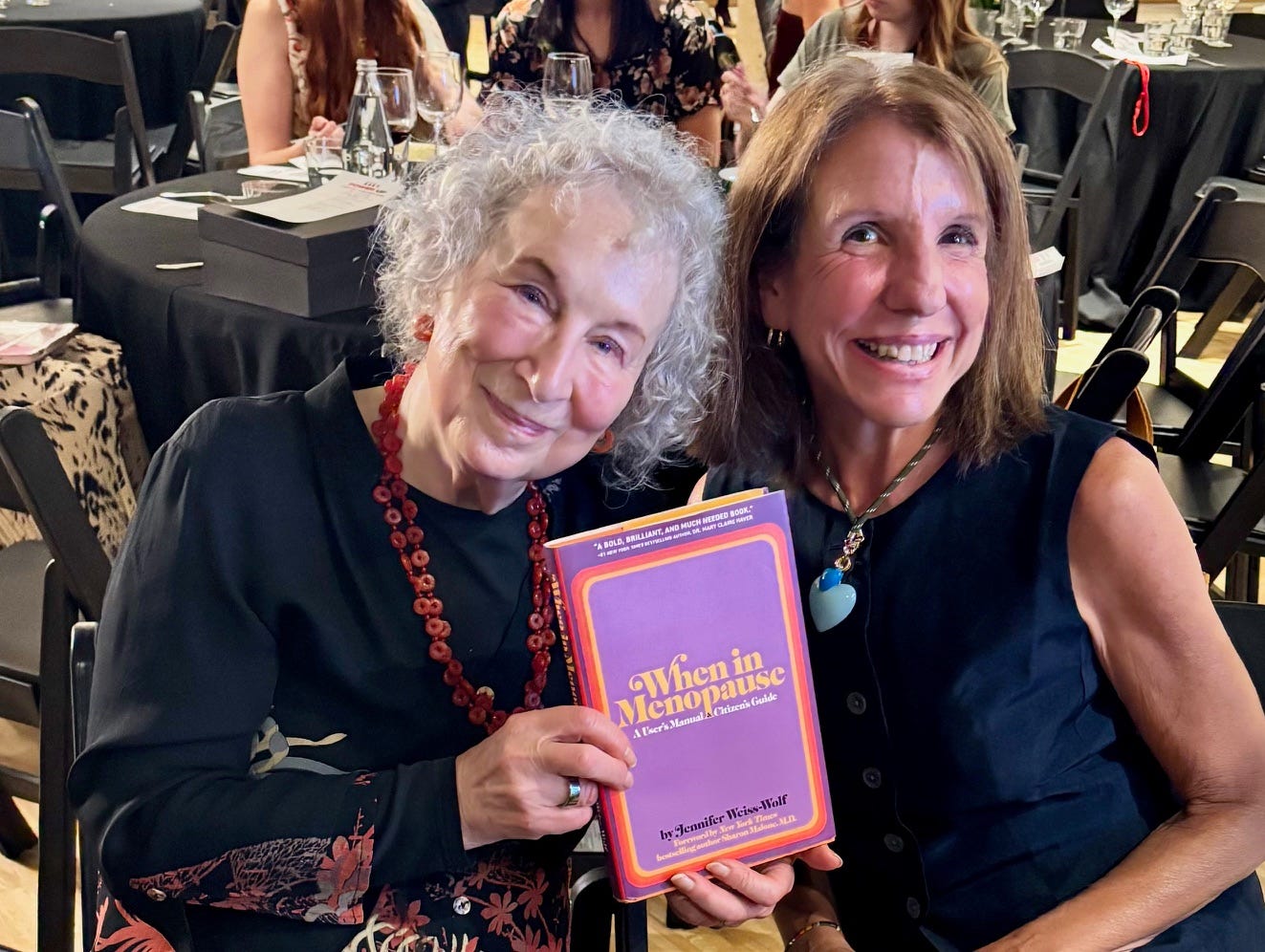
What would you say to The Handmaid’s Tale author Margaret Atwood if you had five minutes to talk to her? Contrarian readers, it happened to me. And yes, somehow, I managed to lead with menopause — a topic that is forever front of mind for me. (My new book, When in Menopause: A User’s Manual & Citizen’s Guide, is out in the world today!)
Atwood inquired about what exactly being a menopause policy advocate entailed. I explained it as an extension of frameworks I’ve long considered for menstruation — how to normalize something taboo, account for individual and systemic inequities, and develop systemic solutions that have political salience.
When I reflected out loud that I was inspired by the prospect of countering Atwood’s own dark vision of what a regressive government could accomplish by weaponizing menstruation and fertility — crimson capes and all — she leaned in close and said, “Tell me more.”
At that moment, I couldn’t imagine a grander trio of words. As a public writer, I worry that my columns will land like trees falling in the forest. As a book author, that stress is exponential. But Atwood’s curiosity quieted my mind instantly. If she, with all her prescience and brilliance, wanted to know more about what motivated this work, I received that as a gift, all the affirmation I needed to carry on.
I decided that I would celebrate my book’s first day in the world by sharing with The Contrarian all the things I said — or wish I had said! — about why I believe focusing on policies that center menstruation and menopause matters so much in 2026.
Periods can transcend partisanship. In my advocacy, I’ve seen that the mechanics of menstruation evoke an oddly potent combination of empathy and engagement among lawmakers of all political stripes, from statehouses to the White House. I once teamed up with a male Republican lawmaker to write publicly about how this has opened the door to uncommon bipartisan agreement.
Which is perhaps why there has been progress on this issue, far more so than most others that involve girls’ and women’s health. Reforms such as dismantling the “tampon tax” and mandating public budgets cover menstrual products in facilities such as schools, jails, and prisons have seen great success, including in the first Trump administration. (Which, if you can imagine, is responsible for signing the only two federal laws on menstruation ever passed in this country’s history. I kid you not.)
But politicization looms. The current administration is on a pronatalist tear, and menstrual literacy — quite literally, teaching young girls how to get pregnant — is high on the agenda. (The Heritage Foundation just held a session on this at its Gilead-style summit, “The Future of Health, Fertility, and Family Formation.”)
True confession: I bang this drum, too. But my argument is that menstrual literacy is an essential form of reproductive self-defense. With abortion outlawed or restricted in more than half of states and rising criminalization of pregnancy outcomes (including miscarriage), fluency in menstrual cycles — which, at a minimum, includes understanding how and when conception can occur and how weeks of pregnancy are counted — is life-or-death knowledge. During the Biden administration, I proposed ways that health agencies could help amplify that information. That was then. This is now.
Neglect of the science of midlife and menopausal health is a deliberate — and deadly — choice. As headlines continue to declare menopause a trendy topic, USA Today recently reported on a silent killer of postmenopausal women: urosepsis from recurrent urinary tract infections. The solution, localized vaginal estrogen, continues to be denied because of a combination of outdated guidelines, lack of clinician training, and failure of Medicare to cover it (despite women over age 65 bearing the greatest risk). It is one of many health crises caused by our failure to invest in research, treatment, and care. The impact is far greater than a hashtag or trend.
Gratefully, the issue has finally arrived in halls of government. Over the past two years, more than 60 bills to fix some of the problems named above have been introduced in 28 states; ten of those states now have 21 laws on the books. Capitol Hill is entering the discourse, too. On September 16, I testified at the first-ever U.S. Senate hearing on the dismal state of federally funded menopause research and vast gaps in treatment and care. Last year, the Food and Drug Administration removed the long-critiqued “black box” warning on estrogen products for menopause, the culmination of a decade-long campaign by physicians and scientists who had been waging the fight for accurate labeling regardless of which party held power.
***
I believe strongly that all of this matters greatly as we count down to the midterms, now four weeks away, and beyond. From the soaring cost of medical care to inadequate health insurance to lagging scientific research, every aspect of daily life affected by menopause is a kitchen table issue that matters to voters.
Add to that the fresh wave of fury women of all ages feel right now — the utter fed up-ness with systems that exclude us, undermine us, and enable our abuse and dysfunction so entrenched in our democracy that it almost matters little whether these are the exception or the rule.
I told Atwood that I remain optimistic because there is absolutely a runway for change if enough of us are committed to fighting for it. Here is what I wrote in by book about why we should:
Every single one of us deserves to make informed choices about our health at every life stage. This includes investment in science, assurance of competent and compassionate medical care, and access to affordable evidence-based treatment. We have every right and reason to demand the powers-that-be commit to these solutions, all of which are essential to our well-being, our dignity, our humanity.
It is also essential to a thriving democracy. The ability to participate fully and fairly in civic life matters now more than ever. We owe it to ourselves, and to the nation’s future, to not back away from the cause of menopause, but rather double down in its pursuit.
In all that you do going forward, I ask that you take the following to heart:
Your actions, your voice, your stories — know that all of it matters. Lend it to this cause in whatever ways feel right for you.
Share your knowledge with others, be a proselytizer, especially to those who you suspect need to hear it for support, as well as those in a position to forge change.
Commit to democracy and show up to VOTE for women’s health every time you can. Act like your life — and that of every girl and woman and person you know — depends on it. It does.
I close the book with a pair of quotes with another giant — the American writer, poet, activist, and voice of conscience Maya Angelou: “When women take care of their health they become their own best friend” and “I’m interested in women’s health because I’m a woman. I’d be a darn fool not to be on my own side.”
Thanks Contrarians, for the journey! I love this community, and I know we will keep fighting for our democracy together.
Jennifer Weiss-Wolf is executive director of the Birnbaum Women’s Leadership Center at NYU School of Law. She also leads strategy and partnerships at Ms. Magazine.

You are absolutely correct, Jennifer Weiss-Wolf! Thanks so much for your advocacy for women’s health issues.