

By Jeff Nesbit
Washington, D.C., is a city built on the art of the “plan.” There are plans for infrastructure, plans for tax reform, and plans for distant wars and foreign intervention.
But for 15 years, the national Republican Party has managed to talk about a non-existent national healthcare coverage plan so frequently it would be impressive if it weren’t so dangerous: The GOP has campaigned on “repeal and replace” of the Affordable Care Act (ACA) without ever producing a single page of a viable replacement.
Today, that 15-year vacuum finally hit a wall.
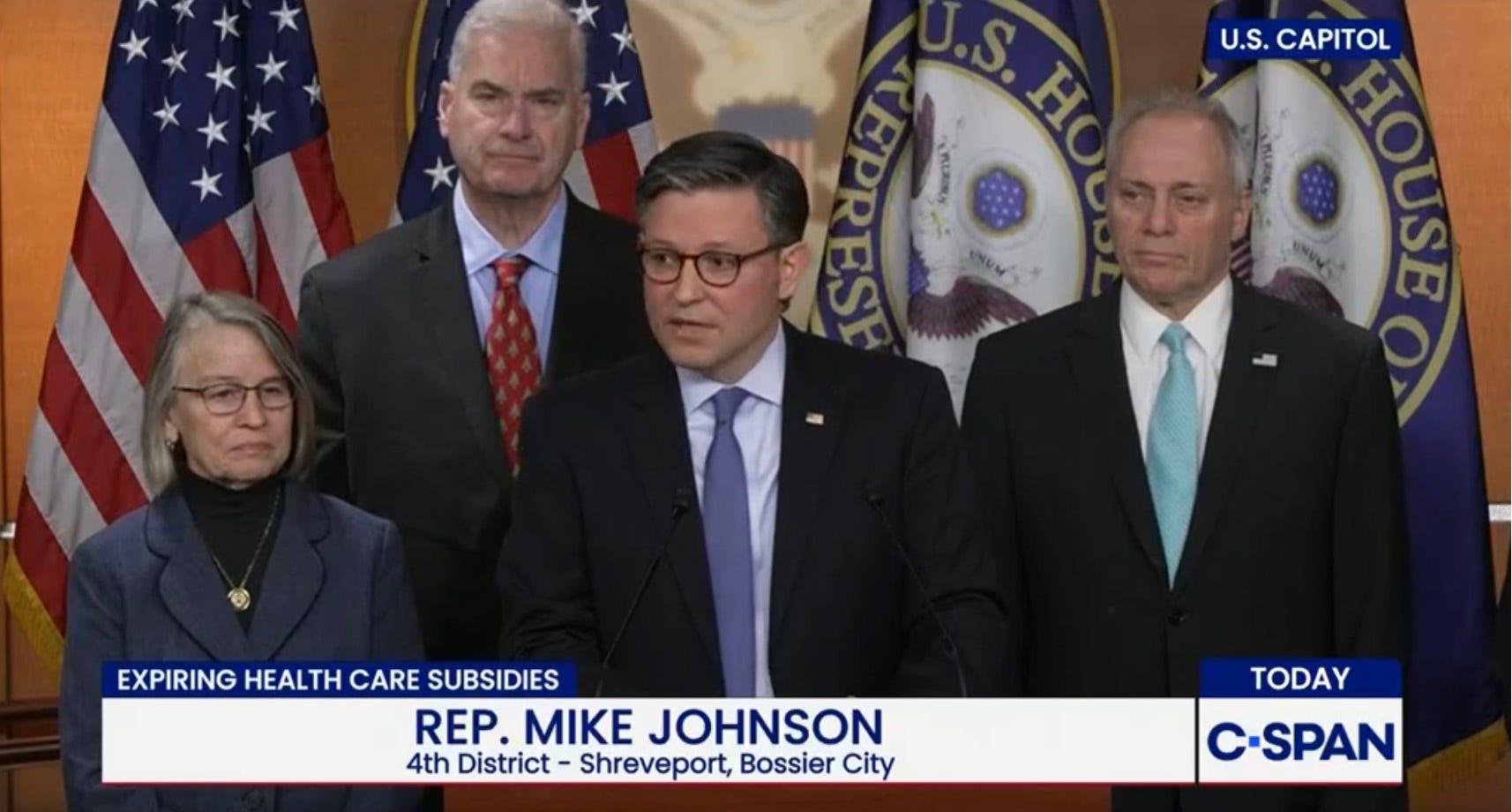
On Dec. 17, in a stunning rebuke to House Speaker Mike Johnson, four House Republicans (Mike Lawler of New York and Rob Bresnahan, Brian Fitzpatrick, and Ryan Mackenzie of Pennsylvania) crossed party lines to sign Hakeem Jeffries’ discharge petition. This maneuver successfully forced a floor vote on the extension of ACA subsidies that are set to expire in just two weeks.
The dam has broken. These four “rebels” didn’t sign on because they’ve suddenly become Democrats; they signed because they’re looking at the math. And the math for the American family on Jan. 1 is catastrophic.
During my time at the Department of Health and Human Services (HHS), we fought every single day to build the record enrollment levels we see today. More than 24 million Americans have affordable health coverage under the ACA, many of them from red states.
We didn’t do it for the sake of a spreadsheet; we did it so a mother in Scranton or a farmer in the Hudson Valley wouldn’t have to choose between a doctor’s visit and the mortgage.
We didn’t just see numbers on a page; we saw the faces of those 24 million Americans who finally found peace of mind. We spent four years meticulously building a bridge to affordable care, reaching record enrollment by proving that the system could work if it was managed rather than mocked.
To watch the Trump White House and GOP congressional leadership stand by as that bridge is dismantled—not by a better plan, but by pure negligence—is more than a policy disagreement. It’s an intentional reversal of progress that thousands of public servants worked tirelessly to achieve. We built it to last; they are letting it lapse.
If the GOP allows these enhanced subsidies to expire, the sticker shock hitting mailboxes in January will be the largest health insurance premium hike in American history.
According to analysis from KFF, the average subsidized enrollee will see premium payments more than double, skyrocketing by 114%. For a family of four, that’s an extra $1,000 to $2,000 a year gone— poof —into the ether of GOP legislative neglect.
The human cost is even grimmer. The Urban Institute projects that 4.8 million Americans will become uninsured overnight.
We aren’t just talking about a policy shift; we’re talking about a death spiral. When healthy people drop out because they can no longer afford the GOP health care tax, the risk pool collapses, leaving the sick and the elderly with even higher bills. It’s a recipe for the total destabilization of the American healthcare market.
The most galling aspect of this crisis is its predictability. For a decade and a half, the Republican Party has promised a better way. Yet it has never produced even a single sheet of paper with any sort of realistic policy proposal. All Republicans have is their political slogan: “repeal and replace.”
The Republican Party had a national government trifecta in 2017 and again in 2025. And all they have to show for it on health care coverage is nothing, literally.
Trump’s “One Big Beautiful Bill” was a collection of hollow gestures—expanding health savings accounts for people who already have money while leaving the working class to drown in premium hikes.
Where is the plan for the 27% of farmers who rely on the ACA? Where is the plan for the rural hospitals that the Commonwealth Fund warns will face a $32 billion revenue loss, potentially forcing hundreds to close?
All we have is political propaganda and the 43-day government shutdown we just endured this fall —a shutdown triggered by the very subsidies the GOP is now failing to address. It’s incompetence masquerading as ideology.
The GOP leadership knows it’s in trouble. It’s why House Speaker Mike Johnson (R-La.) tried to block the vote. He knows that when the 2026 midterm campaigns begin, Republicans in swing districts will have to explain why they voted to double their constituents’ healthcare costs.
Lawler didn’t mince words when he called the refusal to hold a vote “absolute bullshit.” He knows that in the Hudson Valley, a 114% premium spike is a political death sentence. Fitzpatrick called the expiration a “preventable crisis.” They see the writing on the wall: The GOP is about to own the “Un-Affordable Care Act.”
Though the discharge petition ensures a vote in the House sometime in January, when the real battle shifts to the Senate. Despite a “Gang of Four” Republicans—Sens. Susan Collins (Maine), Josh Hawley (Mo.), Lisa Murkowski (Alaska), and Dan Sullivan (Alaska)—signaling they’re ready to act, the GOP leadership continues to hide behind the 60-vote filibuster.
GOP leaders are betting that they can blame the system or the Democrats when the bills come due in January. They’re wrong. You simply cannot spend 15 years promising a replacement, hold every lever of power in Washington, and then blame the minority party when the lights go out.
As someone who spent four years at HHS building a system that actually works for people, I am heartbroken watching this sabotage.
But, more than that, it’s a moral failing. We’re at a point where 340,000 jobs are at risk in 2026 because of this uncertainty. We’re at a point where faith leaders are holding vigils because “people will literally die” without access to care.
The Republican Party has two weeks to decide if it wants to be the party of “no” or the party of the American people. If it chooses the former, the 2026 midterms won’t just be an election; they will be a verdict.
The GOP has spent 15 years looking for an alternative to the ACA. On Jan. 1, the American people will finally see what that alternative is: higher costs, fewer doctors, and millions left behind.
Jeff Nesbit was the assistant secretary for public affairs at HHS during the Biden-Harris administration.
While the ACA subsidies help to lower the cost of insurance to the people, it also is a windfall profit for theinsurance companies. Insurance companies do not provide or produce healthcare. They suck up money; act as a gatekeeper to care, They also cause care providers to process insane amounts of paperwork which costs them time, money and requires additional personnel. It all has to be paid for, and isn't efficient. What would be a winning ticket would be to throw the insurance lobbyists and their money out of the legislators' pockets, the insurance companies out of heathcare, and institute a single payer system. Healthcare should be a right and not a political football. If other countries can do it, with the proper motivation, so can we.
Jeff, thank you for your service! Hopefully the LOSS of service and catastrophic effects will knock some sense into even the most hard core right wingers.