


Two weeks ago, the Senate held confirmation hearings for nominees to two of the most consequential positions in the federal government: attorney general and director of national intelligence. Most of the press attention fell on Todd Blanche, Donald Trump’s former defense lawyer and current acting attorney general. Blanche did not disappoint. His record, his loyalty to Trump, and his conception of Justice Department independence supplied the sharp exchanges and combustible television clips that confirmation hearings now seem designed to produce.
The Senate Judiciary Committee is expected to hold its vote on the Blanche nomination this Thursday.
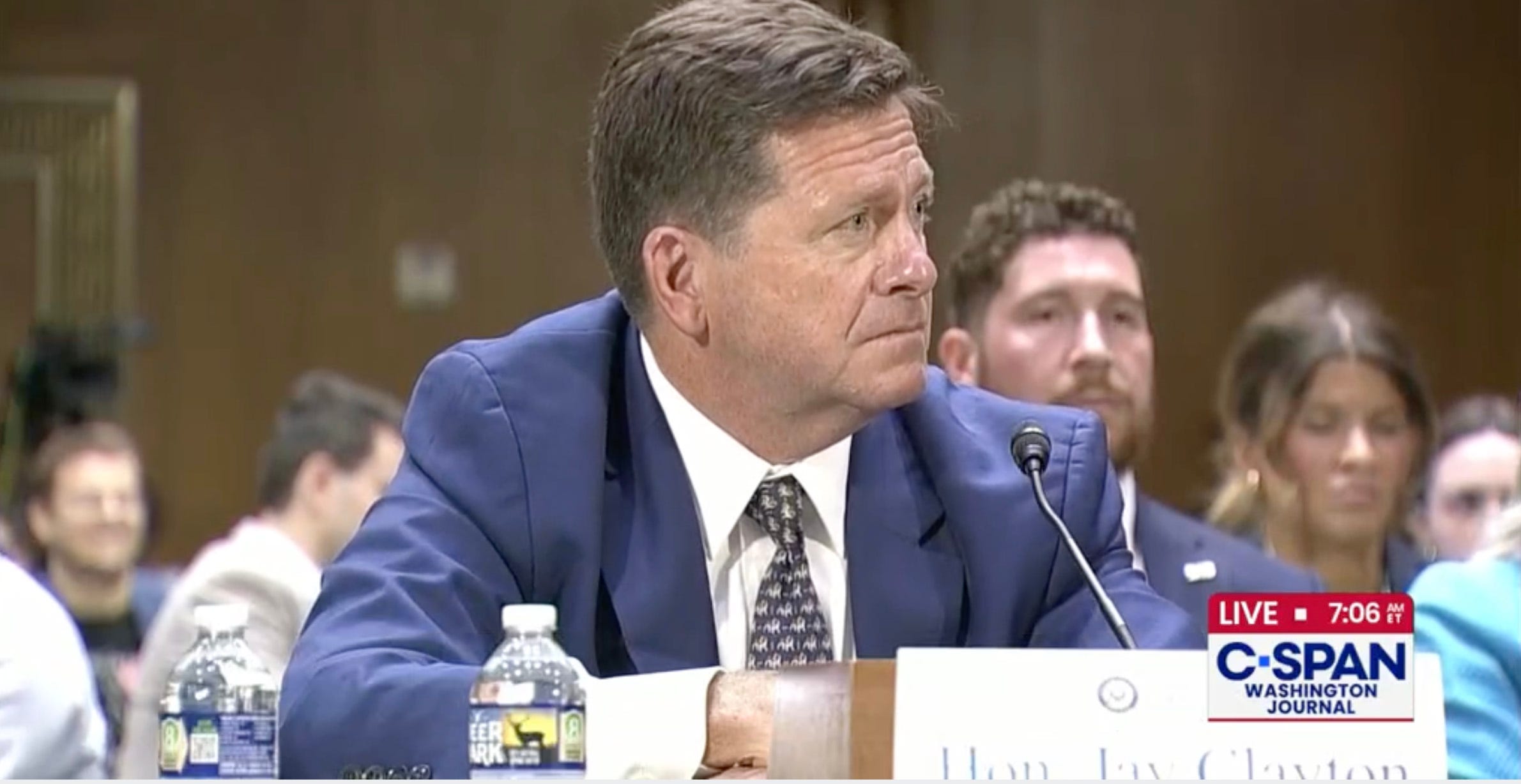
Jay Clayton’s hearing was less theatrical. But the testimony of Trump’s prospective director of national intelligence was no less disturbing when placed against the office he would lead, the president he would advise, and the intelligence system Trump has spent years trying to bend around his convictions.
Democratic senators asked both nominees a question that has become standard for senior Trump appointees: Who won the 2020 presidential election?
This is no longer a gotcha question. It is a test of whether a nominee can acknowledge an established fact when doing so places him at odds with the president who selected him. For an attorney general, the answer bears on the independence of federal law enforcement. For a director of national intelligence, it goes to something even more fundamental: whether the president will receive objective analysis or merely the conclusions he expects from a subordinate.
Clayton offered the equally standard evasion. Joe Biden, he said, had been “certified” as president and had received the most electoral votes. He repeatedly declined to say that Biden won. Sens. Jon Ossoff (D-GA) and Mark Warner (D-VA) pressed him without success.
The distinction was not caution born of uncertain evidence. The states certified the results. Recounts, audits, and court proceedings found no fraud capable of changing the outcome. The intelligence community concluded that no foreign actor altered votes, ballot tabulation, or the technical administration of the election.
Clayton chose ambiguity because the direct answer would contradict Trump.
That response would be troubling from any nominee. From a prospective director of national intelligence, it is a warning.
Yet, on Tuesday evening, the Senate confirmed Clayton on a vote of 51-47.
The DNI manages 18 intelligence organizations and was created in the aftermath of the September 11, 2001, terrorist attacks to improve integration and ensure that the president receives the intelligence community’s best judgment — including evidence that challenges his assumptions, alternative explanations that complicate policy, and conclusions he may not wish to hear.
Clayton’s answer suggested that when an established fact collides with Trump’s version of events, the president’s chief intelligence adviser may search for safer language rather than state what the evidence supports.
Trump’s difficult relationship with intelligence has been documented since his first term. He rarely read the written President’s Daily Brief, preferring oral presentations supported by charts, photographs, and what one official called “killer graphics” every few days. There is nothing inherently wrong with adapting intelligence to a president’s preferred manner of receiving information. Every administration requests it.
The problem here is deeper. Trump has repeatedly treated intelligence not as an independent process for testing assumptions but as either confirmation or opposition. Judgments that support him become authoritative. Judgments that challenge him become evidence of bias, incompetence, or disloyalty.
That pattern took on new significance last month when Bill Pulte became acting DNI. Pulte arrived without intelligence or national security experience and with an apparent mandate to revisit Trump’s claims about the 2020 election. The effort did not begin with a new intelligence assessment asking whether the evidence had changed. It began with a search through existing intelligence holdings for documents that could be used to support the president’s suspicions.
Trump presented the results in his prime-time speech on Thursday, July 16. He accused “rogue bureaucrats” of concealing evidence of Chinese interference and other wrongdoing in the 2020 election. Yet the documents he released did not establish that China or another foreign power changed votes. Several were produced or circulated during Trump’s own first administration, including intelligence products available to senior officials. Their existence therefore did not show that the intelligence community had hidden the issue from him. It suggested instead that Trump had not read, absorbed, or accepted what his own government had concluded.
This is not the traditional politicization problem in which policymakers pressure analysts to change a judgment. It is, in some respects, cruder. Now, the judgment is being bypassed altogether. Officials can search intelligence holdings for fragments that support a predetermined conclusion, declassify them, and allow their secrecy markings to confer an authority their contents do not deserve.
That is the intelligence process Clayton is inheriting — and will soon help shape.
He will also be advising a president who is unlikely to begin reading his traditional briefings and who appears convinced that intelligence officials deprived him of information that was produced while he was president. Clayton’s test will therefore not be whether he restores a document Trump does not value. It will be whether he protects the integrity of the intelligence that reaches Trump through oral briefings, graphics, and private conversations.
Will Clayton insist that raw reporting be accompanied by source evaluation? That vulnerabilities be distinguished from exploitation? That dissent be presented alongside the evidence supporting the coordinated judgment? That the president be told when the intelligence does not support what he believes?
His confirmation testimony offered little reassurance.
A man unwilling to state an indisputable fact in public may be even less willing to deliver an unwelcome intelligence judgment in private.
Brian O’Neill, a retired senior executive from the CIA and National Counterterrorism Center, is an instructor on strategic intelligence at Georgia Tech. His Safehouse Briefing Substack looks at what’s ahead in global security, geopolitics, and national strategy.

Another immoral, unethical. individual, who will refuse to protect America from all enemies foreign or domestic! Unfortunately for all of us, there are more enemies domestic than foreign!
I honestly don't know what to say. They confirmed his ass.