


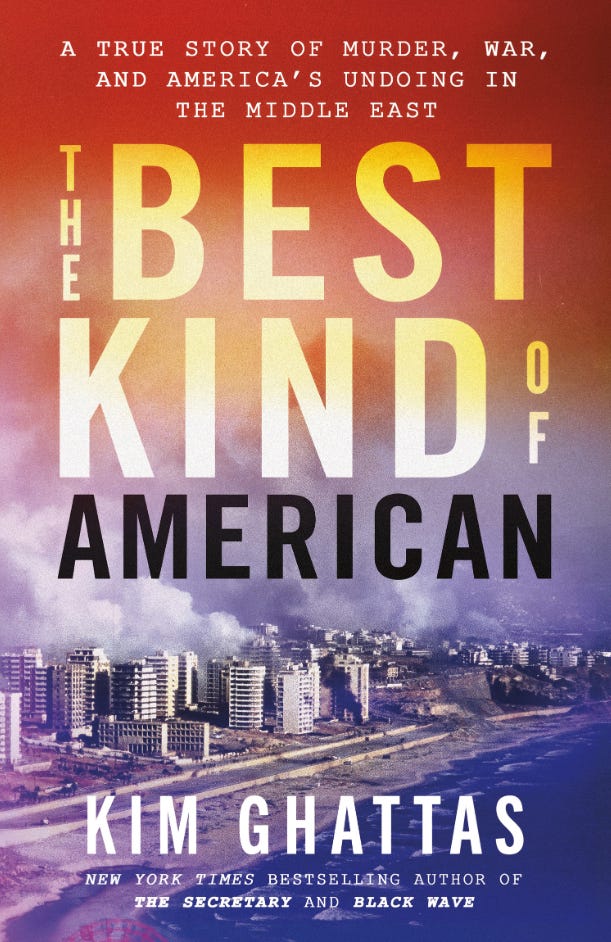
The Best Kind of American: A True Story of Murder, War, and America’s Undoing in the Middle East chronicles the murder of Malcolm Kerr, the president of the American University of Beirut, in 1984, and how his wife Ann and his children sought answers. It is also a broader history of how the Lebanese civil war set the stage for so much of the conflict that has followed in the Middle East. Abraham Kenmore spoke with Author Kim Ghattas from Beirut, where she lives, on Oct. 27 — the day of the Israeli elections. The interview has been edited for length and clarity.
What was the moment that you decided to write The Best Kind of American? What was the process of deciding to write this book?
The beginning of the process was spurred by Ann Kerr asking me whether I’d come across any new information about her husband, because the period that I covered in my previous book, Black Wave, is in part the ‘80s in the region and in Lebanon. That got me thinking about this human tragedy, family tragedy that clearly was still not fully resolved. It made me very much feel that there were so many human tragedies that had still not been fully exposed or talked about or resolved in Lebanon as well, where so many people went missing, so many people were kidnapped or killed.
There are these themes about grief, trauma, impunity, and accountability, which pervade the book. The fact that you can still live with these unresolved issues that are linked to trauma decades later. And that — combined with the general geopolitical position of Lebanon as a playground, where the U.S., Iran, Israel, Syria, and the Palestinians — they all confronted each other during a period which I believed had not been studied enough, understood enough, for us to realize how it had led us to the moment that we were in with the U.S. Iran standoff. I began the book in 2022, before October 7th, before any of this.
What I love to do with my writing is to connect dots. There are a lot of books that have been written about the Marine Barracks bombing. There are books written about the hostages. There are a couple of books written about the Iran-Contra affair, and others written about Reagan’s foreign policy. There are some written about the beginning of the Lebanese civil war. But there wasn’t a book that brought it all together into one neat puzzle, to show us how it all fits. And so that’s what I set out to do.
As you wrote this book, it became kind of terrifyingly relevant to current events.
It was very discombobulating, because I was writing about historical events, and I was watching their paroxysm unfold in front of me, or around me. I was seeing so many echoes from 1982 in the way that the Israeli Defense Minister Yoav Gallant described the siege of Gaza: no food, no water, no fuel. That’s how they had besieged Beirut in 1982.
[One big] concern I had was that I was afraid I would suddenly be writing a current affairs book. I was worried it would taint my thinking, and that I would have to change the book and say, “Oh my God, now we have to start with October 7th.”
Writing history should be very calming. You have time, and you go back into the archives, and you’re daydreaming about the past. But suddenly, I was doing it in the middle of an eruption of violence and carnage and atrocities. In October of 2024, I was writing with war just outside my door. Logistically, I had to make sure that I could leave the country for six weeks to go write somewhere else.
As you were juggling all those logistical challenges, who did you hope would read this book? What was your imagined reader for this?
Black Wave was read by such a diverse readership that it’s not very hard for me to imagine my reader. I had a Republican mother of a young university student in Texas who wrote to me to say that she loved Black Wave — a book with no American characters. I had the deputy commander of CENTCOM tell me how much he loved it. An orchid grower in Dublin; a policeman in Belfast.
And so my reader is a slightly nebulous composite character of all these different people I’ve met. And because I’m Lebanese, I’m imagining people in Lebanon reading it. A lot of people read Black Wave and wrote to say, “Wow, I remember living through the war in Lebanon, or that period in Pakistan, or the ‘90s in Egypt, and I never quite realized how it all fit together.”
In a way, that composite personality of a reader is also me as a young woman growing up in Lebanon trying to understand how it all fit together.
I pulled up a quote that I had set aside: “Sadly, if the Israelis and the Khomeinists had one thing in common, it was the methodical elimination of moderates eager to find a middle ground.” One of the points you make throughout this book is that Kerr was this “best kind of American,” that he and some of his colleagues [in Lebanon] were bridging these divides; he’s fluent in Arabic. He knows the culture. He lives there. He was born there. Who do you see, if anyone, today filling those roles of cross-border negotiators?
We live in a period of extremes of violent language from Washington to Tel Aviv to Iran to Russia — we have an American president who’s calling for the annihilation of a whole civilization, right?
But I still see a lot of people in the United States doing a lot of good work. Maybe no one very prominent at the top in the current administration or in positions of political leadership, but a lot of people who are still working on issues related to the Middle East, who travel back and forth. When we talk about the best kind of American there are millions out there, right?
If I had to name a person who exemplifies this at its best, it’s Ann Kerr and the example she sets to this day. Continuing to teach at UCLA at the age of ninety-two, educating future generations about America and the Middle East and American values and interests in a very complicated environment.
Same question for Lebanon, for Israel, Iran, Syria, all these players that you describe. Where do you see there being places to move forward, do you think that there are places where things can move forward and progress in terms of creating peace?
As I said, we’re living in a time of extreme political positioning, provocative positioning, and so it’s hard for the moderates sometimes to be heard, but they’re definitely out there. I think that in Israel, in Lebanon, in Iran, in Syria, and in the U.S., there are a lot of people who are fighting for the middle ground. I mean, look at what the Syrians were able to achieve. They brought down a fifty-year-old dictatorship.
I get asked a lot about “where is the hope these days, and let’s end our conversation on a hopeful note,” and I’ll admit it’s hard. I want to be candid that we are likely going to go through some very difficult months going ahead [following the Israeli elections]. There are a lot of things that need to happen before we can get on a more peaceful path.
Is there anything else that you wanted to add?
I think that what’s important for readers to come away with from the book is a better understanding of how things went wrong for America in the Middle East, and why 1982 Lebanon is so relevant. It’s the moment when Israel invaded and went far deeper into Arab territory than it had ever done before, and that broke a barrier, that broke a Rubicon. So much became permissible afterwards. And at that same time, as you read, just a few days later, the Iranians showed up to begin fighting Israel and setting up Hezbollah. And then the Americans showed up with the Marines.
But I also think the region really needs to, and the United States and policymakers really need to understand something that Malcolm Kerr had written about very presciently about the centrality of the Palestinian cause to all of this. But equally, I don’t think that we can move forward without finding a different relationship with the Islamic Republic of Iran.
People fall into the trap of thinking, depending on where you fit ideologically, “it’s all Israel’s fault, it all is about the Israeli occupation, it’s all about Israel’s war machine,” and that is definitely an issue. But those people are often not willing to look at what Iran has done to Syria, to Lebanon, to Yemen, to Iraq. And the other way round, there are those, like “it’s all about Iran, it all started in 1979, all the evil comes from there, we just need to bring down this regime.” But when Israel invaded Lebanon in 1982, Iran was not a threat. So there is clearly something wrong with how we’re approaching that. We just need many more Malcolm Kerrs — and we need to read his words and learn from his wisdom.
Kim Ghattas is a Middle East expert, author, and Emmy-award-winning journalist. She’s a contributing writer for The Atlantic magazine, a contributing editor for The Financial Times, and a regular guest on CNN, MSNBC, and NPR. She previously reported for the BBC from the Middle East and Washington, DC. She is the author of Black Wave and The Secretary: A Journey with Hillary Clinton from Beirut to the Heart of American Power. She splits her time between her hometown in Beirut and writing desks around the world.
Buy The Best Kind of American here, or at your favorite independent bookseller.
