


The Trump administration’s “Operation Midway Blitz” has been conducting shock-and-awe operations against immigrants in the streets of Chicago. And the tip of the spear has been an arm of Customs and Border Protection — the Border Patrol.
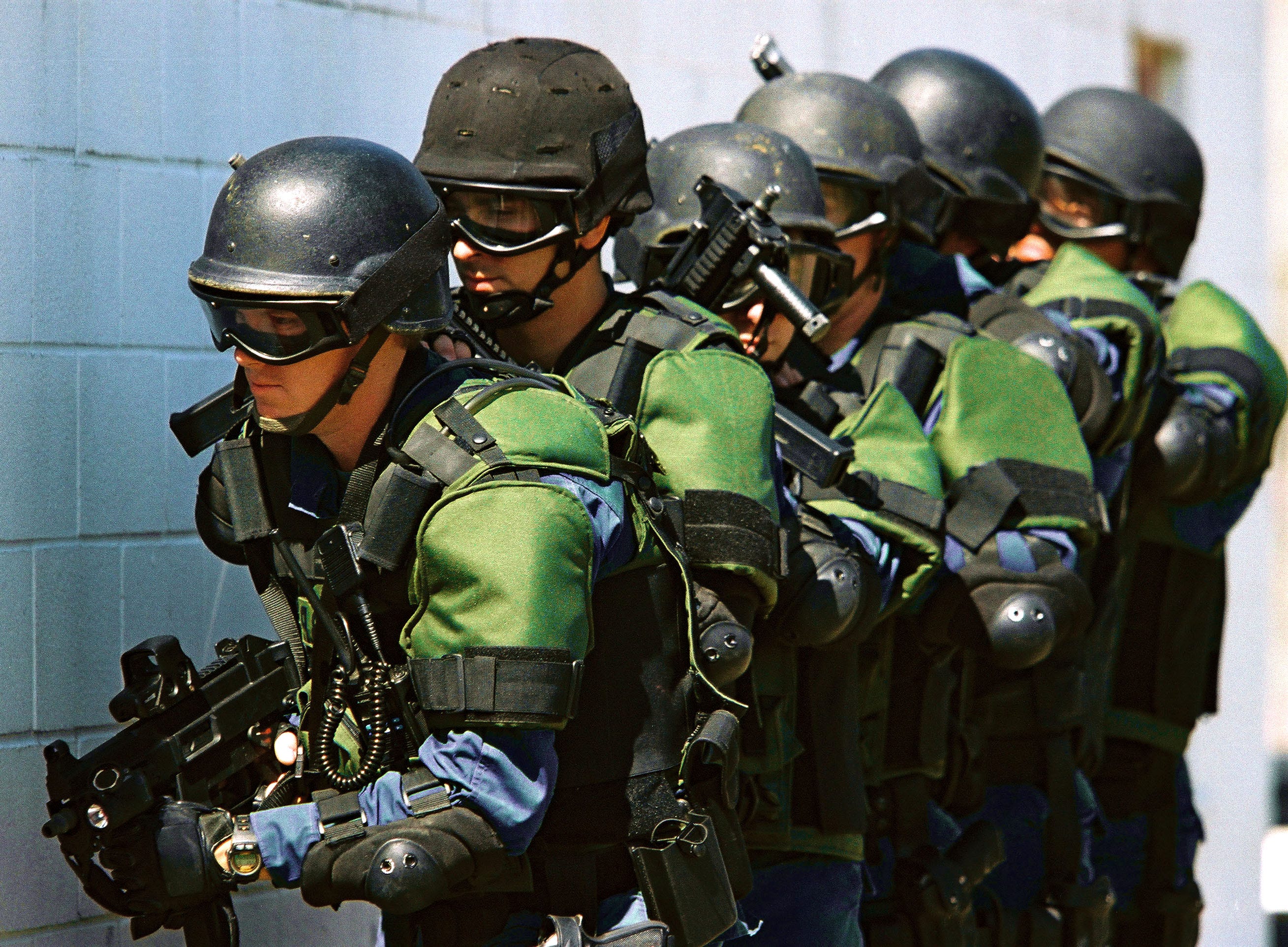
Heavily armed border agents have been patrolling the Chicago River like an occupying force. Border Patrol agents in bulletproof vests feature prominently in viral video from the now-infamous raid of a South Shore apartment complex that produced 37 immigrant arrests — and also saw American citizens dragged from their homes in darkness, zip-tied, and detained for hours. The Border Patrol is also at the center of a lawsuit brought by Chicago residents alleging that “extreme brutality” has been directed at demonstrators, including by the agency’s new frontman, commander-at-large Greg Bovino.
That the Border Patrol is stoking fear and upending livelihoods in the Windy City is clear. What’s less obvious is why the border agency is even operating in Chicago — a metropolis nearly 300 miles from the nearest crossing into Canada. Or why the Border Patrol were deployed to Alameda, adjacent to San Francisco, in Northern California.
The answers to these questions are complex and unsettling — and they underscore the Trump administration’s expansive view of its federal policing powers.
Where is the Border, Again?
When it comes to federal immigration enforcement, “the border” is likely not where you think it is. Federal law gives the Border Patrol authority not only at border crossings and ports of entry, but also “within a reasonable distance from any external boundary of the United States.”
Border Patrol interprets its jurisdiction to include America’s land borders with Mexico and Canada, of course, but also the nation’s maritime boundaries, encompassing the Pacific, Atlantic, and Gulf coasts — and even the shoreline of the Great Lakes. In this jurisdictional model, America’s “border towns” include not only San Diego, El Paso, and Detroit, but port cities from San Francisco to New York to New Orleans to Chicago.
More troubling, federal regulations interpret the words “reasonable distance” expansively — as extending 100 miles into the nation’s interior. As a result, America’s “border zone” extends to landlocked locales like Spokane, Washington; Madison, Wisconsin; Columbus, Ohio; Albany, New York; and Raleigh, North Carolina. It includes nearly all of New England, and every inch of states like Michigan and Florida. (You can see whether you live in a “border” city by consulting this map.)
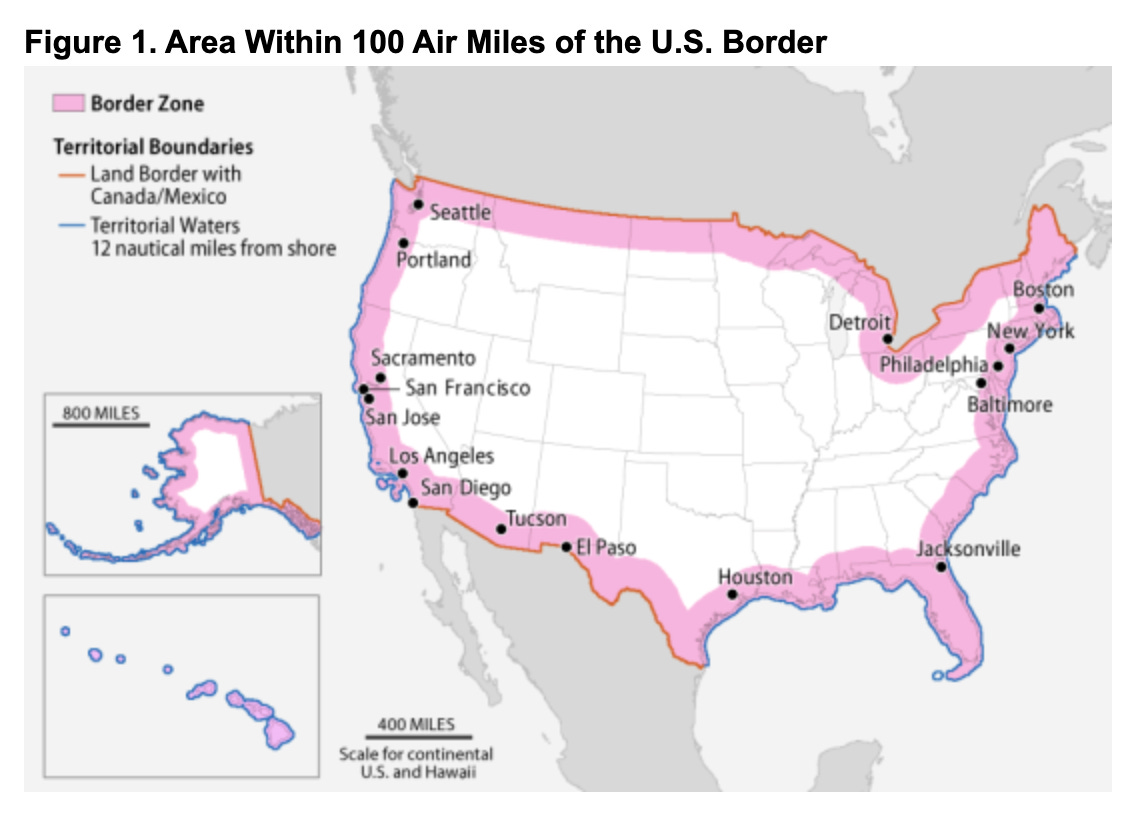
This 100-Mile Border puts approximately two-thirds of the U.S. population — or some 213 million people — within reach of routine Border Patrol enforcement, according to a 2025 estimate by the ACLU. As much as 75 percent of the nation’s Hispanic population also lives in this area.
Within this 100-mile zone, the Border Patrol asserts extraordinary authorities, predicated on what’s known as the “border search exception.” At ports of entry, this exception allows federal agents to rifle through your personal effects. But within the entire border zone, Border Patrol also claims the right to establish immigration checkpoints; to conduct “roving patrols” (pulling over cars and trucks when they suspect occupants may be undocumented); as well as to board buses, trains, and boats to demand immigration documentation. All without a warrant. (These practices are constitutionally thorny, and citizens can assert their rights to limit their cooperation with border agents.)
Historically concentrated along the border with Mexico, such Border Patrol enforcement activity routinely snares law-abiding Americans along with the intended undocumented targets. The agency’s history of harassing and delaying citizens; damaging their property; and not infrequently subjecting them to mistaken arrests, has long raised the hackles of champions of the Fourth Amendment, which bars unreasonable search and seizure.
This issue has periodically captured the attention of Democrats, who have introduced reform legislation to shrink the Border Zone to a more compact 25 miles. But these efforts have never gained significant traction in Congress.
Does the Border Zone Explain Abuses in Chicago?
Is the Border Patrol now in Chicago as part of its routine authority? Or is there something darker going on?
The answer here gets more complicated. That’s because the Trump administration, true to form, has also been invoking expansive executive law-enforcement powers. In fact, it is claiming authority that could allow it to deploy Border Patrol agents well beyond the Border Zone and deep into the nation’s interior, says Spencer Amdur, a Senior Staff Attorney at ACLU.
The Trump administration, Amdur tells The Contrarian, has been asserting its power to assign any federal agents it chooses — be it the DEA, FBI, or IRS — to enforce immigration law, wherever it sees fit. And that is likely legal. “The statutes give the executive the power to re-assign law enforcement quite widely,” Amdur explains. “That’s why they’ve been able to send DEA agents to arrest immigrants. The administration is using that authority in unprecedented ways,” he adds, “to say that no law enforcement purpose matters as much as mass-deportation.”
In this context, Amdur says, the Trump administration is not seeing itself as limited by the scope of the Border Zone. And it could choose to deploy the Border Patrol even to landlocked states like Utah, Iowa, or Tennessee, where agents could enforce federal laws, though they would no longer enjoy the enhanced search authorities of the Border Zone.
The Department of Homeland Security confirms that it views the Border Patrol as a national force, with free range across America. “While the U.S. Border Patrol primarily operates within 100 air miles of the border,” Assistant Secretary Tricia McLaughlin tells The Contrarian in a statement, “the legal framework provided by the Immigration and Nationality Act… and other laws allows them to operate anywhere in the United States.”
“Their ability to operate nationwide ensures Border Patrol can enforce immigration laws, combat smuggling and address national security threats,” McLaughlin says, adding that “immigration enforcement is not limited to border regions when individuals who evade detection at the border can still be apprehended.”
What About ICE?
In high concept, immigration enforcement in the United States is split between the Border Patrol and Immigration and Customs Enforcement (ICE). The former is tasked with halting or intercepting recent arrivals near the border; the latter with tracking down undocumented immigrants in the interior.
In practice, however, this division of responsibility has rarely been clear cut. And the lines of authority have only gotten muddier under Trump — especially in Chicago, where both ICE and Border Patrol agents are out in force, creating what Mayor Brandon Johnson has blasted as “a rogue, reckless group of heavily armed, masked individuals roaming throughout our city.”
In contrast to ICE — which was created in 2003, in the aftermath of 9/11 — the Border Patrol has a century-long history. And it has played a key role in past spasms of American nativism. This includes leading “Operation Wetback,” the racist Eisenhower era mass-deportation program that brutally removed nearly 1 million people of Mexican descent from the country, including many U.S. citizens, wrongly deported.
Even under the best of administrations, the Border Patrol has retained a notorious reputation for sustaining a culture of brutality, racism, and misogyny. Agents have at times shown a wanton disregard for human life. Yet many Border Patrol abuses fly below the radar because the victims are typically marginalized migrants who don’t command much media attention.
The Border Patrol today, is quietly one of the largest police forces in the country, with nearly 20,000 agents, and it is growing quickly. Billions in new funding from the so-called One Big Beautiful Bill are expected to place an additional 3,000 Border Patrol agents under Trump’s command.
The force’s relatively low profile is changing as Border Patrol agents take on unfamiliar roles in urban centers, detaining long-settled immigrants and confronting angry demonstrators — with predictably violent results. “CBP has shown some of the most brutal tactics of any law enforcement agency out there,” says Amdur, the ACLU lawyer. “That’s been true at the border, and that’s been true when they come inland. So it’s not a surprise that some of the worst violations we’re seeing are being committed by CBP agents.”
Who’s In Charge Here?
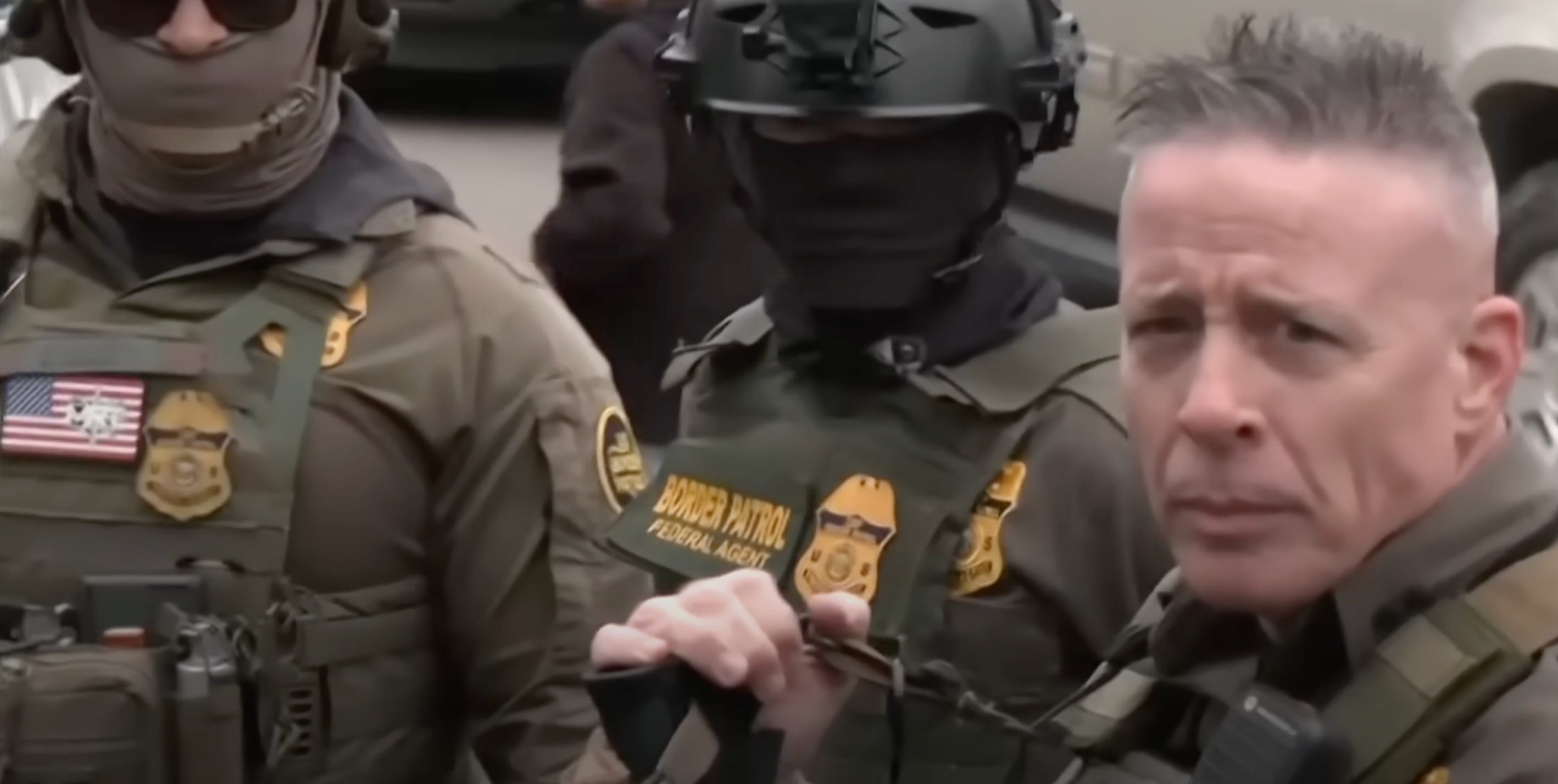
In Chicago, the administration has placed the Border Patrol under the command of Bovino, a relentless self-promoter with a spiky gray buzz cut who dresses like an action figure and relishes making a dark spectacle of immigration enforcement.
Bovino was the commander of the heavily armed Border Patrol forces that stormed Los Angeles’ MacArthur Park on horseback during a July sweep that sparked widespread alarm and condemnation from the mayor. (Bovino ludicrously defended the display of force by claiming that the park, famous for its diversity, was the “birthplace of MS-13,” the violent international gang.)
For Operation Midway Blitz, Bovino has emerged as the top MAGA cop on the scene, and has accompanied Secretary of Homeland Security Kristi Noem to public appearances meant to project the administration’s anti-immigrant resolve.
In short order, Bovino has become infamous in Chicagoland, where his actions are at the center of a federal lawsuit, filed by protesters and journalists against Noem and other administration figures earlier this month. They allege “a pattern of extreme brutality” by federal agents at an immigration detention facility in Broadview, just outside of Chicago, and an “ongoing effort to silence the press and civilians.”
The complaint asserts that government agents have “tackled and slammed people to the ground”, “lobbed flash grenades and tear gas canisters indiscriminately into the crowd,” and targeted individuals with “rubber bullets and pepper balls.”
Bovino is a named defendant in the suit, which claims he “directed federal officers to use excessive force against protesters and journalists.” It alleges Bovino violated the First Amendment by declaring his intention to turn a designated “free speech” zone (reserved for protesters outside the facility) into a “free arrest zone.”
Responding to the suit, federal judge Sara Ellis has imposed a temporary restraining order on federal agents from using riot munitions on protesters — calling on the agents to “follow…what the Constitution demands of them.” The judge has also ordered Bovino to be deposed in the case.
Underscoring the dark politics of the moment, Bovino is also engaged in war of words with the governor of Illinois, J.B. Pritzker. In a social media post highlighting photos of armed Border Patrol agents terrorizing civilians, Pritzker declared that “Greg Bovino, Kristi Noem, and DHS need to answer for their unchecked attacks on Chicago residents.”
Far from any display of contrition, Bovino snapped back in Trumpian fashion during a recent Fox News interview, painting the state leader as part of what the president has called the “enemy within.” Bovino declared, baselessly, that Pritzker has “more in common with terrorist drug cartels than he does with American citizens.”
What’s Next?
Trump is showing an eagerness to expand his deployments of the Border Patrol to other cities not typically associated with the border.
On October 22, the administration began marshalling CBP agents to a Coast Guard station in the Bay Area, in advance of a planned incursion into San Francisco. The federal arrivals were met by a large group of demonstrators who were soon countered with riot-control munitions, including flash bang grenades and pepper-ball projectiles.
Following this initial show of force, however, Trump placed a hold on plans to make the Bay Area the new Chicago. This change of heart came after Trump encountered the only borders he truly respects — wealth and power.
In a Truth Social post Thursday, Trump described deciding to stand down from plans to “‘surge’ San Francisco” after receiving phone calls from “friends,” including major tech executives, who asked him to reconsider, given what Trump praised as “substantial progress” in “fighting Crime” in the city.
These billionaire boundary setters included the CEOs of Nvidia and Salesforce, both of whom have eagerly sought to ingratiate themselves with the president. “Great people like Jensen Huang, Marc Benioff and others have called saying that the future of San Francisco is great. They want to give it a ‘shot,’” Trump wrote. “Therefore we will not surge in San Francisco.”
Is this a temporary reprieve? Will the agents be re-deployed elsewhere in the country? Trump offered little hint, writing only: “Stay tuned!”
Tim Dickinson is the Senior Political Writer & Editor for The Contrarian
Tim is an excellent addition to the staff of The Contrarian. Very well presented facts and arguments in this article.
Along with their cult leader, Miller, Noem, Homan, Bovino and the rest are proving every day that cruelty is the ultimate point.
Excellent article, Tim. Thank you so much for cataloging what CBP has become.