

By Roberto Valadéz
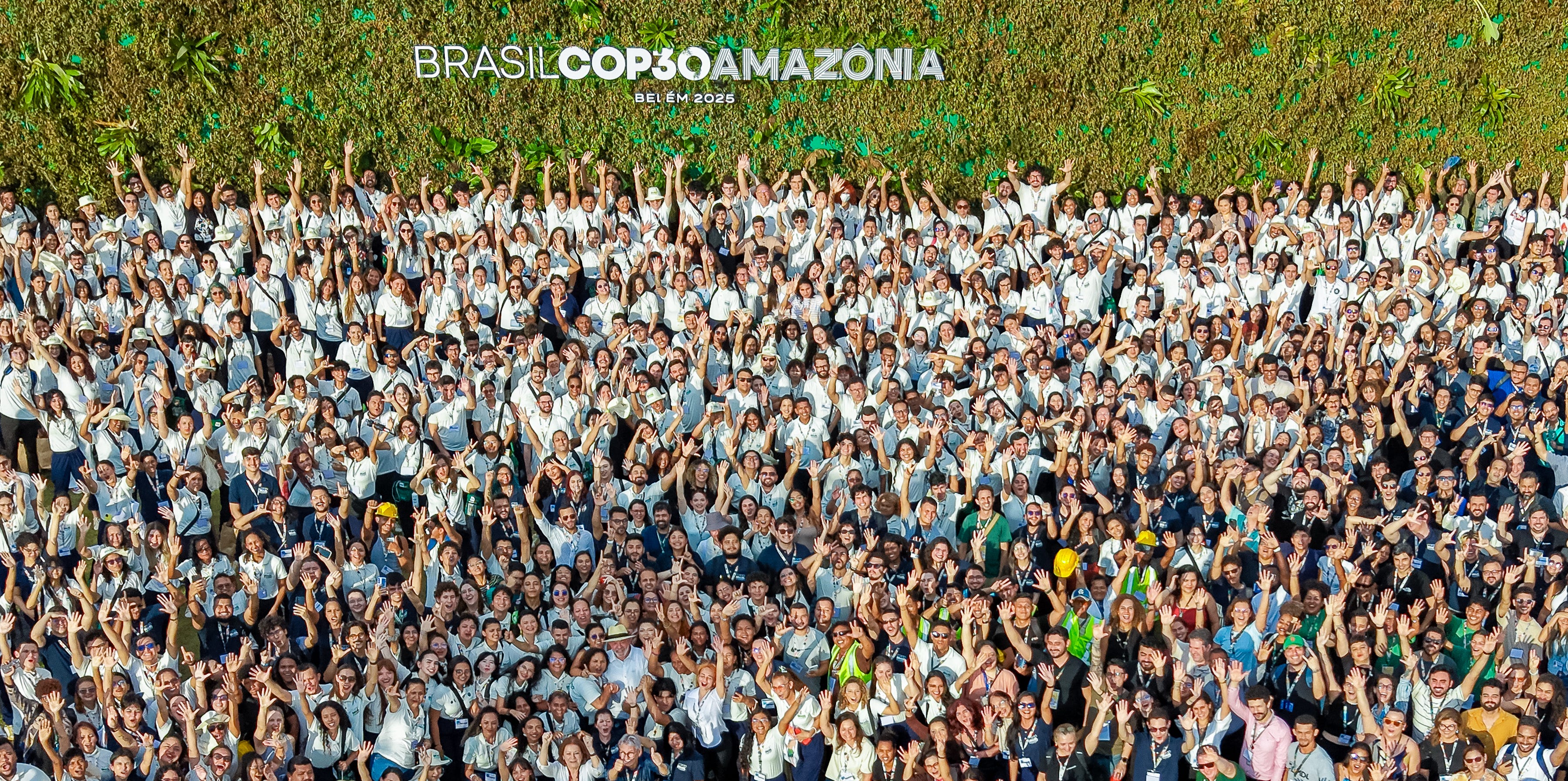
The 30th United Nations Climate Change Conference (officially called Conference of the Parties, or COP30 for short), is convening in Belém, Brazil, placing critical negotiations on climate policy squarely in the heart of the Amazon rainforest. Notably absent from the global gathering is high-level leadership from the world’s largest historical emitter, the United States, and many of the nation’s corporate titans. Yet climate champions both within the U.S. and abroad remain resolute in leveraging this year’s COP30 to drive reform. Here’s how they plan to create sustainable momentum despite political volatility, a rise in disinformation campaigns, and the daunting scale of our most global challenge.
What is COP?
The first COP occurred in Berlin in 1995, with more than 150 countries convening to sound the alarm on the accelerated pace of planet-heating pollution. In 2015, the landmark Paris Agreement was adopted by 195 nations, with the aim of limiting global warming to well below 2 degrees Celsius and committing each signatory country to submit 5-year plans on how they would contribute to realizing this ambitious goal. Under the direction of President Trump, the U.S. is now the first and only country to withdraw from the agreement.
Sobering Reality
According to a newly released report from the UN, delayed and insufficient governmental action has put the world on a path to exceed the 2 degree Celsius threshold, tracking toward a devastating 2.8 degrees of warming. While fulfillment of all new national pledges could temper this rise to between 2.3∘C and 2.5∘C, even these results would risk pushing the planet past critical tipping points, including the complete loss of coral reefs and the irreversible melting of ice sheets. Every fraction of a degree avoided now is crucial to prevent triggering exponential catastrophe.
Tackling Disinformation
The rise of climate disinformation has proven a formidable opponent to the climate movement, enabling destructive narratives that benefit polluters and their political allies. A recent report found a staggering “267% increase in COP-related disinformation circulating in media and online from July to September 2025.” President Trump has been among those most loudly fueling public doubt in the effects of climate change, going so far as to call it “the greatest con job ever perpetrated on the world”.
In response to such systemic threats, 12 countries have signed the Declaration on Information Integrity on Climate Change, formally committing to fighting denialism and attacks on environmental science. It also calls for companies to commit to transparent, human rights-responsible advertising and business practices, pledging integrity of information on climate change.
Notes of Optimism
To offset the absence of a high-level U.S. federal delegation at this year’s COP30, major subnational political players are in attendance, signaling continuing engagement. This includes Senator Sheldon Whitehouse of Rhode Island, who sits on the Senate Committee on the Budget, and projected contender for the presidency in 2028 Governor Gavin Newsom of California, whose state produces more electricity from renewable energy than any other state other than Texas, and whose economy would be the fourth largest economy in the world if it were an independent nation. Mr. Newsom’s resounding message: “California is a stable and reliable partner”.
Another bright spot is that this year, renewable energy contributed more to global electricity than any other source for the first time in history. The rapid transformation of global electricity grids is doubly promising, as it would both shrink the largest source of global emissions (energy) while also holding the potential to provide clean power to other industries. Happily, clean energy is now the most economically competitive option, and the exponential growth in the deployment of wind, solar, and batteries is projected to double global renewable power capacity within the next five years. This will amount to a remarkable 4,600 GW of new capacity, a volume roughly equal to the existing total power generation capacity of three major economic blocs: China, the European Union, and Japan.
Elsewhere, initiatives like Al Gore’s Climate TRACE are using AI and satellite imagery to identify particularly high-polluting facilities—steel plants, landfills, refineries—in the hopes of focusing emission reduction efforts. If followed, Climate TRACE’s recommendations have the potential to supercharge CO2 cuts over the next two decades. With large steel plants alone, about a third of which are due for costly facelifts (“re-lining”) in the next five years, choosing to convert to low-carbon technology rather than to revitalize old systems could save approximately 20.5 billion metric tons of carbon dioxide by 2050—a number equal to about half of all current annual emissions. At COP Gore called Climate TRACE “a ready-made blueprint” for industries to decarbonize as quickly and cheaply as possible.
Finance for the Future
At COP30, the focus on finance has been intense. The host country’s flagship Tropical Forest Forever Facility (TFFF) initiative is designed to attract $125 billion in capital by offering financial returns, framing forest conservation as an investment rather than a grant. The European Bank for Reconstruction and Development (EBRD) and the Asian Infrastructure Investment Bank (AIIB) are reportedly considering investments, signaling that major financial institutions see potential in such structured, market-driven funds for long-term climate stability.
The Way Forward
Ultimately, the global commitment to climate stability is proving resilient, despite formidable headwinds. Governments and business leaders alike are not only increasingly recognizing that their long-term bottom lines are inextricably linked to planetary stability, but also that our climate crisis may already be the largest economic opportunity of the 21st century. The closing session of COP30 will be a watershed moment—demonstrating whether political resolve can unlock viable opportunity, allowing climate champions to make good on the long-deferred promises of a sustainable future.
Roberto Valadéz is the former director of communications and special initiatives for the United Nations Ambassador for Global Health, where he led high-stakes global campaigns, including the office’s work on COVID-19. As the founder of True You, he now equips underestimated C-suite leaders with the tools to level up their leadership and amplify their impact by harnessing their authenticity.
JUST A REMINDER that the issues we worked on at Greenpeace 40 years ago are all being undone by the Loser regime:
No roads in the roadless Arctic
Yes, protect our drinking water via wetlands conservation
No offshore oil drilling
Yes, increase solar and wind electricity generation
No more nuclear bomb testing
Yes, increase protection for endangered species
No more clear-cutting on national forests and other public lands
Yes, regulate factory emissions
No more nuclear waste to leave for the next generations
AMERICA FIRST MY ASS
trump is such a fool for not recognizing we could be the leader in renewable energy from wind, solar and geothermal. He always acts like a spoiled adolescent "if Biden did it I'm against it" that's classic "cut off your nose despite your face"
so China gains both soft power around the world as it accelerates renewable energy. it does not absolve China from its massive coal extraction acceleration but even the Chinese realize fossil fuel paves the way to climate disaster. they just want to have global dominance and a backup plan