


One part of Jen Rubin’s must-read/must-watch with Rep. Adam Smith about the murders of two men in the Caribbean stood out to me. It was Smith’s explanation of why presumed responsible Republicans such Mike Rogers have not openly objected to Donald Trump’s outrages, including abandoning Ukraine and thumbing his nose at Congress. Beyond Trump’s continuing hold on his cult, it is their belief that the other side is trying to create an America they do not want. Refusing to do the right thing because it might give aid and comfort to their “enemies” is a textbook example of what tribalism is doing to our governing fabric.
When Tom Mann and I were writing “It’s Even Worse Than It Looks” in 2012, the most common descriptor of the dysfunction in American politics was polarization. We demurred. The problem was not polarization, but tribalism. We did not deny that we were in an era of polarization, one where our parties had gone from “big tents” including a mix of ideologies across regions, with a preponderance of lawmakers in the broad middle of the political spectrum, to a sorting, where the parties became more homogeneous and moved toward their ideological bases. But we added two caveats. First, that the parties had not moved equally; the polarization was asymmetric, with Republicans moving much further in an ideologically extreme direction than the Democrats. And second, that the political system can still operate and move to solve collective problems even in a polarized environment.
The example we used was the odd-couple partnership of Sens. Ted Kennedy, a Democrat, and Orrin Hatch, a Republican, each representing the ideological wing of his party, with completely different personalities and lifestyles, but a willingness to work together, despite their differences, to bring health insurance to children. They both recognized the problem, found some common ground, did some horse-trading, and stayed together to fend off hostile amendments. The fruit of their partnership, the Children’s Health Insurance Program, continues to protect millions of American children.
What distinguishes polarization from tribalism? Kennedy and Hatch were polarized, but they saw each other as legitimate actors, if misguided, working to create a better America. In today’s environment, their counterparts see those on the other side as evil, trying to destroy our way of life.
That frame radically alters the political and social landscape. If one considers fellow Americans, as evil or as the enemy, anything goes. People are dehumanized, and norms of behavior, including those surrounding vile language, violence, ethical standards, racism, and sexism, disappear. Tribalism, rather than polarization, explains why so many Americans, including deeply religious ones, excuse Trump’s horrible language, sexual predation and abusive and immoral relationships with women and girls, racist and sexist attacks on entire populations (calling Somali Americans “garbage” and referring to majority Black and brown nations as “shithole countries”) and women reporters (“Quiet, Piggy”), and serial lies. And tribalism explains why massive grifting get shrugged off.
Violent acts and threats—including those against anyone challenging Trump, from Marjorie Taylor Greene to Indiana legislators, to election officials who refused to overturn or skew election results, to then-Vice President Mike Pence—get excused, as does a violent insurrection that killed and maimed police officers and deeply damaged the U.S. Capitol. Moves to sanitize history get applauded, as the history could support the aims and frame of the “enemy” within. Trump’s ham-handed efforts to invent bogus charges and use the Justice Department to go after Democrats who have challenged him, from Jack Smith to Eric Swalwell to Letitia James, are applauded by a large share of Republicans in office and around the country.
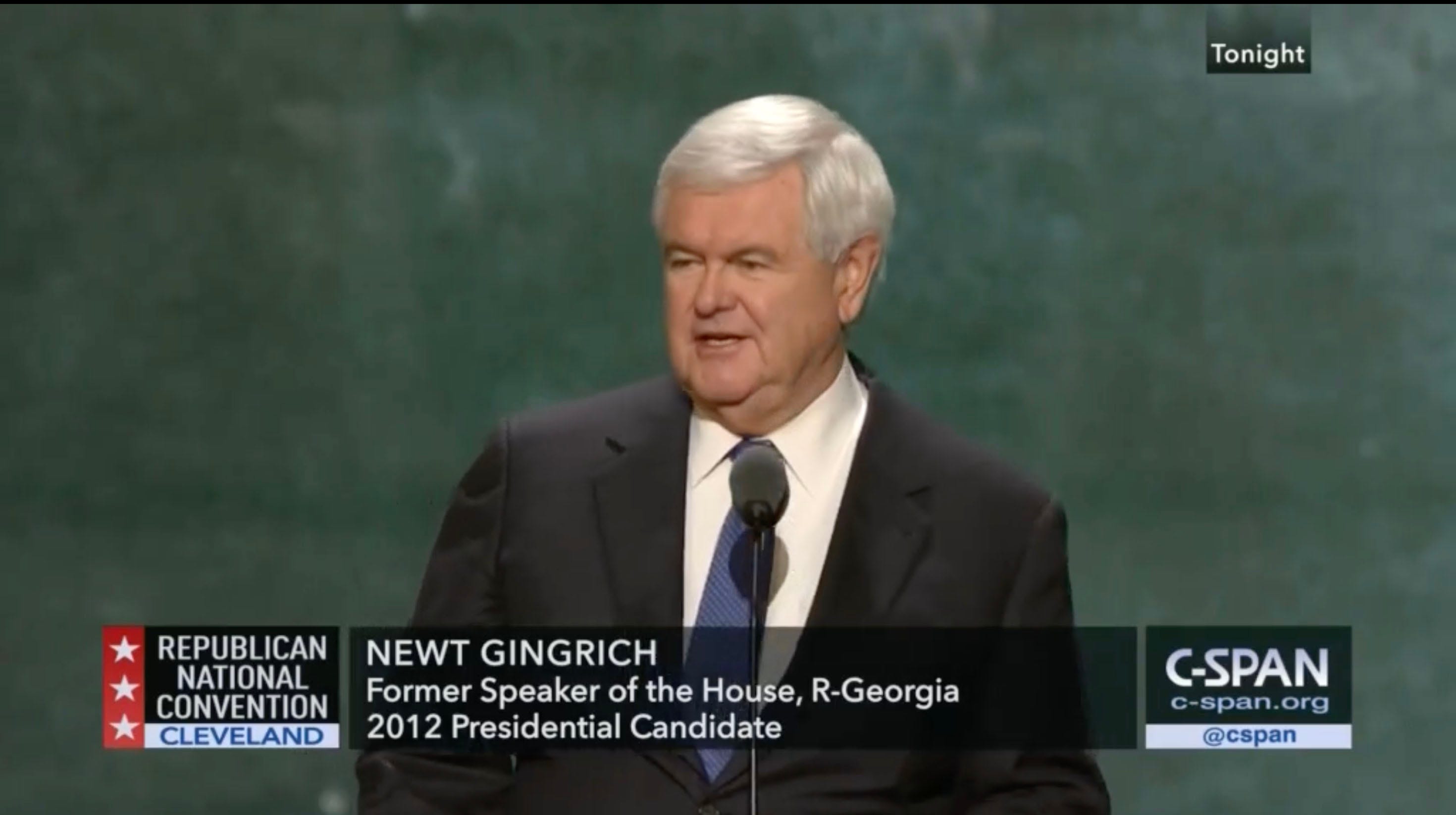
How did we segue from plain—if challenging—polarization to destructive tribalism? Let’s start with Newt Gingrich. In 1978, Tom and I started a Congress Project at the American Enterprise Institute. We recruited newly elected members of Congress to come to regular off-the-record dinners to track their experiences through their first term in office. It was quite a class, and our group of eight included Dick Cheney, Geraldine Ferraro, and Gingrich, among other luminaries. Gingrich, who had run twice before he won and was a history professor at a small Georgia college, dominated our regular conversations. He had a full-blown strategy and tactics to break the then 24-year stranglehold Democrats had on the majority in the House of Representatives.
His goal? To nationalize elections and ultimately convince voters that Congress was so bad, so irredeemable, that anything would an improvement, to get them to ignore incumbency, throw the ins out and bring the outs—the minority Republicans—in. The tale of how he got there has been told well by many, including John M. Barry in “The Ambition and the Power,” Julian Zelizer in “Burning Down the House,” and Mann and me in “The Broken Branch.” But at its core was radicalizing his own House Republicans and deliberately moving from accommodation and compromise to confrontation and tribalism. He attacked his own Republican colleagues, including his leader Bob Michel, who tried to govern instead of obstructing.
Gingrich systematically moved to divide Americans and destroy confidence in Congress and government. He recruited candidates and taught them to use inflammatory language to incite anger and have voters turn on Congress, Washington, and government as evil. It took sixteen years, but the wave election of 1994 gave Republicans their first House majority in 40 years. Gingrich became speaker of the House and told his new members not to bring their families to Washington, as if it were a leper colony and they could be infected.
Cynically, Gingrich hoped to co-opt his colleagues and turn the House into a powerful government machine he would drive, but that did not work. Many of those who came in with and because of Gingrich really did and do believe that government is the enemy and Democrats, the mainstream media, and many parts of the culture are actively engaged in sabotaging not just their view of America but its very existence.
The visceral anger the newer members felt toward government and their Democratic counterparts was real and deep. Gingrich’s tenure as speaker was short-lived, but the tribalism he generated was enduring. It deepened in the House and spread to the Senate, when Gingrich brought their corrosive norms with them, as told by Sean Theriault in his book “The Gingrich Senators.”
The Gingrich-generated tribalism metastasized from House and Senate in Washington to states and to the broader public, thanks in part to another development tied to technological change. In 1987, the Reagan-dominated Federal Communications Commission ended the so-called “Fairness Doctrine,” which mandated equal time for political views. It would have gone away anyway with the rise of cable and the internet, but its demise led directly to the rise of tribalization of talk radio and cable news. Here we can add three other catalysts: Rush Limbaugh, Roger Ailes, and Mark Zuckerberg.
When the Fairness Doctrine fell, Limbaugh, who had been a local radio talk show host, went national with his bombastic, divisive, and entertaining show. Soon, right-wing talk radio became a major driver of the expansion of tribalism to the states and voters alike. Ailes saw in Fox News a business model that could be extraordinarily lucrative.
When social media exploded on the scene, it generated business models that thrive on inciting anger, and many ignored the role of Russia, China, and other malign actors in exploiting the platforms by spreading lies, conspiracy theories, and misinformation. The impact on dividing America into warring tribes was and is profound. And Zuckerberg and other tech barons who have made staggering fortunes from all this are happy to send us further toward a violent abyss.
Of course, Trump, with help from advisers Steve Bannon, Stephen Miller, and Roger Stone, has made this all much worse. And the challenge we face—beyond the immediate, existential one of preserving any elements of our fundamental democracy—is whether, if we emerge in 2029 with a decent government, we can roll back the tribal attitudes and divisions. Structural reform alone won’t do it. We need to have our best minds thinking of steps we can and must take before sectarian division leads to sectarian violence, with no road back.
Norman Ornstein is a political scientist, co-host of the podcast “Words Matter,” and author of books, including “It’s Even Worse Than It Looks: How the American Constitutional System Collided With the New Politics of Extremism.”

"What distinguishes polarization from tribalism? Kennedy and Hatch were polarized, but they saw each other as legitimate actors, if misguided, working to create a better America. In today’s environment, their counterparts see those on the other side as evil, trying to destroy our way of life."
But suppose the other side, Republicans, have signed on with extremists who literally are trying to destroy our way of life--one of inclusion built over the past 75 years, one striving toward economic equality, one that believes our shared government should help all of us, not just a subset? Whether that comes from ignorance, selfishness, or evil--for is it not evil to let children starve?--doesn't really matter.
Putting healthcare out of range for aging and compromised people who will suffer and die is definitely one way to destroy a way of life. Incarcerating or killing folks without due process, ditto. Refusing to hold crooks accountable or pardoning them so you won't look so bad, also ditto. No narrative seems to fit our time right now--we are being attacked by our fellow citizens, really for reasons that are based on lies and ignorance and fear. If that's tribalism, it's on one side only.
The worst forces against our democracy were Gingrich, McConnell, Trump, and the Supreme Court with McConnell helping to get the Supreme Court as one of those forces.