


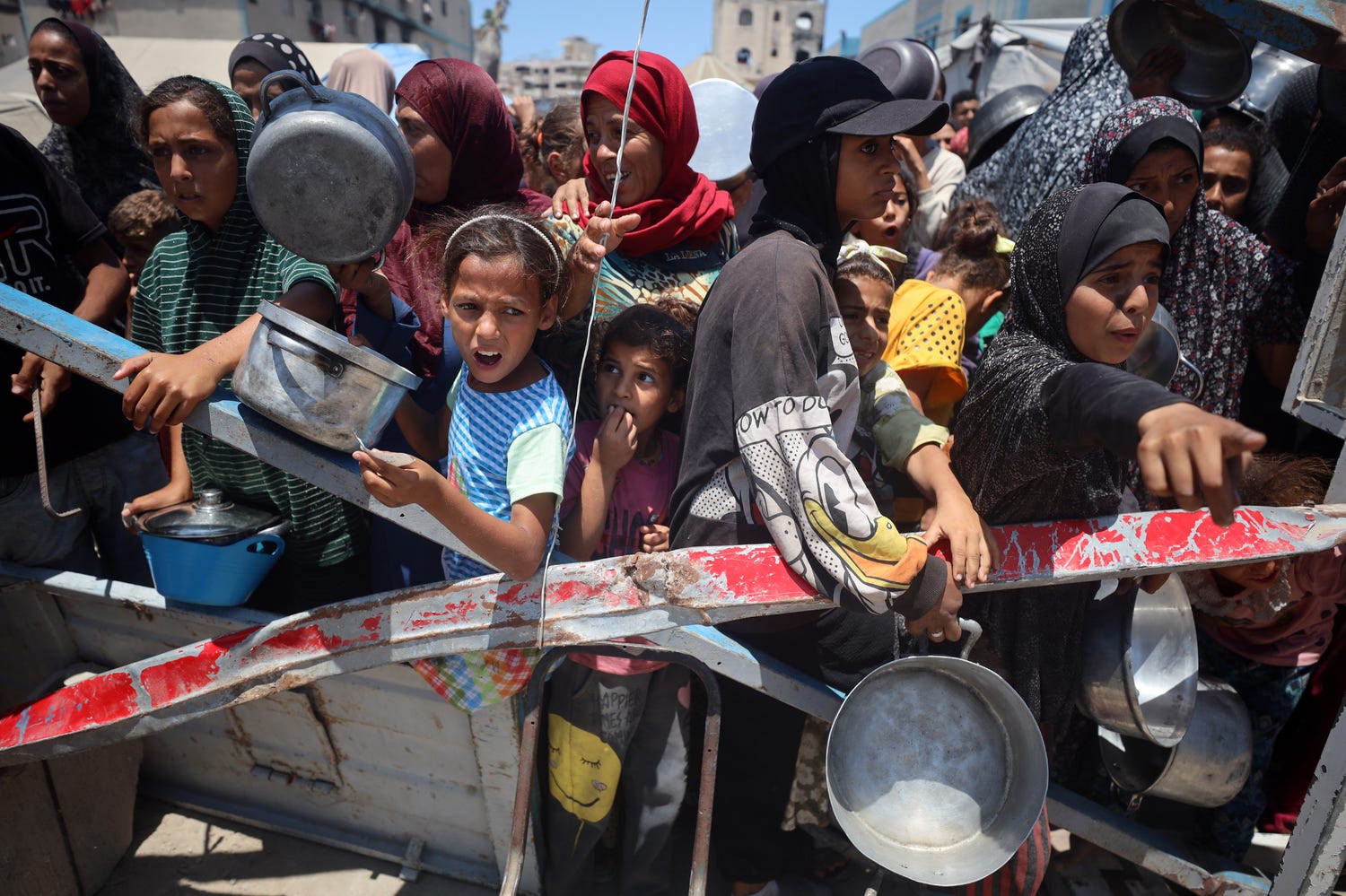
The debate among pundits over what finally pushed President Donald Trump to acknowledge the ongoing famine in Gaza is beside the point. Whether prompted by intelligence briefings, diplomatic pressure, or—more likely—the horrific images on television, it got through to him.
“Some of those kids are—that’s real starvation stuff,” he said Monday during a bilateral meeting with U.K. Prime Minister Keir Starmer at Trump’s Turnberry golf resort in Scotland. “I see it, and you can’t fake that.”
This is not a man known for policy nuance or humanitarian concern. Trump meandered, complained about not being thanked for past U.S. aid, and floated vague plans to work with European allies to establish “food centers” in Gaza. He continued to insist that Hamas has stolen some aid—a claim multiple investigations, including by the Israeli military, have failed to corroborate—but his comments marked a notable shift. They diverged sharply from Israeli Prime Minister Benjamin Netanyahu’s claim that there is “no starvation.”
Vice President JD Vance, speaking in Ohio, was more restrained, if not more helpful. He called the deaths of children from starvation “heartbreaking” and added that Israel “must do more.” As guidance, “do more" is as banal as it is directionless.
Still, the shift matters. The question now is not whether famine is occurring but whether it will be treated as real enough to provoke action.
In the coming days, we will be inundated with debates, accusations, diplomatic choreography, and hopeful statements about humanitarian access. That machinery might produce some relief. But the human damage is already done.
Even if food aid begins to arrive at scale in the coming days, the effects of starvation—especially among children—are lasting. The tragedy in famine is not only the death toll but also the duration of harm.
We speak of malnutrition as if it ends with refeeding. It does not. Especially in children, the impact is often permanent. Medical research spanning decades—including studies dating back to the Dutch Hunger Winter of the Second World War and subsequent medical studies—show that malnutrition during the first 1,000 days—from conception through age 2—is often irreversible. Chronic malnutrition in early childhood significantly raises the risk of type 2 diabetes, heart disease, and neurological impairments. Psychological trauma often parallels the physical. Gaza’s next generation will grow up stunted biologically and emotionally.
That would be reason enough for urgency. But what elevates this from tragedy to strategic failure is its preventability. This famine is not like those in Ethiopia, Somalia, or Yemen. Gaza is not a remote province beyond the reach of aid, nor a parched landscape devastated by drought. It is a narrow coastal strip just 25 miles long, with a dense population. It is urban—and surveilled. International organizations have tracked the caloric intake of its population for years. Border crossings, though contested, are known and accessible. In terms of geography and logistics, this is not a famine of inaccessibility. It is a famine of choice on the part of Israel.
The humanitarian infrastructure that once enabled rapid intervention are gone or gutted. The State Department’s April reorganization eliminated key offices and decimated the U.S. Agency for International Development’s coordinating role for Middle East relief. The State Department, once the nerve center for emergency diplomacy, now functions more as a holding pen for political loyalists. What remains is a patchwork of improvised responses, many only symbolic.
Gaza, in other words, has exposed not only the cruelty of siege but also the hollowness of the United States’ response capacity. The trucks exist. The routes exist. The problem is not in the how but in the will. As Trump put it: “We’re going to be even more involved.” What that means is unclear. But the implication is damning. Even the man who dismantled much of America’s soft-power apparatus now sees the need for something to change.
And he’s not wrong.
Because the problem is not just humanitarian. It is strategic. The more Gaza is allowed to fester in full view of the world, the more certain it becomes that the children who survive will grow into something far more dangerous than malnourished civilians. They will grow into symbols of abandonment. And in the modern Middle East, symbolic grievance metastasizes quickly.
Recent indicators have shown a surge in online martyrdom narratives and religiously framed indignation tied to Gaza. Jihadist propaganda arms—from Al-Qaeda affiliates in Yemen to Islamic State of Iraq and the Levant outlets in West Africa—have placed Gaza at the center of their messaging. The shift is visual, not doctrinal, with “genocide” now a recurring term. That several human rights organizations have described the situation in those terms only strengthens the legitimacy of such messaging. According to U.S. intelligence assessments, this content is not aimed at mobilizing the faithful, but at provoking the alienated.
The Gaza famine is a humanitarian failure that is likely to become an accelerant. It reinforces the view that the international order doesn’t merely neglect Muslim suffering—it enables it.
Western governments might believe that a belated effort to ease starvation will help them avoid political consequences. But the bill is still coming. It might not arrive in the form of large-scale attacks or the resurgence of jihadist armies. It might come through lone actors, symbolic retribution, and a generation no longer interested in reform.
Unlike earlier waves of jidahist radicalization, this one—if it comes—will be emotionally driven. It will be diffuse, symbol-rich, and aimed not only at Israel but at the global system itself. The enemy will not be Western troops. It will be Western silence.
There is still time to act. But not much. Trump and other Western leaders must not treat this as a reputational inconvenience to be remedied with money. The damage is done. That reality demands a sustained effort that goes beyond the optics of this news cycle.
Action now might not undo the long-term consequences, but it is necessary to show the response is more than symbolic. For the Trump administration, that would require empathy and investment without immediate reward—soft power, in other words. And that might be the costliest ask of all. Because if it doesn’t come, the children of Gaza—and the world—will pay the price.
Brian O’Neill, a retired senior executive from the CIA and National Counterterrorism Center, is an instructor on strategic intelligence at Georgia Tech. His Safehouse Briefing Substack looks at what’s ahead in global security, geopolitics, and national strategy.

There is so much we don't really know about all of this. What we do know is that people are starving. The Hamas threat is real and as always, undefined by those assessing all of this. It still does not excuse the lack of food reaching desperate families. Surely there are better ways to deal with this, and the withdrawal of available food aid because of our apparent apathy to suffering that the Trump administration displays daily is inexcusable. Israel should not be the one who decides who in Gaza will be fed. They are at war with these people and will make decisions that are influenced by how they see this war. The United States and Europe need to send in food distributed by impartial groups that are willing to help, despite the ongoing conflict. The fact that Israel is not letting this happen, further damages any credibility that they have left. This article is correct is assessing that this is helping to create future strife and violence. Kindness and empathy, along with real help, goes a long way to ease suffering and until this happens, nothing will be fixed.
What matter is that people in Gaza are starving.
Whatever future terrorist threats might emerge, the fa t that children will die or aurve and grow up emotionally and physically stunted is more than enough reason for the West to act and push Netanyahu to stop this endless war.