

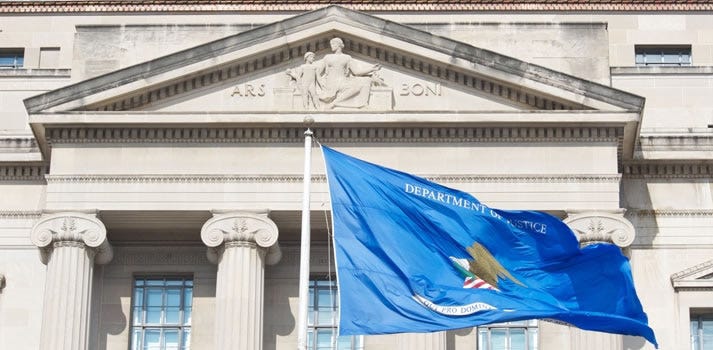
By Ellen Blain
It comes as no surprise that the Trump administration has peculiar notions about civil rights and the purpose of the Justice Department’s Civil Rights Division. Its recent actions have been a series of reversals and weakenings: pardoning a defendant found guilty of harassing women seeking abortions, reassigning division leaders to dead-end jobs, investigating a police department for “depriving ordinary, law-abiding Californians of their Second Amendment rights.”
But two things that happened on Monday were nevertheless shocking. Roughly 70% of the lawyers in the Civil Rights Division indicated they will resign. And the president issued an executive order directing DOJ to defend police officers accused of violating the constitutional rights of Americans. These two events are intimately related, and together they do no less than turn upside down the enforcement of laws that protect the civil rights of all Americans.
Congress passed the first civil rights laws in 1866, primarily to protect Black Americans from violence suffered either directly at the hands of local law enforcement or, in law enforcement’s absence, at the hands of the Ku Klux Klan. Local prosecutors could not be relied on, for obvious reasons, to charge the perpetrators, so DOJ stepped in. Federal prosecutors charged local officers – largely in the South – and their success was limited, as local juries often sided with law enforcement regardless of the facts. In 1957, in a precursor to the Voting Rights Act, Congress created the Civil Rights Division, with the explicit goal of enforcing minorities’ right to vote and protecting them from violence by local officials.
The most vulnerable citizens required federal protection. This was the core of the Civil Rights Division’s mission.
Starting in the 1960s, Congress passed more civil rights laws, expanding the Civil Rights Division’s mandate, reaching into all aspects of American life. Now, the division enforces laws that protect against discrimination on the basis of race, color, national origin, gender, religion, familial status, and/or disability in the areas of employment, housing, public accommodation, and state and local government services; laws that ensure everyone’s right to vote; laws that protect access to abortion clinics and criminalize acts of hate; and laws that ensure police departments and local jails follow follow the Constitution.
These laws impact our daily lives. Now we take for granted that we have a right to a workplace free form harassment or the right to purchase a home regardless of our race, but those rights were not explicitly protected until 1964 and 1968, respectively.
As co-chief of the Civil Rights Unit in the U.S. Attorney’s Office for the Southern District of New York (DOJ’s presence in New York), I was honored to bring cases that helped individuals vindicate their rights. These cases included an individual denied a telephone operator job because he lives with HIV, or a female firefighter fired after complaining that her chief (later promoted) was harassing her, or an incarcerated woman sexually assaulted by a guard. Or cases that defended a handful of people, such as several teachers at a high school in Queens who were fired because of their race, or women forced to exchange sexual favors for reduced rent. Or cases that protected hundreds of thousands, by cleaning up the conditions at Rikers and other jails; making New York City subways, schools, and Broadway theaters accessible; addressing social media’s algorithmic discrimination; and holding police departments to account. The loss of 70% of the Civil Rights Division’s lawyers and the vast institutional knowledge they take with them adversely affects all of these protections. But the last has a special significance.
As at the division’s inception, it, with its U.S. Attorney’s Office partners, has protected Americans’ rights when interacting with the police –not to badger officers for doing a hard job, but to ensure that everyone has the rights promised at our country’s founding, including the Fourth Amendment right to be free from excessive force. DOJ has employed the same laws passed during Reconstruction to prosecute officers who violate the Constitution, as in the tragic cases of George Floyd, Ahmed Arbery, and many more. And, since 1994, when, in the wake of the Rodney King riots in Los Angeles, Congress passed the federal government’s only police oversight law. Tthe division has also investigated entire police departments to address and remedy larger patterns of unconstitutional policing. These are prosecutions and investigations local governments often do not have the desire or courage to take on. But they are cases that go to the heart of Bill of Rights. So, again, the federal government steps in.
President Donald Trump’s latest executive order took aim at this two-century long effort, charging: “When local leaders demonize law enforcement and impose legal and political handcuffs that make aggressively enforcing the law impossible, crime thrives and innocent citizens and small business owners suffer.” And he directed: “The Attorney General shall take all appropriate action to create a mechanism to provide legal resources and indemnification to law enforcement officers who unjustly incur expenses and liabilities for actions taken during the performance of their official duties to enforce the law. This mechanism shall include the use of private-sector pro bono assistance for such law enforcement officers.”
In other words, though DOJ – from 1866 until this week – prosecuted officers accused of violating the civil rights of citizens, DOJ now will defend those officers. To make matters worse, not only will DOJ “provide legal resources and indemnification” to such officers, but DOJ will also arrange for their pro bono representation. Because some of the biggest law firms in the country, rather than fight blatantly illegal executive orders, pledged to donate millions of dollars in pro bono work to causes of Trump’s choosing, these officers will presumably have no shortage of “pro bono” representation.
This is the main reason that all those lawyers resigned. From 380, the division now has fewer than 100 lawyers. That is fine with the Trump-appointed head of the division, Harmeet Dhillon: “We don’t want people in the federal government who feel like it’s their pet project to go persecute” police departments, she said. “The job here is to enforce the federal civil rights laws, not woke ideology.”
These civil servants were not pursing “woke ideology.” They were pursuing the goals established when Andrew Johnson was president: making sure that the Constitution applies to everyone. These DOJ lawyers would rather abandon their careers and face the prospect of not finding a job – a real possibility given the flood of government workers now in the market – rather than do what the Trump administration wants: use the power of the Civil Rights Division to do the exact opposite of its core mission.
Some DA’s offices will step into the gap, though there will not likely be many in red states. But it is certain that in the wake of such mass resignations, enforcement of all civil rights laws will suffer. The Civil Rights Division does not appear to be hiring. There are now vastly fewer lawyers working to make sure kids with disabilities can go to school, women can work free of harassment, and voting is free and fair, all while the Trump administration co-opts the phrase “civil rights” to protect the most powerful among us.
Ellen Blain is a Former Co-Chief, Civil Rights Unit, United States Attorney's Office for the Southern District of New York and a Partner at Clarick Gueron Reisbaum.
This is a wonderful article. Thanks so much for writing it, and for your many years spent protecting our civil rights.
The Trump 2.0 destruction derby over the past 102 days has not surprised me, but it still stings. What buoys me up is the resistance arising from out here in the cheap seats. Finishing up signs now for our May Day / Rule of Law Day protest in rural CA Trump country, Yreka CA, where we've had good crowds for all 3 protests over the past weeks.
Gonna be a big rebuilding job once we turn this thing around. Which we shall.
This administration's actions are playing out like a script of a bad horror movie. You know, the kind where we say don't go down into that dark scary basement to investigate the unknown sound. The only difference is that we are already in the dark scary basement, and we can't get out!!! It makes me wonder what all the brave men and women who protected this country for the first 248+ years would say if they could see what the felon in chief is doing to it now! :-(