

By Shalise Manza Young
If you’ve learned about the Middle Passage, the 5,000-mile trans-Atlantic route that carried kidnapped Africans to Caribbean islands or Brazil where they would be sold into enslavement, you’ve seen renderings of the ships themselves, specifically diagrams of how hundreds of humans were packed into the lower decks.
The men were often chained together for the months-long trip, separated from the women and children. The conditions were inhumane, and disease ran rampant; estimates are that as many as 20% of captives per ship would die from disease en route.
Scrolling Bluesky about a month ago, an image made me stop. I stared at it, stunned: It was strikingly, frighteningly similar to one of those slave ship diagrams. Boxes with row upon row upon row of tick marks, thousands of them, each ostensibly representing a human being.
It is the floor plan for a proposed Immigration and Customs Enforcement “mega center” in Social Circle, Ga., a town of 5,000 about 45 miles east of Atlanta. ICE purchased a warehouse there in February; on the last page of documents the town government posted online is a graphic calling for over 8,000 beds in the facility.
There is nothing in American history that compares to the horrors of chattel slavery and the Trail of Tears.
But damn if the echoes of both can’t be heard when it comes to these federal concentration camps.
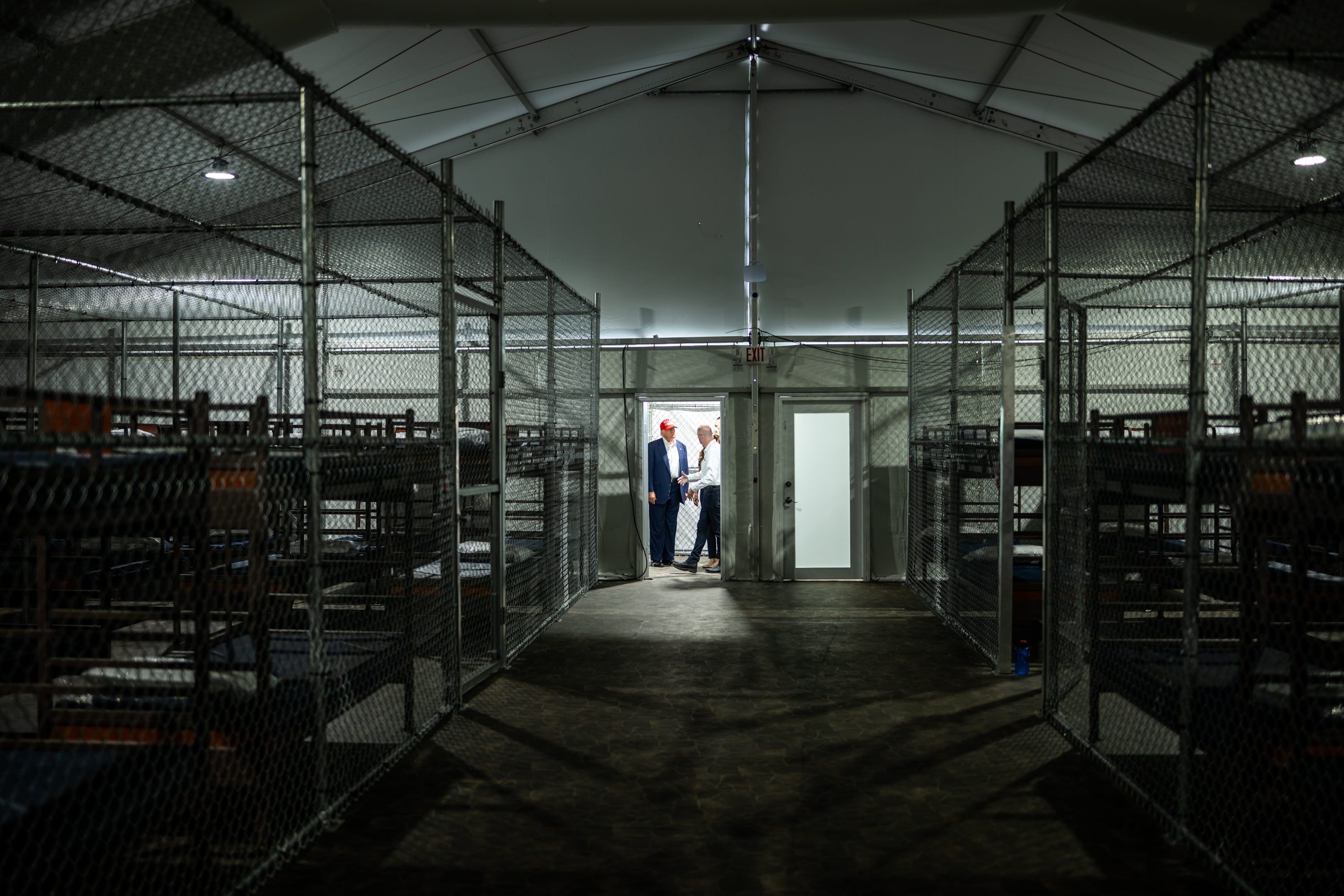
The clear resemblance of the warehouse specs to the diagrams of slave ships is just one thread tying the current American deliberate dehumanization plans to the country’s original sins.
Families are being split up, a tactic of Southern slaveholders. ProPublica recently reported the Trump regime separated 11,000 American citizen children from their parents in just the first seven months of its return to the White House. Sixty percent of the mothers of those children were deported despite data showing that over three-fourths of people detained by ICE had minimal, if any, criminal convictions.
As a reminder, not having the proper paperwork is a civil infraction, and though MAGA acolytes scream if people “do it the right way” they have nothing to worry about, hundreds of arrests have happened at courthouses where immigrants had reported for hearings.
Violence is — as it was — rampant. Just as centuries ago, European colonizers forcibly moved roughly 100,000 Indians from their native lands in what became known as the Trail of Tears, and the enslaved were whipped for any and all manner of “infraction.” In the Jim Crow era, Blacks were lynched on the lies of white vigilantes. Now, the goons of ICE and Customs and Border Protection seem to get off on beating — or worse — those they encounter.
The extrajudicial killings of Renee Good and Alex Pretti in the streets of Minneapolis rightfully received a great deal of attention from the public and instant victim-blaming by government officials. But the numerous other individuals directly killed by Department of Homeland Security employees or the deaths from by sheer negligence haven’t gotten nearly the same level of scrutiny or sympathy.
Part of that is the reality of this moment — as the bloodthirsty but bumbling regime pushes forward unabated with the Project 2025 plans to create a white Christian nationalist country domestically and bombs with impunity globally — news outlets can only cover so much.
But part of it is just good ol’ fashioned American values: that is, only certain lives are truly valued. A great number of the people suffering or dying are Hispanic, part of the African diaspora, or Muslim, and historically, those communities don’t engender as much concern.
Multiple reports say more than 30 people died in ICE custody in 2025, with at least 13 more so far in 2026. Those numbers do not include Keith Porter, a Black man killed in Los Angeles by an off-duty ICE agent, Mexicans Silverio Villegas Gonzalez, shot in Chicago, and Isaias Sanchez Barboza, killed near the southern border in Texas; and others who died trying to escape.
Their stories may have garnered local headlines, but not the sustained reporting we saw from Minneapolis after Good and Pretti’s deaths.
Even as DHS claims otherwise, detainees are telling stories of the horrid conditions at federal facilities. Not long after the opening last year of the so-called Alligator Alcatraz, the shoddily-built camp in the Florida Everglades, opened last year, men sent there complained of floors flooded with fecal waste; more recently there have been complaints of a torture device known as “the box,” a small outdoor cage where captives are shackled at the wrists and ankles for hours at a time. And last fall the Miami Herald reported that hundreds of men held there had essentially disappeared, their whereabouts unclear.
Those sent to the Dilley Processing Center in Texas report that they cannot drink the water, and must buy bottled water from the on-site store, assuming they have the money. There are stories of worms in the food, and a grave lack of medical care.
Dilley and a facility in Florence, Arizona, have dealt with measles outbreaks; both are run by CoreCivic, one of the vilest yet most American businesses there is: for-profit prisons. Again, a tie to the plantation system of the past.
Another similarity between the present day and the past? Sexual assaults. Multiple men at the East Montana facility in Texas have reported abuse by guards, and at least seven reported assaults at a facility in California (run by CoreCivic) last year were not investigated by the county sheriff. One guard who used to work at a Louisiana facility will be sentenced in April after being found guilty of raping a woman in exchange for letting her see her daughter.
The easiest path to torturing other humans is to convince yourself and others that they just aren’t human. The government repeatedly calls undocumented people “illegals” or “aliens,” and right-wing propaganda outlets constantly parrot that framing, highlighting the heinous acts committed by a small number of individuals (while mostly ignoring the shootings and child rape at the hands of conservative white American men).
It all signals that people who came here, often desperate for a better life, aren’t worthy of our empathy, just as Black people have been characterized as illiterate savages for centuries.
Unlike enslaved Black people, whether on 19th-century plantations or modern-day state prisons, detainees at the rapidly growing network of camps aren’t being forced to work the fields that surround them.
At least, not yet.
Shalise Manza Young was most recently a columnist at Yahoo Sports, focusing on the intersection of race, gender and culture in sports. The Associated Press Sports Editors named her one of the 10 best columnists in the country in 2020. She has also written for the Boston Globe and Providence Journal. Find her on Bluesky @shalisemyoung.
Thank you for sharing this vital information. I don't believe people don't care about those dying, facing horrific conditions, and facing violence in these gulags. For Good and Pretti there were pictures and context. People can't image these places because they can't see them. There needs to be more pictures and interviews.
You paint a grim picture of the lives that our government is forcing these people to lead. They aren't all undocumented immigrants, but they are all people with names and families. Due process and respect are being intentionally overlooked. As if we weren't aware of the scope of this inhumane behavior, as of this writing, we are no more. Another incident in our history were the internment camps for Japanese people (often U.S. citizens) during WWII.