

How did we get here?
How did a political movement that was shattered after Barry Goldwater’s overwhelming defeat in 1964 come to dominate state legislatures, reshape the federal judiciary, redefine constitutional doctrine, and alter the balance of power among Congress, the presidency, and the courts?
Some suggest the answer is rooted in Ronald Reagan’s communication skills. Others emphasize the rise of social media, demographic change, growing distrust of government, and Trump’s populism. Recently, the Detroit Free Press described another critical piece of the puzzle: the deliberate construction of a conservative media ecosystem that has evolved into today’s influential right-wing echo chamber.

Each explanation captures part of the story but not the whole story. It is not simply about media, personalities, or elections. It is about understanding where political power resides. Conservatives realized this early on and transformed modern conservatism and the country.
After Goldwater’s landslide defeat, many observers believed the conservative movement had reached its high-water mark. President Lyndon Johnson won more than 61 percent of the popular vote. Democrats held commanding majorities in Congress. The Supreme Court, under Chief Justice Earl Warren, issued decisions that fundamentally reshaped American life: officially sanctioned school prayer was found unconstitutional. State legislative districts were apportioned to the principle of one person, one vote. The constitutional rights of criminal defendants were expanded. Legal segregation was dismantled, reinforcing the promise of equal protection under the law. To many, it seemed the country was moving in the right direction.
Conservatives reached a different conclusion. But rather than asking how to win the next presidential election, they began asking a much larger question: how do you change a nation? The answer has restructured American politics for generations.
Political movements reveal their true character in defeat. The abolitionists lost elections for decades before slavery was abolished. The women’s suffrage movement spent more than seventy years persisting before the Nineteenth Amendment became law. The modern civil rights movement was built over generations through local organizations, churches, labor unions, and political and legal advocacy before Congress enacted the Civil Rights Act of 1964 and the Voting Rights Act of 1965. Lasting democratic change never comes quickly. It requires leadership, institutions, and patience.
Following Goldwater’s defeat, conservatives realized that if progressives had successfully built institutions capable of transforming America, they could do the same. Their objective would not simply be to win elections. It would be to build a movement capable of surviving electoral and judicial losses.
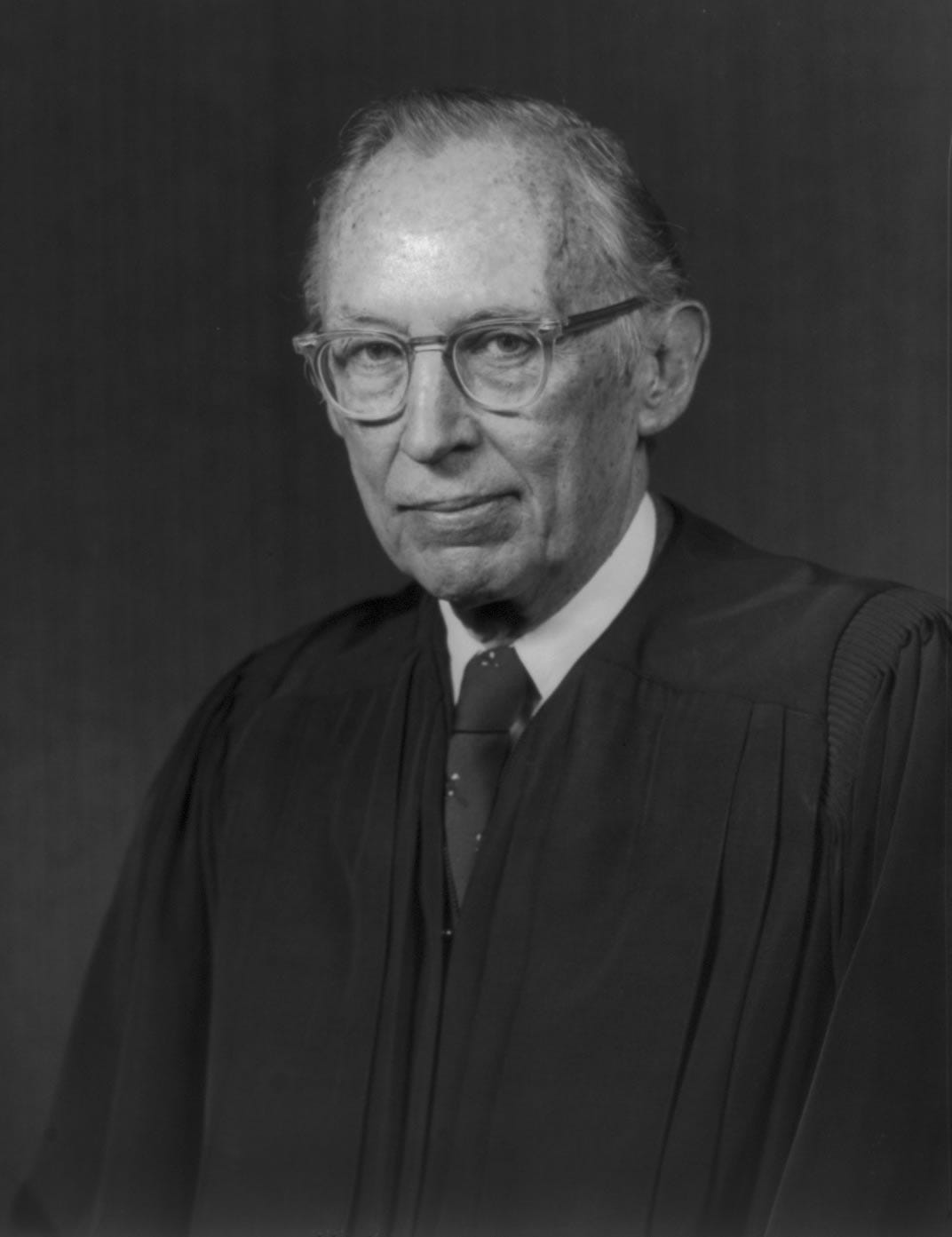
The movement found intellectual reinforcement in 1971, when future Supreme Court Justice Lewis Powell, then a corporate attorney, wrote a confidential memorandum for the U.S. Chamber of Commerce arguing that if business and conservative interests hoped to influence public policy, they needed to invest in institutions—universities, lawyers, scholarship, media, and public education.
It laid out an idea that would define the conservative movement over the next half century: political victories are temporary; institutions create change.
The emerging strategy lay in recognizing that national politics often obscures where lasting power is exercised. Presidents serve four-year terms. Members of Congress come and go. And though the news media obsesses over Washington, constitutional change begins elsewhere. It begins when a local school board adopts a controversial policy or when a county commission cultivates future leaders. When a state legislature passes a law designed to test constitutional boundaries. When an attorney general challenges a federal regulation. When state judges are elected or a governor appoints them.
The Supreme Court rarely initiates constitutional change — it responds to it. The Court can only decide cases brought before it. A law must first be enacted, then challenged. Others must develop the constitutional theory, finance the litigation, and prepare and argue the case before nine “independent” justices. Courts are often downstream from politics; an insight that became foundational to the long game.
Ideas change minds; institutions change history. This became a defining tenet of the modern conservative movement. Leadership pipelines ensure that today’s school board member becomes tomorrow’s legislator, who becomes governor or attorney general. Today’s young lawyer becomes tomorrow’s appellate judge, and someday a Supreme Court justice.
Institutions allow movements to think not in election cycles, but in generational change. Few individuals understood this better than Paul Weyrich. Goldwater awakened modern conservatism, but Weyrich devoted his career to organizing it. He recognized that successful political movements need organizations capable of producing ideas, recruiting leaders, raising money, influencing public opinion, and sustaining momentum.
Weyrich helped translate that vision. He co-founded the Heritage Foundation, a policy engine that transforms conservative philosophy into legislative proposals that elected officials could implement. He helped establish the American Legislative Exchange Council (ALEC), which connected conservative lawmakers across states and developed model legislation. Later, he co-founded the Moral Majority with Jerry Falwell, who mobilized millions of evangelical Christians into one of the nation’s most influential political constituencies.
These organizations were part of an expansive ecosystem that emerged over the following decades. The Federalist Society, founded independently in 1982 by a group of conservative law students and professors, performed a different function. Rather than organizing voters or developing legislation, it cultivated generations of lawyers, judges, academics, and law students committed to philosophies such as originalism and textualism. Over time, its influence extended from law schools to federal clerkships, appellate courts, presidential administrations, and ultimately the Supreme Court.
These organizations cultivated donor networks, foundations, advocacy groups, media organizations, and public-interest law firms. Each served a distinct purpose. Think tanks produced policy proposals. Legal organizations developed constitutional theories. Donor networks financed long-term advocacy. Conservative media steadily expanded its reach. Together, they formed a reinforcing ecosystem that translated principles into policy and sustained a constitutional vision across generations.
By the late 1970s and early 1980s, the conservative movement had built much of the framework it needed. The next challenge was turning ideas into law. That required understanding that Congress is not the only legislature that matters. Every state legislature has the power to shape constitutional laws, which often begin in a state capitol. They can be constitutional laboratories. Conservatives understood this dynamic with remarkable discipline. Rather than viewing an adverse Supreme Court decision as the end of political debate, they viewed it as the beginning of legislative opportunities.
When the Supreme Court decided Roe v. Wade in 1973, many Americans believed the constitutional debate had been settled. The Court had spoken. Supporters’ struggle shifted toward defending the decision. But instead of attempting to overturn Roe immediately, conservatives pursued incremental change. State legislatures enacted parental consent laws, waiting periods, consent requirements, restrictions on taxpayer funding, licensing requirements for providers, and limitations on late-term procedures. Some measures survived scrutiny; others were struck down. Yet defeat rarely discouraged the movement as each lawsuit clarified constitutional boundaries.
The objective was not to lose gracefully but to refine judicial opinion and persuade future courts that constitutional interpretations should be reconsidered. Almost fifty years later, Dobbs v. Jackson Women’s Health Organization overturned Roe. What many viewed as a sudden constitutional revolution was, in reality, the culmination of five decades of legislative persistence.
The same pattern appeared after Furman v. Georgia. In 1972, the Supreme Court invalidated existing death penalty statutes. Supporters of capital punishment did not abandon the issue. They rewrote the laws. State legislatures established new sentencing procedures, appellate review, and statutory standards designed to satisfy concerns identified by the Court. Only four years later, in Gregg v. Georgia, the Supreme Court upheld some of those revised statutes.
Again, judicial defeat became legislative opportunity. The strategy did not stop there. Look at the history surrounding school prayer, busing, gun rights, environmental policy, religious liberty, affirmative action, immigration, etc. State legislatures enacted laws that challenged constitutional interpretations. Some failed, others survived, and some eventually reached the Supreme Court.
Political movements do react to judicial decisions with rhetoric. They create cases that might reach the judiciary. State attorneys general were no longer simply the chief lawyers for their states. They were constitutional strategists choosing which federal regulations to challenge, which lawsuits to join, which precedents to revisit, which constitutional theories to advance, and in which federal court to try them.
Governors assumed a larger role, as well. Their legislative priorities influenced constitutional litigation. Their political success often propelled future presidential candidates onto the national stage. Local government became part of the strategy. School board elections, once considered among inconsequential contests in American politics, became battlegrounds over curriculum, religion, parental authority, and public education. County commissions and city councils developed future legislators. Local organizations became recruiting grounds for the next generation of candidates.
Power moves upward. A school board member becomes a state representative, who in turn becomes attorney general or governor. Governors become a U.S. senator or even a president who appoints federal judges. Political power is cumulative.
Conservatives learned to focus on something much larger than just presidential elections: the institutions that develop and preserve ideas, cultivate future leaders, and sustain political movements across generations. That requires the long-term work of building power from the ground up. It requires discipline, persistence, and a willingness to invest in institutions whose greatest influence may not be realized for decades.
By the early 1980s, conservatives had learned how to win local elections, influence state legislatures, and build such organizations capable of sustaining momentum. Their next challenge was even more ambitious—shaping constitutional law, which required investing heavily in changing the judiciary.
The Federalist Society is perhaps the clearest example. It has evolved into an intellectually like-minded network connecting law students, professors, attorneys, judges, and policymakers around a shared philosophy of constitutional interpretation. It emphasized originalism, federalism, judicial restraint, and separation of powers. It did not tell judges how to rule. It shaped how generations of lawyers would interpret the Constitution.
One idea that illustrates the patience of the long game is the unitary executive theory. It argues that Article II vests executive power principally in the President, giving broad constitutional authority to supervise and direct executive branch officials. During the Reagan administration, it became the subject of sustained legal development. In 1983, when Chief Justice John Roberts was serving in the White House Counsel’s Office, he wrote a memorandum arguing that “the time is ripe to reconsider the constitutional anomaly of independent agencies.” At the time, it appeared to be one small contribution to an internal legal debate. But it became essential to a much larger intellectual effort to reexamine the relationship between Congress and the presidency.
Think tanks such as the Heritage Foundation and the American Enterprise Institute took up the issue, sponsoring research, conferences, and policy papers examining executive power and its limits. Conservative legal scholars—including Steven Calabresi, a co-founder of the Federalist Society—expanded the academic literature on Article II and the unitary executive. Justice Antonin Scalia’s influential dissent in Morrison v. Olson became a touchstone for advocates of stronger presidential authority.
Federalist Society conferences brought together law students, attorneys, judges, and policymakers to debate, refine, and disseminate such perspectives. Public-interest law firms and legal advocacy organizations incorporated the arguments into constitutional litigation, while Republican administrations increasingly appointed lawyers and judges steeped in this scholarship. Although these organizations operated independently, they reinforced one another. What began as an academic debate became part of the intellectual mainstream of conservative constitutional thought. It was the cumulative effect of thousands of scholarly papers, legal arguments, judicial appointments, and initiatives pursued patiently over four decades. Since the transformation was gradual, when John Roberts became Chief Justice in 2005, few could have predicted how thoroughly those earlier debates would shape constitutional doctrine.
In Seila Law LLC v. Consumer Financial Protection Bureau (2020), Chief Justice Roberts wrote for the Court in holding that Congress could not insulate the single director of the CFPB from presidential removal except for cause. The opinion described its holding as limited. Yet for the first time in decades, the Court substantially narrowed Congress’s authority to create independent executive agencies insulated from direct presidential control.
The process continued. In Trump v. Slaughter, the Court overruled Humphrey’s Executor v. United States, the landmark 1935 decision that had long served as the foundation for Congress’s ability to protect the heads of independent regulatory agencies from direct presidential removal. The decision did not fully embrace every aspect of the unitary executive theory. It did, however, continue the Court’s movement toward limiting Congress’s ability to insulate certain agencies from direct presidential oversight.
To supporters, the decision represented a restoration of constitutional accountability within the executive. To critics, it marked a dangerous expansion of presidential power. Regardless of one’s view, the decision illustrates how constitutional doctrine develops — not through a single ruling, but through a succession of cases that gradually reshape precedent.
Congress never enacted unitary executive theory as law. Generations of scholars, legal organizations, and elected officials refined and advanced aspects of the theory over decades. Chief Justice Roberts authored opinions that incrementally expanded presidential authority. His opinions did not end the debate; they became part of its continuing evolution.
Whether the issue was abortion, the death penalty, administrative agencies, or presidential power, change rarely occurred through one dramatic victory. For decades, conservative presidents appointed judges who shared similar interpretive philosophies, while Republican senators increasingly viewed judicial confirmations as a means to shape the nation’s future. No lawmaker better embodied that than Senator Mitch McConnell. As Senate Majority Leader, McConnell made the federal judiciary the Senate’s highest institutional priority. His 2016 decision not to advance President Obama’s nomination of Merrick Garland to the Supreme Court, followed by the confirmation of three Supreme Court justices and more than 230 federal judges during Trump’s administration, reflected a strategy decades in the making. Every judicial vacancy became an opportunity.
Organizations such as the Federalist Society were prepared. They had identified, mentored, and developed generations of lawyers and judges committed to originalism, ensuring that a deep reservoir of like-minded nominees was ready. The movement did not have to search for candidates; it had spent decades cultivating them. Vacancies occur by chance — being ready to fill them is the product of the long game.
The judicial transformation coincided with another long-game strategy. After the 2008 election, conservative strategists identified an opportunity that attracted little national attention. The 2010 Census would require every state to redraw its districts. Republicans launched the Redistricting Majority Project (REDMAP), targeting a relatively small number of critical state legislative elections they could win to control redistricting. It succeeded beyond expectations. Republicans captured legislative chambers and governors’ offices nationwide. Those victories shaped congressional and legislative maps for the next decade, strengthening the party’s influence while reinforcing control over state government. At the same time, the Tea Party transformed grassroots activism and became an organizational force that expanded local party organizations.
Viewed separately, REDMAP, the Tea Party, judicial appointments, and constitutional litigation appear distinct. Viewed together, they reveal the same philosophy: build institutions, develop leaders, win the states, and strategize for future generations. That is the long game. By the second decade of the twenty-first century, its results are unmistakable.
So, how did we get here?
Not because one party discovered a winning campaign slogan, a charismatic leader, or because of one presidential election. We arrived here because one political movement developed a deep understanding of how power operates within the American constitutional system.
The conservative movement did not invent the long game. As noted, earlier reform movements — from abolition and women’s suffrage to organized labor and the civil rights movement — also understood that lasting change requires patience, institutions, and sustained public engagement. Democratic institutions are neither self-executing nor self-preserving. They endure when citizens are willing to invest in them with the same perseverance that others devote to reshaping them.
What conservatives built after 1964, however, was something different in both scale and coordination. It was not a movement. It succeeded because it integrated politics, ideas, law, media, fundraising, state government, and judicial appointments into a single, mutually reinforcing ecosystem.
Whether one applauds or opposes the results is a matter of judgment. The question facing Americans today is not whether the conservative movement mastered the long game. It plainly did. The question is whether those who seek a different future are prepared to learn from it—and to build the institutions, develop the leaders, and sustain the commitment necessary to shape the next generation of constitutional change. If history has taught us anything, it is that those who fail to understand how power is accumulated rarely succeed in changing its course.
John F. Terzano lives in Ludington, Michigan, where he works as a social justice and human rights advocate, locally and around the world.
I divorced the Republican party several years ago even before January 6th. I haven’t looked back. I think what conservatives are doing and have been doing is toxic to democracy and democratic principles. Thank you so much for this excellent piece!
This is an excellent piece that thoroughly describes how the fascists, er conservatives, over decades built the infrastructure that is steadily destroying everything that truly made America great. They must be so proud of their "accomplishment".