


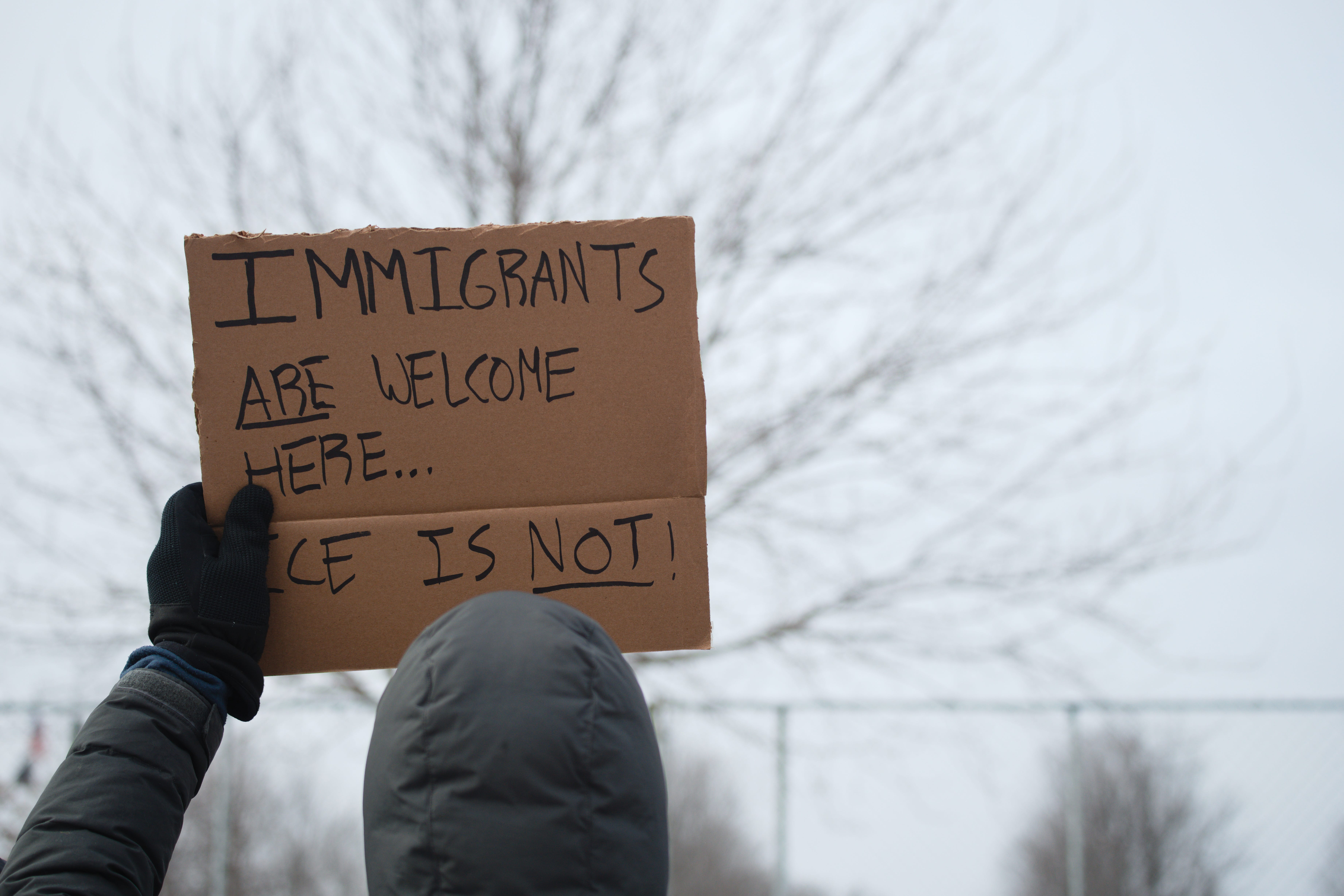
People all over the country are noticing the bravery of Minnesotans marching through frigid conditions and billowing clouds of tear gas. Blowing whistles and toting handmade cardboard signs, they are peacefully facing down masked and armed ICE agents. They are demanding justice and protecting their neighbors—while inspiring others nationwide to do the same. The power of their actions has been matched by a masterclass in messaging.
This is how moments become movements.
Together with my colleagues at the FrameWorks Institute, I study how Americans think about social issues and what moves them to action. Recently, we’ve had a focus on how to counter the pull of right-wing populism and authoritarian thinking. What we’re seeing on signs and hearing in songs and words on the Minneapolis streets mirrors the framing that’s moving the needle on democracy in our recent research.
Here’s what defenders of democracy can learn from the Minnesota protesters:
Call out more than just bad apples. Those standing up to ICE in Minnesota are consistently and successfully framing brutality and violence as a systemic problem, rather than one stemming from the actions of bad apples. Their signs, chants, and sound bites frame the struggle as one against a regime threatening the civil rights of every American, instead of the criminal recklessness of a few bad actors. And they are clear that this isn’t just a Minneapolis problem, but rather one of collective concern and shared fates.
Demand individual accountability—but don’t stop there. Make no mistake: individual accountability is essential. The ICE agents who are committing violent crimes must be fully investigated, tried in a court of law, and face the consequences of their actions. However, stopping there is a trap. Because we want retribution for the harm these offenders cause, any punishment can feel like justice; but we must recognize that their crimes were perpetrated with the full authority, sanction, and resources of the U.S. government. Even if justice is served for the two murders in Minneapolis, there are currently more than 3,000 federal agents deployed to the Twin Cities (compared with only 600 members of the Minneapolis Police Department), and when the Governor deployed the Minnesota National Guard to backstop local law enforcement, the Pentagon responded by putting 1500 additional soldiers on standby. Unless we dismantle the systems creating these conditions, the ability of ICE to perpetrate similar crimes on other people—and to franchise the Minneapolis model throughout the country—is nearly limitless.
Those taking to the streets understand this. They are working hard to communicate the need for individual accountability and systemic change. It’s up to the rest of us to follow suit and amplify their framing.
Be disciplined and put it on repeat. On television screens in airports, hospitals, and living rooms, their signs read, “Stop ICE”. On social media feeds, images of the protests are trending with #iceout and #abolishice on millions of smartphones across the country. One Minnesota resident who was dragged out of her car put it well when she told news cameras in a now viral clip, “The practices I experienced with my own body, ears and eyes do not make sense to me as a an immigration or public safety strategy.” Protestors are lodging the conversation at the systems levels—and avoiding the bad actor trap—and they’re keeping it there, together.
The good news: our research shows that people across the political spectrum see the need for dramatic change at the systems level. We find that people are eager to push the conversation past individual retribution and are willing to think about how toxic systems can be disrupted and rebuilt in the mold of fairness and justice. In research conducted in August 2025, we found that 71 percent of Americans—including a majority of Democrats and Republicans—say that our politics needs either major changes or to be completely reformed.
This is a heartbreaking time for Minnesota and for our country. For many, the violent images on our screens, and the feelings of hopelessness that accompany them, feel reminiscent of the coverage of May 25th, 2020, when George Floyd was murdered just blocks away from where Renee Good and Alex Pretti were gunned down.
Floyd’s killing at the hands of law enforcement accelerated the already powerful Black Lives Matter movement: one of the largest sustained movements for racial justice in modern U.S. history. We saw changes to our public discourse on racism—toward more structural and less individual explanations—and meaningful reforms. We also saw shifts in thinking, with the percentage of Americans believing that racism against Black people in the U.S is widespread reaching record highs.
A journalist recently asked a witness to Pretti’s murder why she took the personal risk to speak up and contradict the government account. She said, “I knew that this was a moment, and we all have to be brave and we all have to take risks, and we’re all going to be given moments to make that decision.”
We owe the people of Minnesota a great debt for their risk-taking and resilience. They have created momentum to change minds about the need for a stronger democracy and better, safer systems. We have the opportunity to deepen the call for change and make it stick. We must follow their lead.
Nat Kendall-Taylor is a psychological anthropologist and chief executive of The FrameWorks Institute.

I was a small and sheltered child during the civil rights struggle, but this ICE crisis gives me a glimpse of how caring adults felt. The horror resides along hope for a fundamental change, and increments of change are like small phoenixes rising from the ashes. We must push this change along. Thanks to all the Contrarians who get me through my depressed days to find the resolve to stand up for democracy again.
Speaking the truth especially if it involves video evidence of what is really happening on the ground is very powerful. We need every incident to be recorded by ordinary citizens in a legal and lawful way. If the government wants to spin lies then we have evidence backing up their falsehoods. This is one way to hold them accountable.