


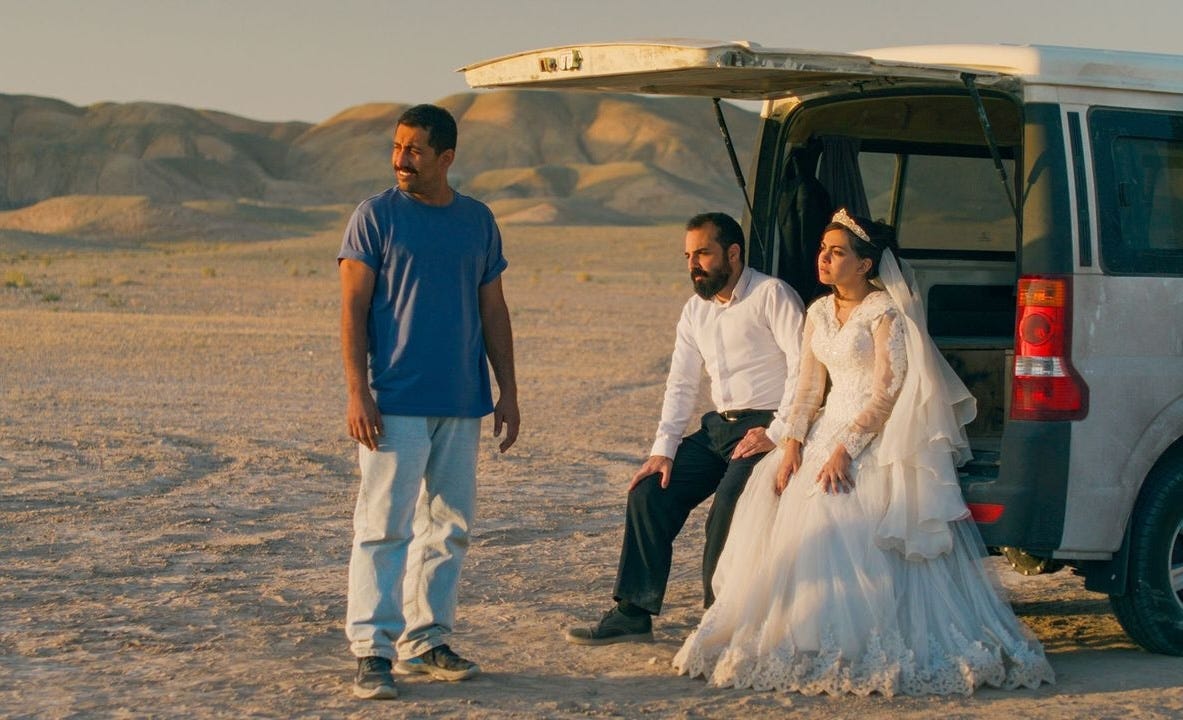
At a time when freedom of speech is under attack and too many artists are willing to ignore their supposed values for a lucrative payday, Jafar Panahi offers a model of creative defiance that should inspire us all.
The dissident Iranian filmmaker, known for work that grapples with issues like gender and class, has been imprisoned multiple times and charged with “propaganda against the regime.” In 2010, he was arrested and banned from making films for 20 years—a prohibition he has bravely ignored, over and over again.
Panahi has continued to work steadily ever since, making numerous internationally acclaimed films in secret, a stubbornly persistent thorn in the side of the Islamic Republic. This is Not a Film, a documentary that was partially shot on an iPhone while Panahi was under house arrest, was smuggled to Cannes on a USB drive that was reportedly stashed inside a birthday cake.
In No Bears, he plays a fictionalized version of himself: a director determined to tell politically-charged stories, despite the onerous restrictions he faces. A few months before it debuted in 2022, he was arrested again, and served nearly seven months in prison before going on hunger strike and finally obtaining release.
All of which is to say: Almost nothing is going to stop Panahi from making films that have something to say about life in an ideological dictatorship. If anything, he has only grown more emboldened with time, and is channeling his experiences as one of Iran’s most high-profile dissidents into his art. Shortly after he was released from prison in 2023, Panahi began work on what may be his most overly political film yet, the remarkable It Was Just an Accident, which will be released by Neon next week.
The darkly comic thriller, which screened before a rapt audience at the New York Film Festival last week, follows an ordinary mechanic named Vahid (Vahid Mobasseri) who has a chance encounter with a man he believes to be the sadistic intelligence agent who tortured him in an Iranian prison. Determined to exact revenge on his captor—but also not totally sure it’s the same guy—Vahid turns to his fellow ex-prisoners for help. To reveal much more about the story, which tests the audience’s sympathy in powerful ways, would spoil the ride. But the film is at least partially inspired by his own experience in Iranian prison, where he was held in solitary confinement and interrogated for hours while blindfolded.
A scathingly funny indictment of a corrupt regime and an insightful look at the lingering trauma of state violence, It Was Just an Accident has been selected as France’s entry for best international feature at the Oscars. After winning the Palme d’Or at the Cannes Film festival, it is also being cited as a possible contender for best picture and best director at the Academy Awards.
The story of how Panahi pulled off It Was Just an Accident is fodder for a movie of its own. The director had been scheduled to attend the festival and was in the process of obtaining a visa to travel from Iran, which is no small feat these days. Then came the government shutdown, which further delayed the process and forced Panahi to skip the New York screening.
In his absence, Philippe Martin, the film’s French producer, described the daunting process of making It Was Just an Accident.
“The story of this film is unlike any other, as you may know,” he said, speaking through a translator at Alice Tully Hall in Manhattan. “The film that you’re about to see is one that was made in total secrecy, with a constant effort on the filmmaker’s part, to avoid having his crew stopped and arrested.”
Panahi worked with a small crew that could fit in two cars. The locations in and around Tehran were not disclosed until the night before filming. He successfully kept the project under wraps for most of the shoot, but two days before it was scheduled to wrap, 15 plain-clothes police officers showed up on set and attempted to confiscate the footage. Luckily, they only got their hands on a camera, not the computer where the footage was actually stored. “Thanks to someone’s mistake, the film was not seized by the police,” Martin said. (In a rare interview this year, Panahi told The Guardian that he thinks the timing of the shoot, which coincided with the second round of the presidential elections in Iran, may have helped him avoid punishment.)
Once filming was complete, he relied on a friend to get the footage to France for post-production. “Panahi is always concerned that someone is going to try to take his film, because the Islamic Republic of Iran always wants to know what the new Jafar Panahi film is about,” Martin said.
When It Was Just an Accident was selected to premiere at Cannes in May, the producers began preparations to bring Panahi and the main cast to the festival. Martin described the “paradoxical situation” they faced:
On the one hand, Iran gave all the principals visas to travel to France, but all the actors were called to the police station where they were asked not to go to Cannes, where they were told that anything they said at Cannes, or if the women were to attend the screening with no veils, could cause them serious problems once they returned to Iran. So they were told, ‘You’re allowed to go, but please don’t go.’
Even when they arrived at the airport, visas in hand, they were still nervous, because “airports in Iran receive a daily list of visa holders who are, in fact, not allowed to take the plane. They were only sure that they would be able to come to Cannes to present the film once the plane took off from Tehran.”
They all made it to Cannes, where the film’s female cast members indeed walked the red carpet unveiled, Panahi spoke to the Western media (despite being banned from doing so), and It Was Just an Accident won the Palme d’Or, the festival’s top prize. In a moving acceptance speech, Panahi urged “all Iranians who are striving for freedom, for human dignity, and for democracy” to come together.
“Let us join forces. No-one should dare tell us what kind of clothes we should wear, what we should do, or what we should not do,” he said.
The next day, as he always vowed, Panahi was on his way back to Iran with his cast.
“We were all extremely worried about what might happen to them once they got home,” Martin recalled, “but when they arrived, many friends of the filmmakers and simply people who were happy for their victory arrived at the airport to show their joy. We think that this spontaneous crowd may have protected them from the police.”
The producer told the NYFF audience that he believes the positive buzz around It Was Just an Accident has created “ a kind of protection” around Panahi and his cast and crew.
“For now,” he said, “They’re able to continue having a normal life.”
With the movie arriving stateside next week and the Iranian regime no doubt closely monitoring its reception overseas, we can only hope the acclaim becomes truly deafening.
Meredith Blake is the culture columnist for The Contrarian
I have saved and will watch! What an amazing story - maybe we start a write in campaign for The Oscar’s????? Thank you for this post ☮️🏳️🌈💕
Excellent article about this incredible movie. Saw it last night at the Mill Valley Film Festival and can’t stop thinking about it.