


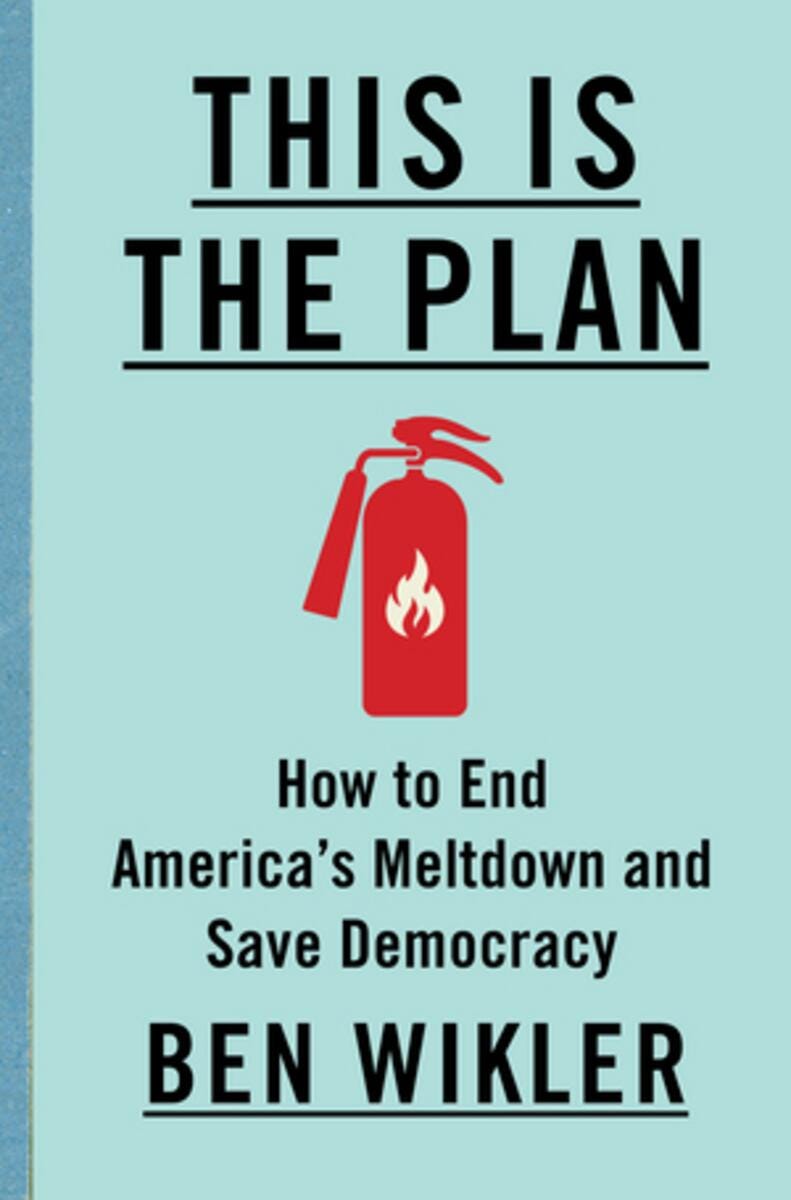
This essay is adapted from This Is the Plan: How to End America’s Meltdown and Save Democracy, available for preorder now wherever books are sold.
The ceaseless attacks by the Trump administration and its allies on democracy, our communities, and fundamental American values can be overwhelming. ICE agents shooting people in the streets. Trump pushing the FBI to “investigate” free and fair elections and menacing future ones. Defunded public services leading to outbreaks of explosive diarrhea — and deadly diseases ravaging the world after the shredding of aid programs.
It can leave you with a sense of powerlessness. When so much is falling apart, you might ask, how can we possibly get out of this mess?
As you think about where to spend your time and energy between now and November 4, it can help to keep this in mind: Mind-bogglingly important elections are, mind-bogglingly often, decided by a mind-bogglingly small number of people.
This was true in 2024.
The entire planet is profoundly affected by the outcomes of United States elections. But the vast majority of humans on planet Earth right now don’t have any say in who wins them. Out of 8.3 billion people alive, there are 245 million eligible voters in the United States. And, of those, 156,766,239 people (about 1.9 percent of humanity) voted in the 2024 presidential election.
But thanks to the atrocity known as the Electoral College, the vast majority of ballots cast in that election were essentially irrelevant.
If just 114,885 Trump voters — spread in the right proportions across the “blue wall” states of Wisconsin, Michigan, and Pennsylvania — had flipped their votes over to Kamala Harris, she would have won, and Trump wouldn’t be prosecuting an Olympic canoe gold medalist in order to distract from the botched touch-up of the Reflecting Pool.
The voters separating two starkly different timelines — this dark world of Trumpian rampage and the alternate universe in which President Harris just signed the John R. Lewis Voting Rights Advancement Act of 2026 — represent less than one-tenth of one percent of the voters who cast a ballot in the presidential race.
Of course, even that margin was gigantic compared with the most notoriously microscopic margin of all — the 2000 presidential election, in which, thanks in part to a disgraceful intervention by the Supreme Court of the United States, George W. Bush carried the tipping-point state of Florida by 537 votes.
And consider this: It’s not just the presidency.
The closest U.S. Senate race in 2024 came down to just 15,115 votes. Flip those votes, and Trump’s “One Big Beautiful Bill Act,” cutting taxes for the rich and slashing health care — a bill that passed the Senate by one vote — might’ve died a justly ignoble death, instead of dooming thousands of newly uninsured people to die unjust deaths.
How about the GOP’s U.S. House majority? In 2024, that was the product of just 7,309 votes across three ultra-close House races.
Similarly tiny margins frequently determine elections for offices like governor and attorney general, as well as control of state supreme courts.
The margins that determine majorities in state legislatures can be even more excruciatingly minuscule.
In 2022, the majority in the New Hampshire House of Representatives came down to just 21 votes spread out across four nearly tied legislative races. Twenty-one votes! This sentence, if you count this appositive phrase (and this unnecessary parenthetical phrase to boost the word count), has 21 words. If only those words could have voted in New Hampshire that year.
Or look at the Virginia House of Delegates — the lower chamber in their state legislature. In 2017, in a Democratic wave that smashed through an intense GOP gerrymander, Democrats flipped 15 seats, jumping up to 49 out of 100. Republicans held on to 50. And then there was that final seat — where unofficial recount results had shown Democrat Shelly Simonds winning by a single vote. With each party controlling half the chamber, Virginia was headed for a possible power-sharing agreement that would end 18 years of Republican control.
But then, a panel of judges ruled that a previously disqualified ballot should have counted for Republican David Yancey.
The election was now tied, 11,607 votes to 11,607 votes.
What happened next? They put each candidate’s name on a piece of paper, sealed it in a little film canister, put the canisters in a bowl, and pulled one out. David Yancey won. Republicans held their majority. Seriously. That’s how electoral ties get sorted out: random draws.
One vote would have changed majority control.
As a result, Democratic bills — on abortion access, voting rights, consumer privacy, and discrimination protections — all stalled until Dems finally got the majority two years later.
If that sounds agonizing to you, imagine how it felt for the candidate. Or for her friends who just didn’t get around to voting.
After the local Wisconsin elections in April 2022, in which at least six local races came down to a tie, I remember talking to Andre Walton, who lost the random “pick a card” draw that determined the winner in his race for the City of Sheboygan’s Common Council. He told me that, afterward, he was getting his hair cut, and his barber asked him how the campaign had turned out.
“I lost. One more vote and I would have won,” he recalled saying.
There was a long pause.
Andre asked his barber if he had voted.
Nope!
Augh!
If you can choose the right elections to focus on, tiny numbers of votes can change huge things.
And those hyper-close elections often happen in the same places, over and over.
The most closely divided state of all? Wisconsin.
In Wisconsin, the 2024 presidential margin came down to about four votes per precinct. It was the closest state in the nation, with a presidential margin of victory of under 1 percent.
The margin of victory was even smaller in 2020. And in 2016. In fact, five of the last seven presidential elections were decided by under 1 percent margins.
And at the same time, in most U.S. elections the margins are enormous.
This is the paradox of this moment.
In most of the country, most people are so entrenched — or, to be more precise, they’re so polarized against the opposite political party (even if they don’t particularly love the one they vote for) — that election results are highly predictable long in advance. Very few races are competitive. In presidential and Senate elections, most states are solidly blue or red, and in 2024, four out of five congressional seats were decided by margins of more than 10 percent. In fact, most seats were decided by margins of more than 25 percent.
So, most elections are snoozefests, and yet a tiny shift of a small number of votes in a handful of places determines control of the White House, the Senate, and the House— and many, many state and local offices that matter enormously both for life in their particular jurisdictions and to the entire country, because those offices set the rules that shape the elections higher up.
It’s like plate tectonics: Most land is solid. But where the tectonic plates meet up, vast amounts of force build up on both sides. And when those forces become too great — and one side gets an edge — volcanoes erupt, the earth moves, and the world is reshaped.
Page through a history book or scroll through history’s For You Page, and you’ll see that there are long periods of national political-geologic stability in American history.
This is not one of them. In this moment, the volcanoes keep erupting.
In most of our nation’s history, the presidency has stayed in the hands of one party or the other for extended periods. Not recently. The presidency has shifted parties five times since 2000. The only period with that level of instability was the years leading up to the Civil War, when the nation was riven by bitter arguments over the expansion of slavery.
Over the last 25 years, we’ve also seen four changeovers in House majority control and six changeovers in the Senate majority. That’s a level of change that’s only ever been approached in one period: the years after the Civil War, during Reconstruction and the backlash that followed.
In short, among the House, the Senate, and the White House, at least one has changed hands in every one of the last six elections. There’s never been a period in U.S. history with so much change in both the legislative and executive branches of government.
In plate tectonic terms, this is the kind of pressure pattern that blows up Mount Krakatoa, creates the Himalayas, or splits Pangaea into continents.
You live in the United States of America during one of the most closely divided and unstable periods in its political history.
Which means that, if you can figure out a way to zero in on the most critical spots on the electoral map and then propel even a handful of people to vote who wouldn’t have voted otherwise or to switch their vote from one candidate to another, you can change everything.
Ben Wikler is the chair emeritus of the Democratic Party of Wisconsin, host of This Is Wisconsin with Civic Media, and an advisor to Democracy Defenders. This passage is drawn from This Is the Plan: How to End America’s Meltdown and Save Democracy, coming July 21 from W.W. Norton & Company.

I've been writing hundreds of postcards for the last 3 years urging unregistered potential Democrats to register to vote. Sometimes I feel its a futile exercise, but this article gives me hope, that if even a few people are moved to register and vote, we might have a chance.
VOTE, VOTE, VOTE.