


The Odyssey, Christopher Nolan’s sweeping adaptation of the Ancient Greek epic about a triumphant military leader who encounters some serious delays on the journey home from war, is finally in theaters after years of development and months of online backlash.
The film, which opened Friday, stars Matt Damon as Odysseus, the heroic king of Ithaca, who leaves his devoted wife Penelope (Anne Hathaway) and infant son Telemachus (played as an adult by Tom Holland), to fight in the Trojan War. He spends the next 20 years trying to vanquish the enemy and return to his family safely, battling mythical creatures and his own demons along the way. The high-wattage ensemble also includes Zendaya as Athena, the goddess of wisdom, Charlize Theron as the nymph Calypso, Lupita Nyong’o as Helen of Troy, and Robert Pattinson as Antinous, Penelope’s scheming suitor.
As reimagined by Nolan, The Odyssey is a high-minded work of cinematic spectacle. It’s a great adventure, yes, but it’s also the haunting story of a military hero transformed by his wartime deeds and unsure how to return to a life that now seems utterly foreign.
You would think that the Right would be happy to see one of Hollywood’s most celebrated filmmakers tackling a foundational text from the Western Canon. Yet ever since the trailer dropped in May, MAGA grifters, nitpicking history nerds, and racist trillionaires with too much time on their hands have been stoking outrage over the film’s supposed inaccuracies.
The backlash started with Elon Musk, who shared posts on X mocking Elliot Page, who plays a brave soldier named Sinon in the film, and declared that “Chris Nolan desecrated the Odyssey” by casting Nyong’o as the woman whose transcendent beauty set off the Trojan War, according to Greek myth. Professional grievance farmer Matt Walsh also chimed in, saying that “not one person on the planet actually thinks that Lupita Nyong’o is the most beautiful woman in the world,” a claim that is blatantly racist and demonstrably false.
Other pedants took issue with the helmets, armor, and ships pictured in the trailer.
Complaints about historical accuracy conveniently ignore that The Odyssey is set in a fantastical realm inhabited by armed giants and enchanting Sirens whose hypnotic singing lures sailors to their deaths. Strenuous realism was never the point — and fretting over historical details ignores the timelessness of Homer’s poem, which continues to resonate thousands of years after it originated.
But such quibbles are nothing new, especially — for some reason — when it comes to the fantasy genre: toxic fans have freaked out over the casting of non-white actors in Snow White, Harry Potter and the Cursed Child, The Little Mermaid, and House of the Dragon. By this twisted racist logic, a whimsical talking crab makes sense, but a Black Hermione is too far-fetched.
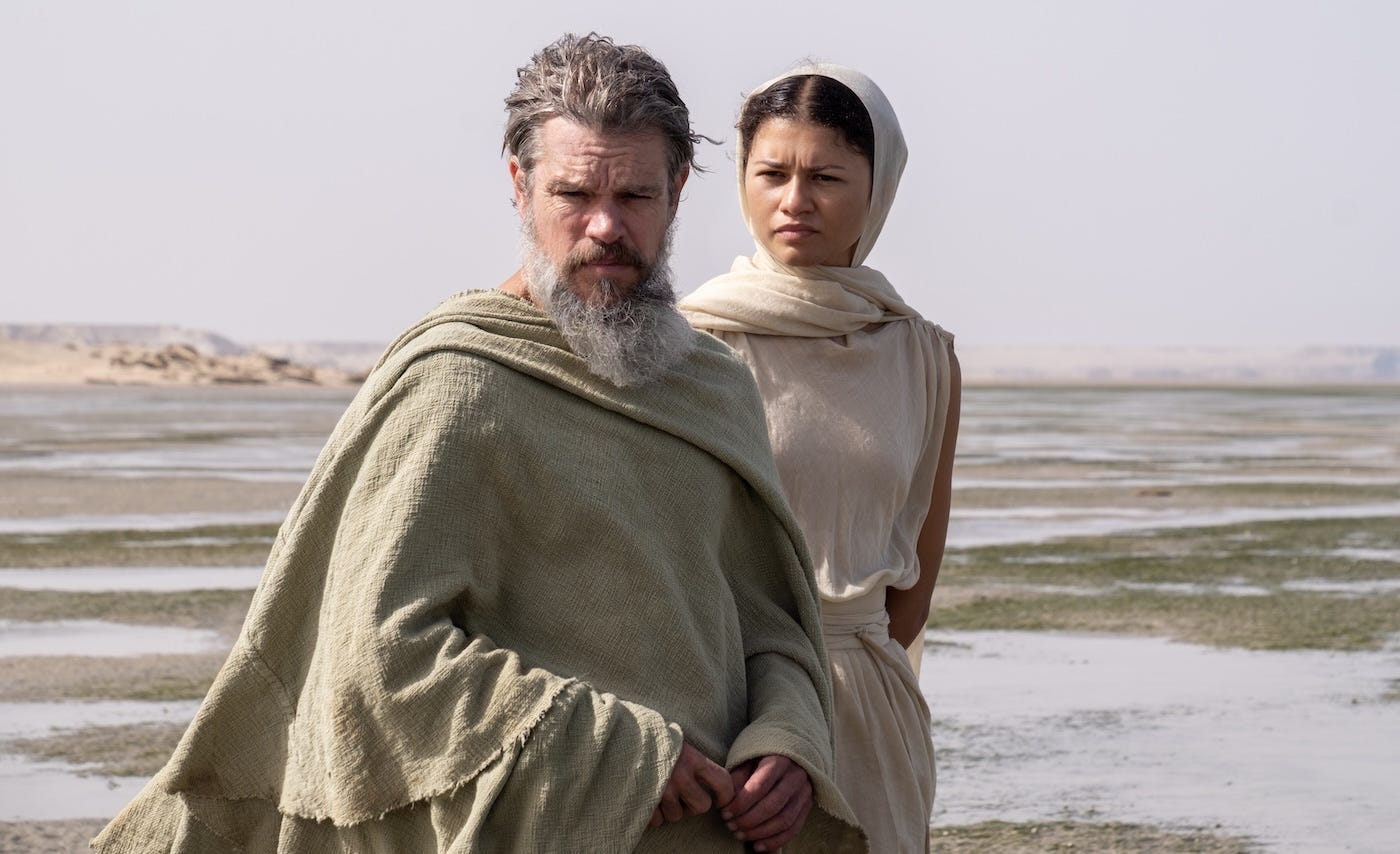
But because I can also be a pedant, I was immediately struck by the fact that virtually everyone in The Odyssey speaks with a regionally nondescript American accent, no matter where the character, or the actor playing them, is from. This was especially noticeable given how many of the film’s most prominent stars (Pattinson, Holland, Samantha Morton) hail not from the United States but from England. Why did the soldier played by Himesh Patel — a Brit raised by Indian parents in Cambridgeshire — sound like he grew up in Anytown, U.S.A.? If Nolan deliberately cast The Odyssey so that it visually reflects the gloriously multicultural world we live in now, shouldn’t it sound that way too?
Accents are a tricky thing in historical dramas, especially when you have actors speaking in languages their real-life counterparts never would have spoken. Some viewers who loved everything else about Chernobyl, the acclaimed HBO series about the 1986 nuclear disaster, couldn’t get over the fact that the Russian and Ukrainian characters spoke with British accents. But that was a conscious decision by creator Craig Mazin, who felt that “Russian accents can turn comic very easily,” and opted to let the cast speak in tamped-down versions of their normal accents.
For ancient tales with elements of fantasy, like The Odyssey, the question of how characters should sound is even more fraught. There’s no reliable way of knowing how people who lived in continental Europe thousands of years ago might sound speaking modern English. Filmmakers portraying ancient times have to take linguistic license out of necessity. But they tend to do so in ways that subconsciously reflect the geopolitics of the day. What the heroes and the villains in our movies look like — as well as how they speak — says a lot about the society we live in.
In Hollywood sword-and-sandal epics for most of the last century, from Ben Hur to Gladiator, the default accent for Ancient Roman characters is a generic upper-crust English. It’s a choice that works for modern American audiences because it’s just different enough to track as “foreign” and maybe even “regal,” but isn’t so distracting as to take anyone out of the story. But it also registers on a more profound level, because of the implicit connection between the British Empire and the Ancient Roman one; between Britain’s recent history of conquest and the broader story of Western Civilization. Put another way: if you want someone who sounds like they could be a brutal, marauding imperialist, a British accent tends to do the trick.
So why did Nolan subvert this longstanding cinematic paradigm and make his Ancient Greeks vocally indistinguishable from your average suburban Yank? It may have started with his lead. As we all know, Damon can do a wicked good Southie accent, but his track record for sounding anything other than American, especially in movies involving swords and armor, is not as impressive. Maybe Damon felt more comfortable using his natural accent and Nolan simply opted to make everyone else sound American too, for the sake of consistency.
But the film’s American flavor also works on a thematic level. Though it is set thousands of years earlier, The Odyssey feels almost like the third installment in a trilogy that includes Dunkirk and Oppenheimer — films by Nolan that examined the horrors of war from different perspectives. Dunkirk embedded audiences with terrified soldiers trapped on a French beach, while Best Picture-winner Oppenheimer told the story of a brilliant scientist who used his genius to create a weapon of mass destruction.
The Odyssey is also about the terrible things humans are capable of doing to one another in wartime, but it’s more concerned with the psychological aftermath of violence — with the literal and metaphorical impossibility of going back to who we once were after the depravity of combat.
The question at the heart of The Odyssey, and the one that haunts Penelope and Telemachus for years, is why it takes Odysseus so damn long to get back to Ithaca. Sure, there’s some bad weather, there’s a man-eating cyclops, and there’s a lengthy interlude spent eating lotus flowers with Charlize Theron (which is going to be hard to explain to Penelope, if we are being honest).
But the real reason for Odysseus’s delay becomes clear near the end of the film. (Minor spoilers ahead.) Disguised as an old beggar, Odysseus tells an unsuspecting Penelope why her husband has taken so long to return and opens up about the terrible things he witnessed during the fall of Troy.
A harrowing flashback sequence shows Odysseus and his men crawling out of the giant wooden horse given to the people of Troy as a peace offering, then laying waste to the city. It reframes the familiar story of the Trojan Horse not as a neat military trick, but as a heinous war crime that violated the most basic laws of humanity.
That night, Odysseus realized that “to burn the walls of Troy was to burn the world-entire, including his home.” Not unlike the nuclear bomb, the siege of Troy unleashed something awful that can’t be reversed.
“Our age of bronze is collapsing,” Odysseus says, “and maybe he couldn’t bear to see the ruins of what he’d done anywhere — least of all, his home.”
Odysseus is tormented by guilt and remorse — emotions that ultimately make him more heroic (but which our current military leaders would probably dismiss as evidence of “low T.”) He might be wearing sandals, but he sure sounds a lot like the conflicted war veterans we’ve seen in movies like The Deer Hunter and Coming Home.
If The Odyssey is ultimately a film about a weary soldier trying to reckon with the atrocities he committed in war, and a society crumbling because of a lack of basic decency, then it makes perfect sense these Ancient Greeks sound like Americans. (Or at least as much sense as if they sounded like posh Brits.) Whatever motivated Nolan’s decision to give everyone the same accent, the result is the same: we don’t have to strain to see ourselves in this timeless story.
Meredith Blake is the culture columnist for The Contrarian.
There's something else which is being generally overlooked: Nolan's inspiration was the recent new translation from the original by classicist Emily Wilson (what??? a woman???) who wrote it in iambic pentameter but matched Homer's length line for line, in itself an extraordinary feat. She chose to use contemporary English idiom, to scrape away decades of noble prose used by earlier translators and restore the reality enjoyed by Homer's original readers 3000 years ago. I like Meredith Blake's thought about this being the conclusion of a trilogy.
You’re right about the anachronistic accents, but let’s face it. Most of the folks complaining about casting and accents are the same ones who insist that Jesus was a white guy with blue eyes and blond hair, that the novels of Ayn Rand are nonfiction, and that outdated medical knowledge is inherently better than the new stuff.