

By Shalise Manza Young
We have already seen example after example of anti-Black racism from President Donald Trump and his second administration, seemingly aimed at resegregating American society.
Trump and his band of wealthy, unqualified, sycophantic Cabinet members have already fired the incredibly accomplished chairman of the Joint Chiefs and replaced him with a white man whose resume was so lacking he needed a special note from Dear Leader to take over the role. They indicated in so many words that Black people aren’t smart enough to be air traffic controllers, and claimed that Black people don’t need the same vaccine schedule as others.
But something feels especially pernicious about the recent report from the New York Times that all of the Environmental Protection Agency’s environmental justice offices—those address the disproportionately high levels of pollution poor and minority communities face – are set to be shuttered.
For the record, the EPA says environmental justice will be achieved “when everyone enjoys the same degree of protection from environmental and health hazards and equal access to the decision-making process to have a healthy environment in which to live, learn, and work.”
There’s 50 years of evidence of Trump’s disdain for Black folk, but not wanting them to handle your money or rent your apartments is one thing, however awful. It’s another to be so nakedly racist that you OK the removal of the EPA agency aimed at protecting majority-Black and poor communities from being slowly killed by corporations that decide to put their pollution-producing plants in those areas specifically because they know there will be little to no pushback as long as the wealthy and/or majority-white neighborhoods are safe.
In a statement, EPA administrator Lee Zeldin indicated the environmental justice program was akin to “forced discrimination.” Asked for clarification of Zeldin’s claim, a spokeswoman claimed it prescribes “race-conscious decision-making.” Getting rid of the program specifically because it aims to protect the health of Black communities is the definition of a race-conscious decision. Unfortunately for Black folk, we’re not the right race for the far-right. Or the soft right. Or a lot of the “white moderates” the Rev. Martin Luther King Jr. wrote of nearly 60 years ago.
Closing the EPA offices has the added bonus for the current administration of undoing some of the actual achievements made during President Joe Biden’s term in office. Biden had made addressing environmental justice a priority, committing billions of funding for studies, cleanup and lawsuits against companies to force them to comply with regulations.
Environmental racism is not new. In the early 1980s, North Carolina dumped 60,000 tons of soil contaminated with polychlorinated biphenyls, a carcinogen commonly known as PCBs, in majority-Black Warren County despite NAACP-led protests. Though the effort to stop the landfill failed, the fight is generally acknowledged to be the impetus for the environmental justice movement.
Way back in 1987, a study by the United Church of Christ Commission for Racial Justice found a “striking relationship” between the location of hazardous waste facilities and the race of the communities where they were located.
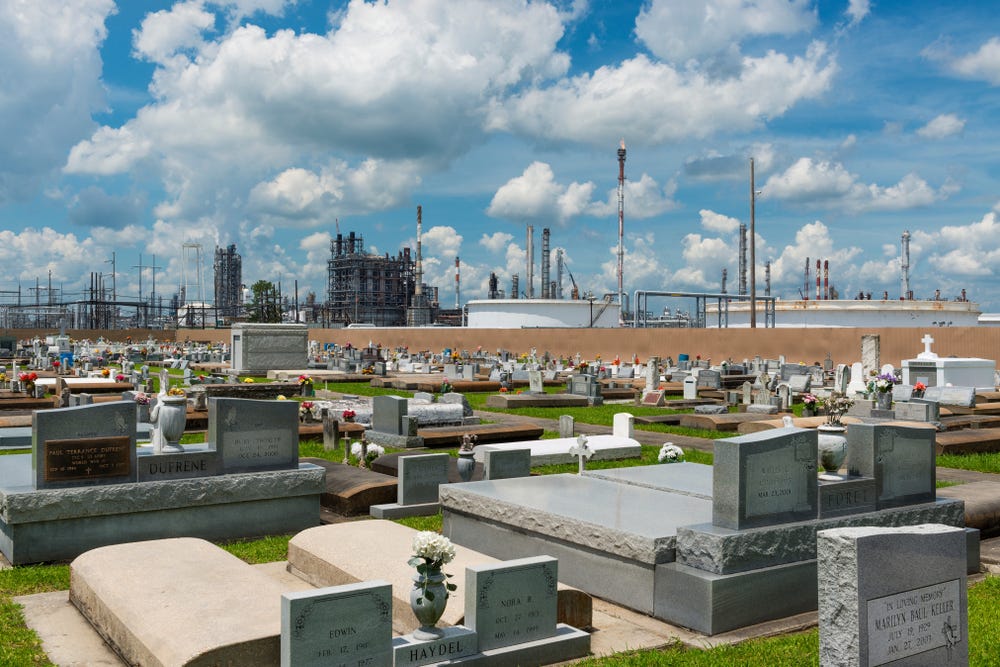
Along the stretch of the Mississippi River between New Orleans and Baton Rouge known as “Cancer Alley,” dozens of petrochemical plants lining the river pump toxins into the air and water. Though the state health department says there is no evidence residents in the area have increased rates of cancer and other illnesses, the people who live there strongly disagree. In St. Gabriel, a town of 7,300 that is two-thirds Black, stories abound of residents who died far too young of cancers and other illnesses.
This month, the EPA dropped a Biden-era federal lawsuit against one of those plants, Denka Performance Elastomer, which produces the synthetic rubber neoprene. Neoprene is made with chloroprene, a likely carcinogen, and the EPA argued in the suit that the plant’s high levels of emissions posed an “imminent and substantial endangerment to public health and welfare.”
Memphis’s McKellar Lake, once a summertime haven for thousands of residents so popular that it attracted Elvis Presley, is now so polluted from the 140 or so industrial plants that ring the waterway that fish from the lake are unsafe to eat because they have cancer-causing contaminants and humans develop a rash within moments of touching the water. The smell of rotten eggs permeates the air.
Not surprisingly, a nearly all-Black community that was developed near the lake in the 1950s became a “sacrifice zone,” and industrial facilities began popping up all around the neighborhood.
Nationally, Black children are five times more likely to be hospitalized for asthma than non-Hispanic white children, and eight times more likely to die from asthma. Thanks to redlining and relocation, African-Americans in urban areas historically were segregated into corners of cities that were then cleaved by interstate highways, forced to breathe the pollution produced by cars and trucks constantly passing through.
One way to help mitigate such pollution is through hearty tree canopies. But to the Trump administration, even trees in majority-Black districts are forbidden. Last month, a $75 million grant earmarked to the Arbor Day Foundation to help restore some of the thousands of trees lost in the Lower Ninth Ward during Hurricane Katrina was terminated.
Matthew Tejada, a former EPA official who spent a decade working with the Environmental Justice office, told the New York Times, “If anybody needed a clearer sign that this administration gives not a single damn for the people of the United States, this is it. …This doesn’t make America healthier or greater. It makes us sicker, smaller and uglier than we have been in at least a generation.”
For the Trump administration, the cruelty is always the point. Especially when it comes at the expense of Black Americans.
Shalise Manza Young was most recently a columnist at Yahoo Sports, focusing on the intersection of race, gender and culture in sports. The Associated Press Sports Editors named her one of the 10 best columnists in the country in 2020. She has also written for the Boston Globe and Providence Journal. Find her on Bluesky @shalisemyoung.
This kind of thing should be disturbing not only to racial minorities but also to racial majorities as well. There are ways that mishandling environmental toxic waste can come back to bite you. Not only should we care about our fellow brothers and sisters but we should care about all of humanity. Clean air, clean water and clean green spaces for all. Environmental responsibility goes to all of us.
Racism has been a bone of contention in America since its beginning. Slavery literally built our country. Cruelty simply cannot be avoided in even the most casual sojourn into history, and not just American history.
So, when we see minority races being dealt with in ways we would not like to be treated ourselves we (and, yes, I myself) become quite conflicted. The whole world has been engaged in discrimination of one sort or another for seemingly as long as man has existed.
So, to me, as long as one man desires to put himself above another, racism and inequality will continue. As many religions preach, racism stops when we we see each other in our own image, as one.