


When it comes to our environmental impact, most of us are probably aware of the damage done by the flights we take or the car we drive — even the meat we eat. But the real offender might just be lurking in the back of your fridge.
Food waste is kind of a big deal when it comes to climate change. According to the UN, global food waste is responsible for up to 10 percent of all greenhouse gas emissions, up to five times more than the emissions caused by the entire aviation sector. So much for planes, trains, and automobiles — last week’s shepherd’s pie might have even more of a negative climate impact.
When I heard that statistic, I assumed that most of this waste must be generated on the commercial level. Agriculture is notoriously wasteful, and I know firsthand from volunteering from my mom’s amazing food rescue nonprofit, FoodCycle, how much beautiful, perfectly good food is discarded by restaurants and grocery stores (last year alone, they diverted over 11 million pounds of food, providing more than 9 million meals. Go Mama!).
But more waste than I expected happens at the household level. According to one source, over 1 billion meals are left uneaten each day worldwide, with households responsible for about 60 percent of that total.
So does that mean that the next time my son doesn’t want to finish his dinner I should break out the climate statistics? Is “think of the methane” the millennial generation’s version of “think of the starving children”? Not exactly. But learning all this did help me reframe the way we think of leftovers in our household and commit to being better about reusing and repurposing all those little scraps and odds and ends before giving up and throwing them away.
Making do has always been part of the American way. Lydia Maria Child’s The American Frugal Housewife, published in 1829, is a classic example, offering thrifty housewives recipes for “made-over dishes” or réchauffés, with the French word adding a touch of glamor to the prosaic practice of repurposing the overdone ends of a roast or stale scraps from a loaf of bread into fricassees, bread puddings, or fritters.
But a lack of access to refrigeration meant that food safety was an issue, and frequently leftovers flowed down the economic ladder. You only have to look as far as classic Southern foodways to see how dishes like red-eye gravy were created from the scraps that the wealthier and more powerful eaters left behind.
Maybe this economic history is where leftovers gained some of their stigma. With the rise of refrigeration, cookbook authors like Fanny Farmer still counseled the retention and reuse of food scraps as prudent household management, but consuming “fresh” food became more of an important class signifier than ever before. During the World Wars, using leftovers was seen as a patriotic duty, but once the conflict passed, they felt tied to scarcity and the Depression years most people were desperate to leave behind.
Which brings us to today. Most of us eat our leftovers, but there is still some stigma around their consumption in a few settings. I’ll never forget the former co-worker who blithely asked me why I bothered packing a leftover lunch every day. Was I getting paid less than she was? Could I not afford to hit up the SweetGreen? For me, though, leftover consumption, or the lack thereof, comes down more to practicality than politics. Sure, I’m happy to bring a full enchilada or a slice of lasagna to work, but what’s an ethical eater to do with the minimal scraps most dinners leave behind? I’m embarrassed to admit how often I’ve dutifully packed away a little spoonful of stew or a single salmon fillet, only to be confronted with my own wastefulness once trash day rolls around.
My solution? A winning formula that uses Stone Soup-style magic to transform those scraps into something worth stepping away from the computer for.
First, I start with our household’s favorite multigrain blend, made with whatever quick-cooking whole grains we have lying around layered over a base of good old white rice. We always have a container in the fridge, ready to form the base of lunches, a side for dinners, or even be stirred into pancake batter for a surprisingly delicious and filling griddle cake.
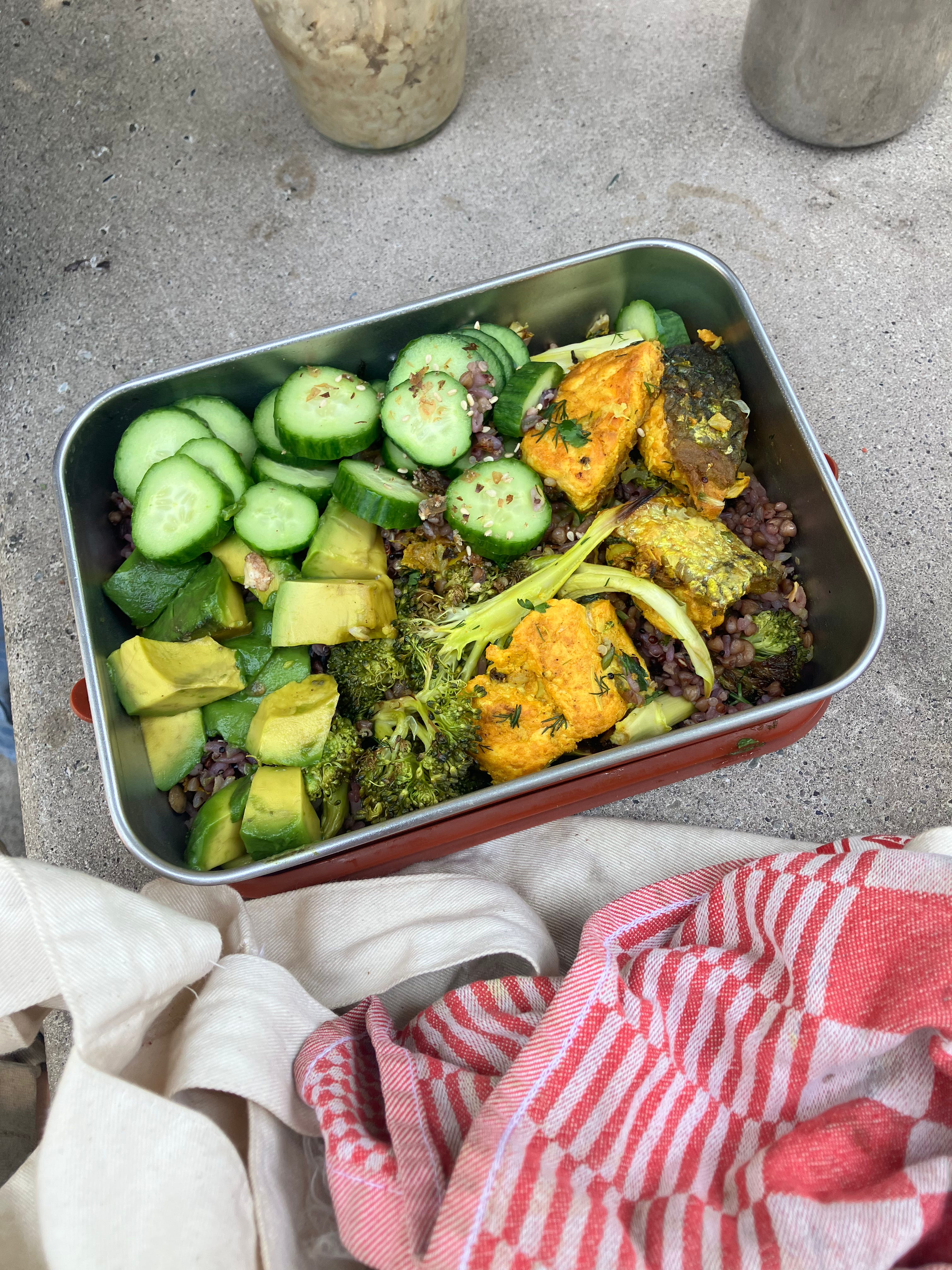
Then the leftovers come in. You’ll find my formula below, but I like to twerk the accompaniments to match whatever needs using in the fridge. If I have some leftover posole, I might mix in white beans, slice up avocado, and add in pickled red onions, with a drizzle of hot sauce on top. If I’ve got a little scoop of goulash, I might add in sauerkraut, sour cream, and a cold boiled potato. Yesterday we had Vietnamese turmeric salmon, so today lunch is the last few pieces bulked up with avocado and quick cucumber pickles, with a sprinkle of furakake on top.
The resulting meals might not be glamorous, but delicious and nourishing is a much easier barrier to clear. And hey, if you need an incentive to clean your plate, don’t think of those proverbial starving children—think of the greenhouse gasses. Look at you, saving the world one lunch at a time!
Better Than Before Left-Over Fried Rice
Multigrain blend:
Note: The following is more a suggested ratio than a recipe — the beauty of the multigrain blend is that it works with whatever grains you have on hand. The only constant is the rice.
1 cup long grain white rice
¼ cup quinoa
¼ cup millet
2 tbsp brown lentils
2 tbsp buckwheat
2 tbsp spelt
Fried rice:
1 tsp neutral oil, such as avocado
1 clove garlic, sliced into thin chips
1 cup of leftover multigrain blend
1 egg
1 tsp of soy or fish sauce
Scrap Stretching Leftover Assembly Method
Whatever leftover protein you have
¼ cup salad veggie — think cherry tomatoes, avocados, cucumbers, or bell peppers, anything you like to eat raw
¼ cup pickles — kimchi, sauerkraut, daikon pickles, or just your classic dill
If needed, bonus protein: a scoop of cottage cheese, lebneh, cooked beans, or a boiled egg
Special touch: something to elevate and make your leftovers feel special. Think: a sprinkle of furakake, a drizzle of nice balsamic or hot honey — anything that zhuzhes up the flavors and makes them feel new.
Method:
For the multigrain blend:
Cover your grains with water, and, if time permits, soak them for a few hours. This helps break down their anti-nutrients to increase nutrient absorption and make them easier to digest. When you’re ready to cook, drain your soaking water, cover grains with fresh water, bring to a boil, and cover and cook for about 20 minutes.
For the fried ice:
Heat your wok until smoking. Add a splash of oil, then your garlic, and briefly stir until golden and crisp.
Pour in your leftover multigrain blend and press into the hot garlic oil. The grains should become crispy quite quickly. On our stove, it takes about three minutes.
Once the bottom layer of rice is crisp, crack in the egg, tossing rapidly to incorporate so every grain gets fluffy and coated with egg. Deglaze with a splash of sauce.
Assembly:
Give everything its own little quadrant, a move that makes lunch feel cute and bento-inspired rather than a tragic fridge-rescue situation. Top with your special touch. Pack away, get on the road, and wait with anticipation for lunch to come.
Emily Beyda’s writing has appeared in the Los Angeles Times, Built, Refinery29, Smartmouth, Fodors, the Thrillist, the Austin Chronicle, and more. Her novel, “The Body Double,” was published in 2021.
