



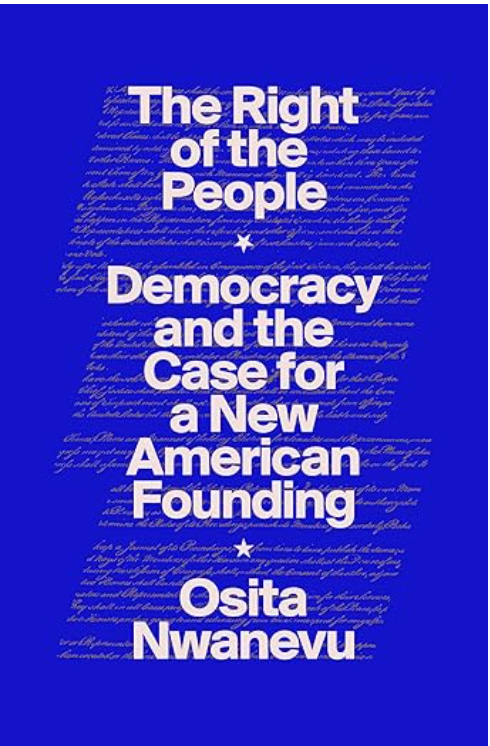
Osita Nwanevu, contributing editor at The New Republic and a columnist for The Guardian, is publishing his first book tomorrow. The Right of the People covers a lot of ground—an explanation and defense of democracy, an argument about the systemic barriers to democratic governance in the United States, and a possible path towards a truly democratic society. Nwanevu spoke with The Contrarian about the book. The following is excerpted from that conversation, with edits for length and clarity.
Abraham Kenmore: You write about feeling bored with the way journalists talk about democracy, and how that kind of kicked off this book. Is there a particular point where you became frustrated or bored with the way we write about democracy in the press?
Osita Nwanevu: I don't know if there was a particular moment. I will say that covering the 2020 Democratic primary in particular got me thinking about some of these issues pretty deeply. I found myself writing pieces where I'd say, “well, you know, Democrats might want to pass Medicare for All or Green New Deal or immigration policy or gun control and so on. But for basic structural reasons, a lot of that stuff is probably not going to happen without some major changes.”
I felt myself having to write versions of that over and over and over again without getting into the nitty-gritty of, okay, why is the system set up that way in the first place? Could we do better? And also, how do you respond to conservatives who talk about some of the structural inequities that I had mentioned, and would say in response, “well, you know, United States is not actually supposed to be a democracy in the first place, we’re a republic, there's something we should distrust about democratic rule.”
I felt like that was worth a real intellectual answer, a real investigation of the origins of our institutions. All of that felt like deeper material than you often get the chance to write when you're doing work in a political journalism. You don't really get many opportunities to revisit Plato or even the founding, to think about the fundamental principles that underpin the system and the fundamental principle of democracy.
Americans, we ask ourselves what the Founders intended. We ask ourselves what the Constitution says, what it binds us to. We ask ourselves far less often, what we are fundamentally entitled to as human beings, what does a just society look like? What are some of the underlying principles of society we have? What do they actually mean? Should we interrogate them in a deeper way? I wanted this to be a book that would invite people to discuss politics at that level of not just abstraction, but that level of depth.
As you were thinking about this sweep and all this information that you wanted to include in this book, who was your imagined reader or your ideal reader?
My ideal reader was definitely not somebody (as much as I love these people), who had already read my writing from a left perspective. There are a lot of leftists, and I consider myself a leftist, who read this book and say, “oh, yeah, of course, this is not democracy, of course we need to have both political and economic democracy.”
I wanted the reader of this book to be somebody who was engaged with politics, maybe angry and concerned about what's going on in this administration, who has been upset about the undoing and the threats to our democracy, and I wanted to sort of enlarge that person's conception of what democracy even means, both to help them understand the origins of this particular political moment but also to help them understand wider and broader political possibilities.
Would this book have been different if Kamala Harris had been elected?
It would have been different in a lot of ways. If Kamala Harris had won, you would see less anxiety about the state of our institutions, in many respects, despite the fact that I think we'd still be facing some basic structural problems, basic anti-democratic inequities that would be worth addressing, that would have frustrated, I think, Harris's ability to pass some of the things that she ran on, right? So this material would have been as worth discussing, but I think it would have been harder to make this sell to people.
I was struck, to that point, by this quote where you wrote that (our constitutional) systems “make it extraordinarily difficult for majorities of the mass public to make economic policy and curb inequality—just as the Founders intended.” And I wonder, because you also write about this being a book about political economy, why was it important to bring in that economic perspective and talk about the economic roots of a lot of these systems that create those barriers?
You can think about this in two ways. One, I think this is one of the places where the last few months have really mattered a lot. We saw at the beginning of this administration a man, Elon Musk, wealthiest man in the world, who donated about $250, $260 million to Donald Trump's reelection effort, get rewarded with a post in government that he used to rework a lot of federal agencies; cut and gut a lot of vital programs. If that doesn't tell you that there is an intrinsic connection between inequality, the economy, the health of our politics, and the democratic character of our institutions, I don't know what would.
But I also think that understanding the links there also help us understand why the system was designed the way it was in the first place. We have a view of the founding that we're told in school, where the smartest, most intelligent people in the whole country came together and on the basis of principle and ideals crafted these compromises in Philadelphia in 1787.
The founders were responding to political and economic conditions in America at the time the Constitution was written, they were animated by very particular economic concerns. Matter of fact, I go into how in the aftermath of the American Revolution, we had an economic depression, the worst economic depression this country would face, people say, until the Great Depression of the 1930s. A lot of farmers, poor people in the country struggle to pay off their debts, pay their taxes, and they begin appealing to their state constitutions for relief in the form of being able to pay their debts in kind—with goods, for instance, or the printing of paper money. And the elites of the country look at this with horror. They think it's going to erode the validity and stability of contracts and the creditworthiness of the country.
So this is a key to understanding why things like the Senate exist. They say explicitly that the Senate is intended to be the body in government that most represents the wealth and property of the country.
It's important for us to understand these things. One, just to have an explanation of why it's been so hard to govern in ways we want to, but also to give ourselves permission to imagine something better.
In the states, we talk about voting as equaling political engagement, right? If you don't vote, you're not doing political engagement, and when you ask about political engagement, you're told, “go vote.” In the book, you elaborate on a whole bunch of other ways that people can be involved in the democratic process. How do you think we move past that idea that there is one thing that is political engagement?
Yeah, that's a good question. I think we understand that in the states and in localities, we already have mechanisms for democratic participation that are well beyond what we can access at the federal level. State constitutions tend to be more democratic in certain ways. You can do referendums, you can appear in certain forums, same with local government. And so I think those are opportunities to participate in governance at a level beyond voting and more regularly, too. And we should avail ourselves of those and figure out, too, how to improve them.
Maybe in the course of doing that, we build ourselves up to large-scale federal changes in the future, once we try different models out in different states, and also through that work, build confidence in democracy itself enough to convince enough people that we need more democratic change at the federal level.
The economic piece of this is important, because so much of the large-scale change that we need to happen can only really happen if we build up a democratic capacity within the economy. I say this for all kinds of reasons. One of the easiest to understand and agree with is that democracy takes practice. The more that we do this, the better we are at participating in politics. It would be great if, instead of just doing those things every two to four years, we have places within our own working lives where we practice these skills and capacities. I think this is one of the things that unions did that made them such a boon for democracy when they were stronger in this country.


Thanks for this. It has frustrated me to see time and again efforts to improve our social safety net and to eliminate the barriers to opportunity be thwarted. I’ve always seen the barriers to be envy and greed, citizens pitted against each other, in the present day without giving any thought to this actually being intended from the start. I think the author is correct that what’s happened with Trump’s election has made the various barriers to true equality of opportunity, etc., be easier to see. It seems that we are on a precipice for change that can be defined by we the people and not just the few wealthiest. For all that we weren’t taught in our history and civics classes, we were all taught “We the People.” That phrase inspires every American.
I’m looking forward to reading the book.