

By Alex Aronson
Two weeks after Donald Trump took office last January, I proposed a blueprint for how Democrats could stand up to his administration and send MAGA packing: “It’s the Corruption, Stupid.” Our post-election polling showed that the public’s cynicism toward government was deep and widespread, and that Democrats were vulnerable, viewed as out-of-touch defenders of a broken system. We distilled three takeaways: 1) don’t defend “the government” at all costs; 2) communicate on corruption early and often; and 3) show how MAGA’s corruption harms Americans.
It took over a year, but Democrats eventually got with the program, and they were laser-focused on these messages as they sprinted through the tape last week. Coalescing around this strategy delivered a repudiation of MAGA oligarchy more resounding and conclusive than anyone foresaw. From emergent DSA strongholds to the deepest red Trump country, Americans sent an unmistakable message: “We have had enough.” As best exemplified by Texans’ rejection of Elon Musk’s brazen attempt to buy their Senate seat, the election was, more than anything, a repudiation of a system that a broad majority sees clearly is rigged.
With MAGA now on life support, the next target must be the Roberts Court.
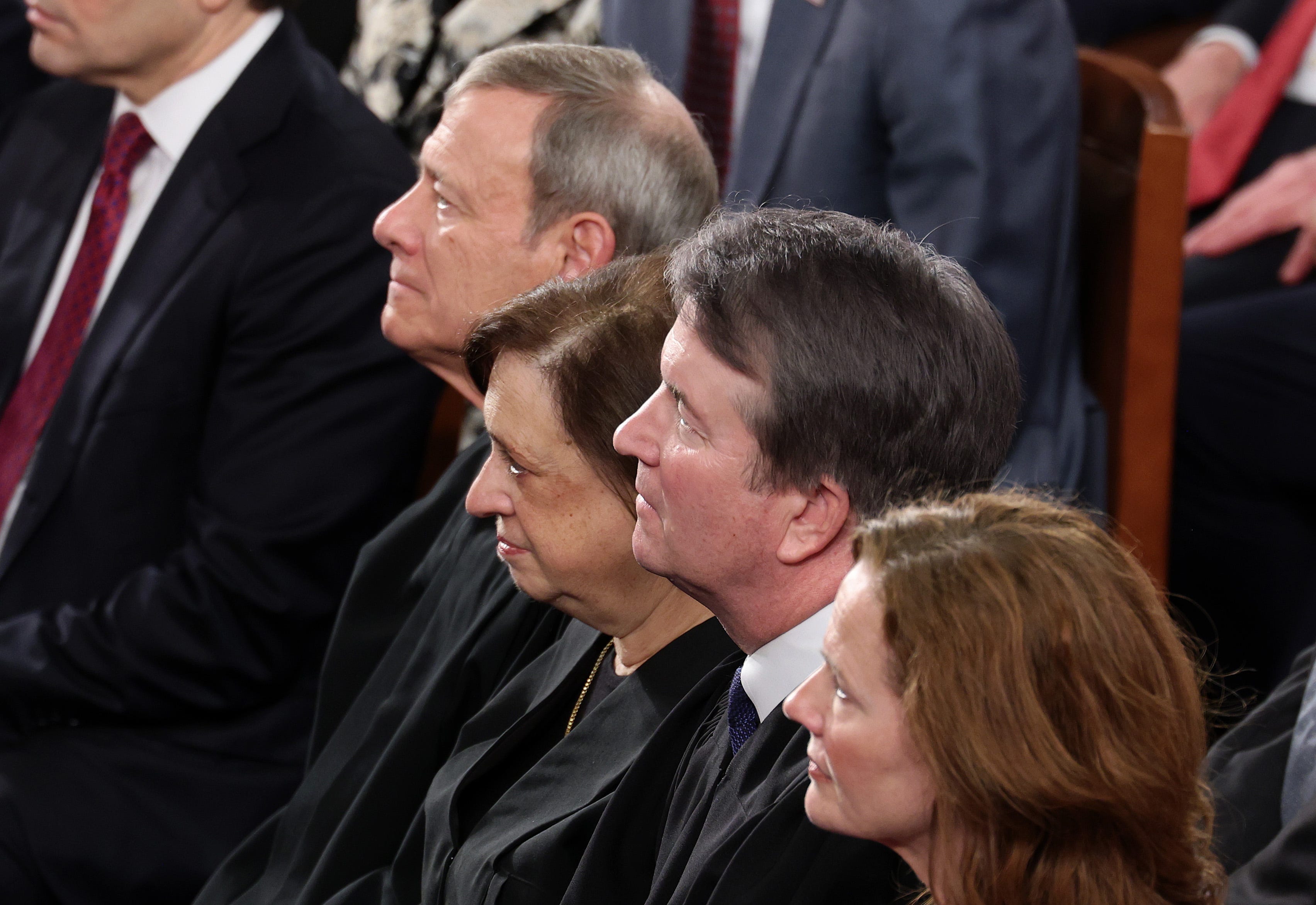
We should understand Trump and MAGA as symptoms of the rigged system, not its cause. The Supreme Court under Chief Justice John G. Roberts Jr. has long been the central engine of authoritarian consolidation in the United States. Installed over decades by Leonard Leo’s sprawling, billionaire-funded judicial capture campaign, six life-tenured justices—four confirmed by senators who represented less than half the country, three nominated by a president who lost the popular vote—have rewritten the Constitution to aggrandize the judicial power and dismantle the pillars of bipartisan twentieth-century economic and social progress.
These justices have enriched their benefactors, endorsed their political allies’ abuses of power, and stripped away Americans’ hard-fought freedoms. After granting Trump blanket immunity in 2024, the Roberts Court has sided with his administration in 74% of cases, and in 79% on its shadow docket, according my organization’s analysis. One study determined that the “best estimate of the next time the Supreme Court is expected to have a majority of Democratic-leaning justices is in 2065.”
So, as seismically important as last Tuesday was, it does not break the court’s constitutional stranglehold. As Michael Podhorzer laid out in his latest must-read analysis of Roberts’s “Confederate Realignment,” we are nowhere near out of the woods. Absent a significant check on the court’s power, the doors to democratic progress remain locked shut.
But people want results. They want the system unrigged. Trying is not enough, and excuses are no longer acceptable.
Unfortunately, thanks to a hobbled Congress, the filibuster, Trump’s veto pen, and the Roberts Court’s entrenched supermajority, tangible results will remain hard to come by, even if Democrats do secure a trifecta in 2029. Because whatever a possible Democratic majority passes in 2029, we can expect that the Roberts Court will try to take it away.
So, after they bust through the filibuster (duh), what should congressional Democrats do about the court as they seek to marshal Tuesday’s ideologically diverse new coalition into a durable political realignment?
They should run a playbook just like the one that powered their defeat of MAGA this year, leading with organized fights on the issues Americans across the political spectrum just told us they care about most: costs and corruption. This is where the Roberts Court and its unprecedented pro-corporate jurisprudence are least popular and most vulnerable.
We must stop asking the Roberts Court for its permission. The only way out is through. Just as they have repudiated Trump’s claims to monarchical executive power, Democrats must now cast off the false notion that the Supreme Court is the ultimate and exclusive decider of law. As scholars Nikolas Bowie and Daphna Renan demonstrate in their recent book Supremacy, that is a myth, and one which liberals have long been complicit in perpetuating. Lincoln governed on this insight, warning in his First Inaugural that if policy is “irrevocably fixed by decisions of the Supreme Court … the people will have ceased to be their own rulers.” Then, directly against Dred Scott, he signed legislation banning slavery in the territories. That is the tradition Congress can now reclaim.
First, as they drive their oversight agenda to deliver accountability for elites who have been acting against Americans’ interests with impunity, Congress cannot let the justices and their backers off the hook. Just as former Federal Trade Commission Commissioner Alvaro Bedoya argued last week that complicit corporate CEOs cannot be off-limits, neither can Samuel Alito, Clarence Thomas, John Roberts, and the web of oligarchs who installed them. The justices take secret gifts from billionaires with business before the court, then turn around and decide cases—like Citizens United—that let those billionaires buy our politics and dominate our lives.
We’ve still only scratched the surface of this corruption. In 2023, groundbreaking investigative journalism surfaced the biggest Supreme Court corruption scandals in United States history. But under Dick Durbin’s tepid leadership, Senate Democrats folded when the justices declared themselves immune from congressional scrutiny.
Now we have unfinished business and wind at our backs. Incoming Senate Judiciary Chair Sheldon Whitehouse and new Finance Chair Ron Wyden have given every indication that they intend to finish that business with aggressive oversight of the justices and their benefactors — starting with Clarence Thomas and Harlan Crow. On House Judiciary, incoming Chair Jamie Raskin is developing an oversight and reform agenda to address the untenable separation-of-powers crisis that the Roberts Court—through its unfettered supremacy—has provoked. Seeing that writing on the wall, Leonard Leo’s minions in Congress are already crying “constitutional foul!” in defense of their crown jewel.
Even if the justices now slink to the shadows and seek to “refill their ‘reservoir’ of public trust” by finally standing up to Trump (and I agree with Steve Vladeck: they will try), the oversight needs to proceed. Exercising these atrophied muscles to deliver accountability would produce the first tangible good this Congress can deliver to restore public faith in its ability to govern. And it would put the justices in their place.
Second, Congress must seize the reins of constitutional power as the “primary and paramount” branch of government by driving bold legislative fixes to the affordability and corruption crisis while making clear the court’s role in gutting democratic guardrails on corporate oligarchs. The Roberts Court broke Congress and cemented a new Gilded Age. From forced arbitration, to Medicaid expansion, to immunity for corporate and presidential abuses, to unlimited money in politics, the Roberts Court has eviscerated the U.S. Code and our Constitution to legalize corruption and unleash this era of exploitation and extraction. These precedents belong on the chopping block.
These ultra-popular wins would build momentum toward the harder fights over structural democracy entrenchment and rights restoration: voting-rights guarantees built for this century, an end to the partisan gerrymandering Rucho unleashed, statehood, proportional representation, a woman’s right to choose, the right to organize and bargain collectively, and every person’s day in court. The structural reforms will decide whether future majorities can secure political representation at all.
Finally, court reforms are indispensable to any democracy restoration strategy. But Congress should not pursue these measures as ends in themselves. Like road salt, people cannot eat court reform. And in a world controlled by Leonard Leo’s Calvinball Court, there are no silver bullets, anyway—court expansion included. Any reform Congress passes must survive the review of the court it seeks to check. Samuel Alito has effectively written the first draft of the opinion striking down any reform we might pass; he said, “no provision in the Constitution gives [Congress] the authority to regulate the Supreme Court — period.” We cannot “reform” an institution this pathological. Instead, the goal is to subordinate the court to the will of the people and our elected representatives.
An ambitious reform agenda allows Congress to pass the people’s laws without fear of corrupt judicial invalidation and to reassert its power to regulate the court. There is no shortage of options. Congress can use its power to end the secrecy of a court that makes national law through unexplained and unsigned emergency orders; to root out the justices’ corruption and hold them accountable with enforceable ethics laws; to make “The Court” a court again rather than an unaccountable superlegislature that handpicks cases to rewrite the people’s laws; and to limit its jurisdiction, withhold or condition its funding, and set term limits and control the composition of the court by adding seats. Informed by Congress’s oversight, the reforms should be drafted, pressure-tested, and ready to go when the moment arrives.
Some of these reforms are already popular, but they are not top priorities for most people struggling to afford their next month’s rent. Only when more people understand them as the tools necessary to take back what the Roberts Court stole from us all will they broadly demand them. Then, the court will have no choice but to yield to the people’s will.
Alex Aronson, a former chief counsel to Sen. Sheldon Whitehouse (D-RI), is co-founder and executive director of Court Accountability.