


There’s a scene in Star Trek II: The Wrath of Khan where Admiral Kirk, trapped and outgunned, pauses to observe his opponent. “I’ll say this for him,” Kirk says of the villain bearing down on him. “He’s consistent.” It’s not a compliment. Khan is brilliant, dangerous, and ultimately undone by the very patterns — and ego and vitriol — that make him readable.
Watching this week’s exchange of strikes between the United States and Iran, the line keeps coming to mind.
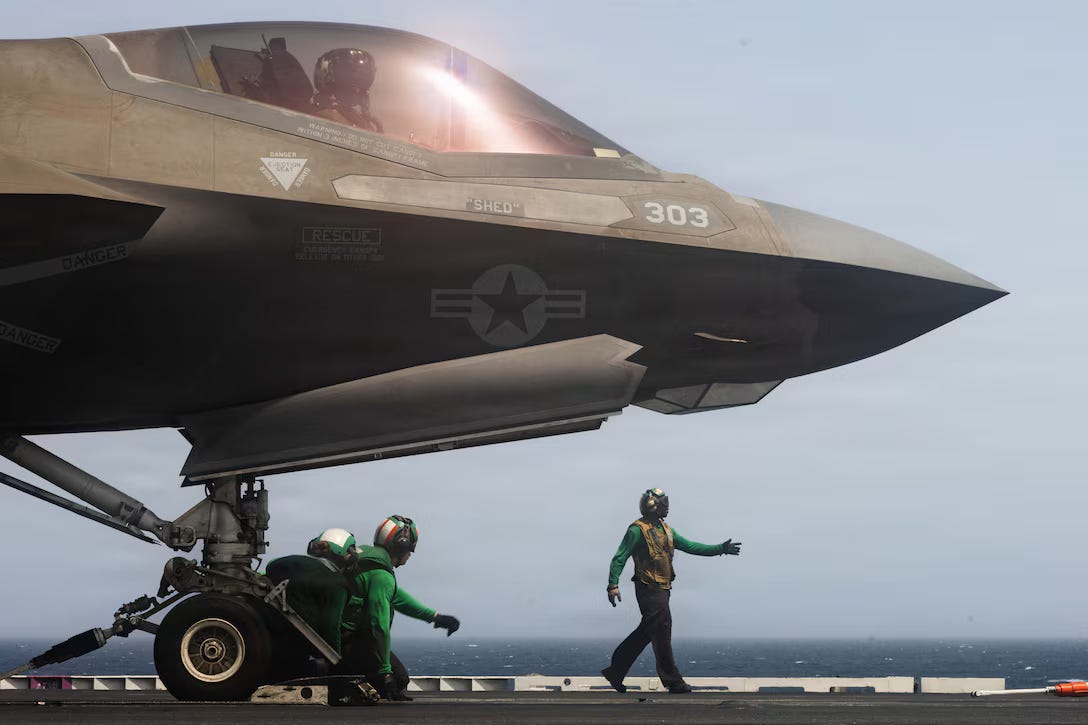
Wednesday brought another round of what has become the operational rhythm of this war: American jets striking Iranian military infrastructure; Tehran retaliating against Israel and U.S. bases in Bahrain, Kuwait, and Jordan; most Iranian weapons intercepted; no American casualties confirmed; and President Donald Trump posting on Truth Social that Iran “will pay the price.” Defense Secretary Pete Hegseth offered the week’s most quotable line: “If we need to negotiate with bombs, we’ll negotiate with bombs.”
The markets dipped. The price for oil per barrel — again — edged higher. The United Nations Secretary-General warned of a “full fire” ablaze in the Gulf. Qatari negotiators landed in Tehran. And then, as of this writing, the cycle began again.
Perhaps I will be proved wrong, but I do not see this, as some analysts have rushed to declare, a war spinning out of control. Yet.
Nor is it, as the administration insists, a successful pressure campaign on the verge of breakthrough. It is something more frustrating, and more consequential, than either: a managed stalemate in which both sides have strong structural incentives to keep fighting at low intensity and almost none to stop.
Understanding why requires setting aside the daily noise — the Truth Social posts, the chest-thumping from Hegseth, the Iranian president’s carefully worded defiance — and looking at the underlying mechanics.
The Trump administration is operating under domestic constraints that Tehran does not face. A U.S. consumer price index reading of 4.2 percent — a three-year high — arriving on the same morning as fresh airstrikes is not a coincidence the markets ignore, even if the White House does. The Dow was down Wednesday. The S&P is off. “The war with Iran seems to be getting longer, not shorter; that doesn’t help the psychology,” one wealth management analyst told CBS this week.
Iran, by contrast, governs a population accustomed to sanctions-era hardship and has no midterm elections approaching, no Federal Reserve watching inflation tick upward. Regular Iranians suffer, as they have for decades — but suffering has never, by itself, changed the calculus of the Islamic Republic.
This asymmetry doesn’t mean Iran is winning. Its energy exports remain severely constrained, its military has absorbed real damage, and the Strait of Hormuz — now closed “again” to commercial traffic per Tehran’s Wednesday announcement — is a card it cannot play indefinitely. But it does mean Iran can outlast discomfort far longer than Washington can politically.
There is a pattern to how this administration communicates military action that is worth naming plainly. The emphasis falls on metrics: targets struck, tankers disabled, radar sites destroyed, oil barrels escorted through the strait. “100 million barrels,” Trump announced Wednesday, describing a “secret mission” that apparently remained secret until the president described it on Truth Social. “More than 200 commercial ships.”
These are real accomplishments presented in a frame designed to satisfy a domestic audience that he believes wants to see a scoreboard. The problem is that most Americans have grown tired of the statistics and redundant claims of pending victory and conquest.
Fifteen weeks into a war the president initially estimated would last four to five, Trump is still saying a deal will come “very soon.” Vice President JD Vance, in the same breath this week, said it could also take “months.” That range — a week to months — is not diplomacy. It is uncertainty wearing the costume of optimism.
For all I know, we will wake up to Kharg Island — the heart of Iran’s oil export infrastructure — burning, a threat Trump issued this morning with his signature gravitas: “VERY HARD TONIGHT.” And Iran concedes. Or, more likely, the threats ease by the weekend and a Persian-version of Groundhog Day — sorry, another movie reference — returns to the news cycle, with both sides declaring victory.
In other words, this is not the moment for a grand verdict. The war has not entered a new phase so much as it has revealed the limits of the phase it has been in. Trump is predictable in the Kirkian sense: forceful, transactional, oriented toward optics, genuinely willing to use military power, and genuinely uninterested in the grinding work of diplomacy that doesn’t produce a quick signing ceremony.
Iran is predictable too: resilient, ideologically committed to outlasting American political cycles, and rational enough to avoid the one escalation — a strike that produces American, but not necessarily Israeli, body bags — that would change everything.
The danger in predictability is not what each side does next. It’s what happens when one of them miscalculates, and the other has no off-ramp ready.
That hasn’t happened yet. Watch for when it does. It could come soon.
Brian O’Neill, a retired senior executive from the CIA and National Counterterrorism Center, is an instructor on strategic intelligence at Georgia Tech. His Safehouse Briefing Substack looks at what’s ahead in global security, geopolitics, and national strategy.

Join the fight now and get 25% off an annual subscription
Contrarians in Court bring hundreds of cases and legal matters against Trump’s regime — by joining our community today, YOU help STOP the chaos!

What is most predictable is that Trump will let the markets drop a few percent, and he and his cronies will put out buy orders. Then he'll announce that a deal is imminent. Again. The lemmings on Wall Street will dutifully move the markets higher. Rinse, repeat.
Vice President JD Vance, in the same breath this week, said it could also take “months.”
JD Who?